skip to main |
skip to sidebar
 There is a famous Billie Holiday song called Strange Fruit (written by Abel Meeropol). It's a powerful and savage indictment of lynching and Southern racism. It's acknowledged as a classic and a milestone and it is to be admired. And I admire it. Unfortunately, I also rather think it's a heap of junk.
Why? Because, although it may be an excellent polemic, it's a lousy song. There is no pleasure to be had in listening to it. It is tedious, glum and strident. I'm sure some of its adherents would argue that it shouldn't be a pleasurable experience. Such serious subject matter, they'd say, demands an equally serious (read "po-faced") treatment.
 I beg to differ. To support my argument, allow me to direct you to the delightful Count Basie Jimmy Rushing number It's the Same Old South (written by Jay Gorney and Edward Eliscu, from their revue Meet the People). This is also an assault on Jim Crow laws and racist atrocities. But instead of being doleful, blunt and overblown it is sarcastic, satirical and hilarious. And its lyrics are set to a jaunty, catchy tune that will have your foot tapping.
Instead of bludgeoning us with horrors as in Strange Fruit — "Pastoral scene of the gallant South/The bulging eye and the twisted mouth" — in It's the Same Old South we are offered snarky humour: "Let the Northerners keep Niagra/We’ll stick to our Southern pellagra."
This song shows that a pitiless attack on Southern bigotry can be swinging and upbeat and fun — it doesn't have to be a painful dirge.
 This brings us to my argument about 12 Years a Slave versus Django Unchained. I think Tarrantino's Django is a vastly better movie and, even though it is a prurient, overheated pulp fantasy it is a better denunciation of slavery. No, strike that. Because it is a prurient, overheated pulp fantasy it is a better denunciation of slavery.
You come out of both movies hating slavery. But with Django Unchained you are also exhilarated, uplifted, and entertained. With 12 Years a Slave you are just numbed, dulled and deadened — and quite possibly bored. This is because the film makers of 12 Years are enslaved — if you will forgive the term — by the silly and simplistic notion that form must reflect content.
Thus 12 Years a Slave must be austere, horrific, tedious and repellent, because that is the experience it depicts. I say no. I say if you want to make an effective polemic against slavery why not couch it in the form of a hugely enjoyable, utterly lurid neo-Spaghetti Western?
Why is it better to take this approach? Because you will reach a larger audience. It will also be a more receptive audience because people enjoying an art work will be more open to the ideas it conveys.
 Early in Django Unchained, Christopher Waltz dismisses "That slavery malarkey." This brilliantly throw-away line is a more effective reproach than hours of explicit polemicisim.
I'm not suggesting that 12 Years could, or should, have been reconfigured as Tarrantino style pop-art action movie. But neither did it need to be so solemnly numbing and ultimately dull.
(Footnote: Amazingly the lyrics for It's the Same Old South are only available online in one place, and the geniuses who transcribed it didn't know what 'pellagra' meant, so they just invented a word. In any case, you can make a mental correction and read the lyrics here.)
(Image credits: Jimmy Rushing by great jazz photographer William P. Gottlieb is from Jazz in Photo. Billie Holiday by the equally great Don Hunstein is from Jazz Dot Com. The posters for 12 Years a Slave and Django Unchained are both from the reliable Ace Show Biz.)
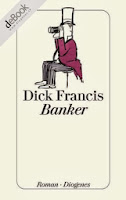
 It's a testament to Dick Francis's skill that he can even make a merchant banker (that contemporary bogeyman) a likable figure. The title of his novel 'Banker' has a double meaning. It refers to both the hero of the story and to the racing slang for a horse who is believed to be a certain winner.
The milieu of private banks is only part of the setting for the book. Dick Francis also explores the fascinating world of alternative medicine and herbal remedies. The story is as compelling as I've come to expect from him, getting off to a flying start with a knife attack in the second chapter.
 In classic, brilliant fashion the author has his hero save someone from the attack, jumping on the teenager with the knife. But then the police jump on him, thinking he's assaulting the kid, and let the real attacker get away. This really punches the reader's buttons, making us angry and frustrated. The hallmark of a writer who truly knows his stuff, and can get a powerful emotional reaction from his audience (Thomas Harris is also superb in this regard).
The plot also packs a real emotional punch, and is often stomach churning, dealing as it does with the birth of deformed colts to prize thoroughbreds. It's an immensely suspenseful book because I genuinely didn't want anything bad to befall the horse Sandcastle or his owners.
 But this being a thriller, bad things do happen, to all sorts of people. And animals. Once again Dick Francis impresses with the quality of his prose. There are masterful descriptions of horse racing: "The ground trembled from the thud of the hooves... the sweat, the effort and the speed filled eyes and ears and mind with pounding wonder and then were gone, flying away, leaving the silence." (I particularly like "pounding wonder". Nice alliteration of the "nd"s.)
There also beautiful little bits of observation. A stable lad is sweeping up in front of the thoroughbreds' stalls, watched by the horses "with the same depth of interest as a bus queue would extend to a busker." It's just perfect.
 If there's a flaw in the book, it's that the death of one of the characters doesn't seem to have sufficient impact on some of the other characters. This didn't ring emotionally true to me. But that doesn't prevent Banker being one of Dick Francis's best.
(Image credits: The Colin Thomas cover photo at the top (white-on-black instead of his usual black-on-white designs) is from Jan-Willem Hubbers excellent site. The others are from Good Reads. I'm rather fond of the German Kindle edition. And the yellow US hardcover is stylish, too.)
 I've always regarded Kingsley Amis's masterpiece as being his brilliant ghost story The Green Man, so I've tended to ignore his much more famous first novel Lucky Jim. But Lucky Jim has been loved and admired by generations of readers and I recently re-read it myself, in the edition illustrated (right) with a very useful introduction by David Lodge.
I have always vividly remembered at least one inspired comic scene from the time I first read Lucky Jim, decades ago. It is the magnificent set piece where our hero Jim Dixon is desperately racing to try and get to the girl he loves before she leaves, and he's on a bus and it seems to be travelling in slow motion.
 Sitting on the top deck of the double decker, Jim is being driven into a frenzied rage by the bus's leisurely progress:"the driver added to his hypertrophied caution an almost psychopathic devotion to the interests of other road-users."
Every possibly delay ensues in an almost animated-cartoon style. And Jim begins to fantasise feverishly about more of the same, encouraged by the bus driver's utter lack of urgency: "gossipping knots of loungers parted leisuredly at the touch of his reluctant bonnet; toddlers reeled to retrieve toys from under his just-revolving wheels."
 When the bus stops to allow a farm tractor onto the road in front of it, "Dixon thought he really would have to run downstairs and knife the drivers of both vehicles."
Published 60 years ago, Lucky Jim stands up amazingly well. It's hilarious, brilliantly written and beautifully observed. The best drawn characters include Professor Welch (Jim's boss at the university where he has begun to teach, who holds Jim's fate in his hands).
 A master of evasion, Welch can never finish a sentence. Then there's Welch's son Bertrand, the loathsomely pretentious bearded, beret-wearing painter who has the girl Jim wants. And Margaret, Jim's sort-of girlfriend, a manipulative and emotionally blackmailing bundle of neuroses whom Jim can't quite get free of.
Unusually in Amis's canon, the book ends very happily and makes for an entirely satisfying read (though I kept tut-tutting about how many cigarettes everyone smoked). Highly recommended.
 Recent Penguin editions also include David Lodge's insightful and informative introduction which makes the interesting point that Lucky Jim was a sort of reversal of Graham Greene's The Heart of the Matter. Greene's book was dark and tragic, Amis's light and comic. And while The Heart of the Matter leads to a genuine suicide through the hero's inability to free himself from morbid pity, Lucky Jim features a fake suicide which allows its hero to shake off just such pity, and escape happily to London with the girl he fancies.

(All the images were taken from Good Reads including the Penguin of Graham Greene's The Heart of the Matter with the excellent Paul Hogarth cover illustration. The copy of Lucky Jim I just read had Jonny Hannah cover art, seen at the top of this post. Note the little vignettes surrounding Jim. For instance, you can see Bertrand with his beard and beret above Jim, and Professor Welch in his ridiculous fishing hat below him. I also discovered that the US first edition hardback had cover art by Edward Gorey, recently reprinted in both American and British paperbacks. Now I lust after a copy.)
 Lord Dunsany (Edward John Moreton Drax Plunkett, 18th Baron of Dunsany, 1878-1957) was an Anglo-Irish fantasy writer whom some regard as the equal of Tolkien — indeed, early in their respective careers, Dunsany was much the more successful author.
Among Dunsany's extensive literary output there is a strange and beguiling little novella entitled My Talks With Dean Spanley. This (literally) shaggy dog story concerns a clergyman, the eponymous Dean, who when plied with an appropriately expensive wine — Imperial Tokay — recalls his past life as a dog. It's a charming, oddball little tale.
 And it had the great good fortune to fall into the hands of Alan Sharp, the magnificent Scottish screenwriter (Night Moves, Rob Roy). Sadly, Sharp died recently and there are numerous interviews, retrospectives, obituaries and tributes worth reading and a lot to be said about him, including this splendid one. I need to write about him at length myself. But right now we're concentrating on a drunken cleric and his life as a dog.
Alan Sharp loved the novella and developed it into a short (50 page) screenplay, purely for his own pleasure. He thought it might be a one-off TV show. But there were no takers. Then a producer called Matthew Metcalfe discovered the script and encouraged him to expand it to feature film length. No easy task. Dunsany's scant tale is just a series of dinner conversations. "There wasn't enough leg to fill the stocking," as Sharp put it. A "whole new plot" had to be added and attached to the original.
 Sharp's brilliant solution — with Metcalfe's help and encouragement — was to invent for the narrator (played by Jeremy Northam) a troubled relationship with his father (Peter O'Toole), an emotionally shut down man who won't even grieve for his other son, recently killed in the Boer War.
The only trace of feeling in the bitter old man is his love for his dog Wag, who inexplicably disappeared when he was a small boy. Sharp weaves the old and new strands together by leading us to the discovery that the former incarnation of Dean Spanley (wonderfully played by Sam Neill) was that very dog.
When O'Toole finally learns, through Spanley, that Wag never came home because he was shot by a farmer, he is suddenly able to grieve both for his lost dog and his lost son. (The film's editor, Chris Plummer, came up with the beautiful notion of inter-cutting the shooting of the dog with the shooting of the son — a stroke of genius, and very characteristic of a film editor.)
 And so the father is able to come to terms with loss and also to movingly connect again with his living son...
Although he himself conceived these powerfully affecting additions to Dunsany's whimsical original, Alan Sharp was worried whether the expanded script would work.
It was, he said, like "introducing Chekov into Gilbert and Sullivan." He needn't have worried.
The film is a masterpiece and deeply effective, thanks in no small part to its top-drawer cast. Dean
Spanley is full of delightful characters brought to life by top actors, such as the wheeler-dealer
Wrather — a great name, as is Spanley, come to think of it — played by
Bryan Brown.
 Full credit is also due to production designer Andrew McAlpine, cinematographer Leon Narbey, editor Chris Plummer, the aforementioned producer Matthew Metcalfe and above all the gifted director Toa Fraser.
"Sometimes you get lucky," said Alan Sharp. You certainly do.
Dean Spanley is a gem of a film, lovingly crafted and very touching, and you must see it.
 Some clever soul also thought to reprint the Dunsany novella complete with the Alan Sharp script and some excellent articles about making the film, as a movie tie-in. If you can find a copy (regrettably, it's become a somewhat pricey collector's item), you should grab one.
(Image credits: The poster of Sam Neill and the dog is from Media Fire. The book cover with the red band is from ABE, where you can buy the book if you have deep pockets. The cover without the red band is from an excellent blog about the book and film. The DVD cover is from Movie Talk. The image of the Dean (Sam Neill) sipping ecstatically is from Vimeo, where there is a trailer for the film. The happy doggie image is from Netflix.)
 I've always been a bit dismissive of Sylvester Stallone as a script writer. This is largely because of his tendency to re-write people whom I consider to be considerably more formidable talents. Stallone has sought to improve on the work of Joe Eszterhas (F.I.S.T.) and James Cameron (Rambo), two of the greatest screenwriters of all time.
But Stallone himself is not a negligible film writer — after all, his 1978 script for Rocky was nominated for an Oscar and a BAFTA.
I was reminded of this when I saw Homefront, an edgy and exceptional popcorn thriller with a screenplay by Stallone (who produces, but does not appear in the film) based on a novel by Chuck Logan.
 The star of Homefront is Jason Statham. Normally a serviceable leading man in action movies, Statham was recently highly enjoyable in Parker and here is very effective, largely because instead of just being a killing machine he plays a vulnerable father. There is even a scene with his young daughter where we see a glint of a tear in his eye.
But don't worry, that was between beating people up and shooting them.
 Homefront is a really superior thriller, though, and much better than its provenance would suggest — the posters make the mistake of invoking the title of the execrable The Expendables. The director of Homefront is Gary Fleder, who has largely worked in TV of late, but previously directed the wonderfully off-the-wall Things to Do in Denver When You're Dead and the Philip K. Dick adaptation Impostor. He does a marvelous job on Homefront, as does cinematographer Theo van de Sande.
 The film benefits immeasurably from its beautiful southern bayou locations, a fine score by Mark Isham, and also from a great cast. Kate Bosworth is terrific as a white trash mom, Winona Ryder outstanding as a crank (as opposed to crack) whore and the ever wonderful James Franco is a slimy but likable — and very formidable — villain.
 This is a much better picture than I expected. Normally in a movie like this, when a cute little kitten is introduced in the first reel it's so that the bad guy can kill it in the third reel. But Homefront turns out to be a lot less formulaic than that (although the hero's black best buddy does get used as cannon fodder, in the grand tradition).
Great fun, involving, and unexpectedly smart, Homefront does finally fall apart at the end (I wish I had a dollar for every time I've had to say that about a movie) but it remains superior fare, and well worth a look.
(Image credits: all the photos and posters are from Aceshowbiz. It's instructive to compare the different campaigns: the posters of Statham and daughter, with and without gun in hand. And the way his shoulders are draped with the American flag in one version.)
 I've seldom been as surprised — or moved — as I was by Oldboy. I was peripherally aware of the Korean film which came out some ten years ago, but I didn't really know anything about it. Which was lucky, because any prior warning might have diminished the impact of this great motion picture.
And it is great. It's one of those extraordinary, dark films — like Fight Club, Killing Them Softly or Bad Lieutenant: Port of Call New Orleans — to which American cinema occasionally gives rise. It was extraordinary and shocking and beautifully made.
 Not to mention deeply moving and ultimately heartbreaking. I think it's probably the best film Spike Lee has ever directed, though I fear it's too bleak and brutal to gain the huge audience it deserves. In — very brief — summary it is about a man who is mysteriously imprisoned for decades, then released to try and put his shattered life back together.
 The cast is pure platinum: Josh Brolin is the hero and is quite wonderful, Elizabeth Olsen is terrific as the woman who helps him on his quest, Samuel Jackson does a great turn as a bizarre heavy with some nifty costumes and Sharlto Copley, who was an unforgettable villain in Elysium, is an unforgettable villain again here, in an utterly different mode.
Lee does a superb job on the film, aided immensely by his writer Mark Protosevich.
 Protosevitch has been involved in a number of high profile productions. He co-wrote the screenplay for the most recent adaptation of Richard Matheson's I Am Legend. But his most towering achievement was the brilliant sf-tinged serial killer story The Cell, whose script was entirely Protosevitch's creation. Another favourite film of mine and one whose macabre and ravishing visual sense is similar to Oldboy's.
 Oldboy has its roots in a 2003 South Korean film with a screenplay by Hwang Jo-yoon, Im Joon-hyeong and the director Park Chan-wook, based on a Japanese graphic novel (or, more accurately, a manga) by writer Garon Tsuchiya and illustrator Nobuaki Minegishi. The Japanese comic, when reprinted in translation in America won a prestigious Eisner Award. You can buy it from the excellent publishers Dark Horse.
 The Spike Lee and Mark Protosevich version of Oldboy is not a movie for the faint-hearted. It goes to some very dark places. But if you have the disposition for it, you will find it's one of the great films of the early 21st Century.
(Image credits: All the Oldboy posters are from Aceshowbiz. There is an interesting dispute reported on that site about the artist who allegedly created some of the posters. More details from the Guardian. And you can check out the comparison here. The red poster for The Cell is from Terrorifilo. The blue German poster for The Cell is from BlackBoxBlue, an intelligent blog posting about the movie.)
 It's not often one can report a miracle, but last week my local cinema held a one-off revival screening of Gone With the Wind. I eagerly attended and I can testify that, during the entire four hours, not one person used their phone.
I'd seen the movie before, decades ago, but it had faded in my memory and I was unprepared for how impressive it was. The early colour photography by Ernest Haller and Lee Garmes was immediately magnificent. It was often more expressionist than realistic. Rhett's farewell to Scarlett after the burning of Atlanta takes place in a world which is entirely a garish, gorgeous red. Scarlett's frightened nocturnal return to her ravaged plantation is a spectral blue. The scene where she finds her dead mother laid out is a jaundiced yellow.
 Also stunning were William Cameron Menzies' set designs, the special effects by Jack Cosgrove, and Max Steiner's music. The cast were impressive: Clark Gable is predictably charismatic as Rhett Butler while the real surprise is Vivien Leigh, unforgettable as the scheming little tart Scarlett O'Hara. She's an English actress, who beat out every female star in America for the part. Interestingly, her impeccable Southern belle accent slips a little when she's playing scenes with Leslie Howard, another fine actor who was also English.
The brainchild of producer David O. Selznick, the film's named director was Victor Fleming (The Wizard of Oz), with uncredited contributions by George Cukor, a specialist in women's pictures and musicals and Sam Wood, who worked with the Marx Brothers.
 But I'm chiefly concerned here with the story and screenplay. As the presence of three directors suggests, Gone with the Wind was a troubled production (known as "Selznick's folly") and there were also a lot of hands on the script. The sole credited writer is Sidney Howard but Oliver HP Garrett, Jo Swerling, John Van Druten and Ben Hecht are also known to be involved.
 It was based on a novel by Margaret Mitchell. This book was originally entitled Mules in Horses' Harness until her publisher insisted on something less catastrophically crappy. I haven't read the book, but I suspect that it's responsible for the movie's fatal flaw.
Gone With the Wind is entirely gripping for the first two hours, which sets up the characters and propels them into the inferno of the Civil War. And even when the war ends, after the thoughtfully provided intermission, it exerts a terrific narrative grip. Scarlett is trying to rebuild her destroyed plantation when she is visited by a renegade Union soldier. The deserter walks up the stairs towards Scarlett, intent on rape — but first, robbery. "What's that you've got in your hand?" he leers.

What Scarlett has in her hand is a gun and she shoots him dead at point blank range. Scarlett's sister in law Melanie, ill in bed, is drawn by the sound and comes running in her nightdress. Scarlett gets her to strip naked on the spot and uses the nightdress to mop up the soldier's blood.
 There is also some wonderful dialogue. Rhett Butler insists on seeing Scarlett after her latest husband has died. Scarlett couldn't have cared less about the dead spouse, but is theoretically in mourning, working her way through a bottle of cognac. "I told him you was prostrate with grief," says her servant, Mammy (Hattie McDaniel). She has no illusions about her boss: knowing that Scarlett has designs on Melanie's husband she says, "You'll be waiting for him like a spider!" Rhett has no illusions, either. "You're a heartless creature," he says. "It's part of your charm."
The last hour or so gets hopelessly bogged down in the dull melodrama of the love triangle between Gable, Leigh and Howard. But up until then, Gone With the Wind is a revelation.
(Image credits: all the posters are from AllPosters, where you can actually purchase them.)