skip to main |
skip to sidebar
 Murder on the Orient Express is the tenth Hercules Poirot novel, published in 1934.
I was familiar with it long before I read it, through the two movie adaptations.
In many ways it's the archetypical Agatha Christie novel, with its challenging mystery and brilliant resolution.
Murder on the Orient Express is the tenth Hercules Poirot novel, published in 1934.
I was familiar with it long before I read it, through the two movie adaptations.
In many ways it's the archetypical Agatha Christie novel, with its challenging mystery and brilliant resolution.
Finally reading it was satisfyingly like arriving at a long-awaited rendezvous.
 The story begins beautifully and concisely and evocatively: "It was five o'clock on a winter's morning in Syria."
And it makes for rather odd reading now, with exotic place names such as Mosul so horribly familiar to us because of the current conflict in Syria.
The story begins beautifully and concisely and evocatively: "It was five o'clock on a winter's morning in Syria."
And it makes for rather odd reading now, with exotic place names such as Mosul so horribly familiar to us because of the current conflict in Syria.

But we are in the 1930s here and the romance of travel is very much to the fore. "A whistle blew, there was a long, melancholy cry from the engine... The Orient Express had started its three-days' journey across Europe."
It seems obvious now, but a train — what's more, a stranded train stuck in a snow
drift — is a truly inspired location for a murder investigation...
 Because, of course, that's what happens. As with Death in the Clouds, a diverse and intriguing collection of characters have been brought together by their travel plans.
There is an aristocratic old Russian lady, the aptly named Princess Dragomiroff, with a "yellow, toad-like face."
Because, of course, that's what happens. As with Death in the Clouds, a diverse and intriguing collection of characters have been brought together by their travel plans.
There is an aristocratic old Russian lady, the aptly named Princess Dragomiroff, with a "yellow, toad-like face."
 And Mary Debenham, a pretty young English woman who displays an "almost feverish anxiety" when it looks like she might miss the train.
Plus a chap called Foscarelli who moves with a "swift, cat-like tread" and who might be one of those "nasty murdering Italians..."
And of course, there is Hercules Poirot.
And Mary Debenham, a pretty young English woman who displays an "almost feverish anxiety" when it looks like she might miss the train.
Plus a chap called Foscarelli who moves with a "swift, cat-like tread" and who might be one of those "nasty murdering Italians..."
And of course, there is Hercules Poirot.
 Whereas in Death in the Clouds a poison dart dispatched a passenger in broad daylight, this time there is a murder in the middle of the night. A stabbing.
And Poirot is enlisted to find the culprit.
Whereas in Death in the Clouds a poison dart dispatched a passenger in broad daylight, this time there is a murder in the middle of the night. A stabbing.
And Poirot is enlisted to find the culprit.
This novel is the polar opposite of Sad Cypress — a Poirot tale where the victim was almost unbearably undeserving of her fate.
Here the guy was a gangster who really got what was coming to him.
I won't say too much about the plot, except that the train getting stuck in the snow interferes crucially with the killer's plans.
 As usual, there is considerable fun at our hero's expense — he is thought to look like "a women's dress maker" — as the other characters initially underestimate him.
But soon Poirot is cracking the puzzle in his own unique way: "to solve a case a man has only to lie back in his chair and think."
 And his formidable intellect begins to make itself evident. "Poirot's eyes... were bright and sharp like a bird's."
Following his own advice, "Hercules Poirot sat very still. One might have thought he was asleep."
And his formidable intellect begins to make itself evident. "Poirot's eyes... were bright and sharp like a bird's."
Following his own advice, "Hercules Poirot sat very still. One might have thought he was asleep."
 And then the solution comes to him. "His eyes opened. They were green, like a cat's."
And what a solution it is.
A true classic.
And then the solution comes to him. "His eyes opened. They were green, like a cat's."
And what a solution it is.
A true classic.
(Image credits: As usual, the main image with its gorgeous Tom Adams cover painting is a scan of my own copy. All the other covers save one are from the ever-useful Good Reads, including the beautiful art nouveau Richard Amsel painting for the American movie edition, with its train/dagger. The exception is the Norwegian edition with the cool, retro cut-away diagram illustration, which is from Bergen Bibliotek.)
 When I first set about learning my craft as a writer, the playwrights I most admired were Harold Pinter and Tom Stoppard. I was aware of Neil Simon and Alan Ayckbourn (who occupied similar positions on either side of the Atlantic) — funny, accessible and hugely popular.
But compared to the austere brilliance of Pinter or the pyrotechnic dazzle of Stoppard I consider Simon and Ayckbourn too broad, clownish, lowbrow. I didn't think there was much going on in their work... Their stuff was just too damned simple
I didn't realise how much craft was involved in achieving that appearance of simplicity. As with the smoothly swimming swan, there is a hell of a lot of activity going on unseen beneath the surface.
When I first set about learning my craft as a writer, the playwrights I most admired were Harold Pinter and Tom Stoppard. I was aware of Neil Simon and Alan Ayckbourn (who occupied similar positions on either side of the Atlantic) — funny, accessible and hugely popular.
But compared to the austere brilliance of Pinter or the pyrotechnic dazzle of Stoppard I consider Simon and Ayckbourn too broad, clownish, lowbrow. I didn't think there was much going on in their work... Their stuff was just too damned simple
I didn't realise how much craft was involved in achieving that appearance of simplicity. As with the smoothly swimming swan, there is a hell of a lot of activity going on unseen beneath the surface.

These days I tend to prefer Simon and Ayckbourn to Pinter and Stoppard. And The Norman Conquests may well be Alan Ayckbourn's masterpiece.
It is a series of three linked plays which can be (and have been) performed in any order. They deal with one weekend in the life of the philandering librarian Norman (His conquests are the women who succumb to his dubious charms.)
He has planned to take his wife's sister Annie away for a dirty weekend, but fate has other ideas...
I've never seen these plays performed. Just read them and heard an excellent radio version. And it really doesn't matter which one of the three you start with, or which one follows it, although each sequence has its own particular pleasure and shift of emphasis.

Ayckbourne is a truly great writer with unforgettably brilliant observations of character. When discussing the dull and lugubrious local GP, Annie says "I'm really very fond of Tom but he really is terribly heavy going. Like running up hill in roller skates."
(Image credits. For such an important sequence of plays, it's almost impossible to find good images online. The Penguin edition, with the John Ireland cartoon cover, is my own scan of my own copy and it is, in all modesty, the only decently sharp version to be found anywhere on the internet. The others are from Good Reads.)
 This is the 39th Hercule Poirot, published in 1969, and sees Agatha Christie cautiously dipping her toe into the turbulent waters of the Swinging Sixties.
I've been particularly looking forward to reading this novel as part of my Poirot project, because of the gorgeous Tom Adams cover art — which I've always admired, even back in the days when I snobbishly declined to read Agatha Christie...
 (Incidentally, that fantastic image of the apple transforming into a skull, and the water dripping from it, will make sense very rapidly when you read the book, although I don't intend to give any spoilers here.)
The book begins with some adroit, busy scene-setting as preparations are made for the titular Halloween party, with character largely established through dialogue.
 Among those present is Ariadne Oliver, whom I was pleased to find. Ariadne is a recurring minor character in Christie's work, and I first encountered her in Cards On the Table. She's a spinster crime novelist — sort of Agatha Christie's alter ego.
Unlike Christie, Ariadne's detective is a Finn. (When asked, "Why a Finn?" Ariadne responds, "I've often wondered.")

Like Christie, Ariadne Oliver is a bestseller and a big success, and there's an amusing throwaway bit here when she's asked if her books make a lot of money, which sends "her thoughts flying to the Inland Revenue." Christie must have known a thing or two about high income tax...
Anyhow, Ariadne's presence at the party is actually the trigger for a murder to take place there. The police, of course, are baffled, and Ariadne summons her old friend Hercule Poirot and the carefully engineered Christie plot is underway.
 Hallow'een Party is the newest in the Poirot series that I've read, and indeed the most recent of Christie's novels — which caused me some concern... A friend who's a Christie buff had told me that it dated "from Christie’s declining years when her faculties are not what they once were."
At first this prescription seemed glumly accurate. After the drama of the initial murder, the book seemed a trifle dull — somewhat colourless and repetitive.
 Was Christie having difficulty with writing in the milieu of a changing world? Had the sexual permissiveness, and casual drug use of the Sixties baffled her?
 Well, Agatha Christie had always written about drugs, including cocaine and heroin... Although now things are somewhat different. Ariadne's friend Judith Butler says, "Peculiar drugs and — what do they call it? — Flower Pot or Purple Hemp or L.S.D."
On the other hand, Christie had never written very directly about sex. However, all that changes in this novel, and a rather lifeless book surprisingly comes to life — and Christie herself snaps awake — with the introduction of two children of the era.
Well, Agatha Christie had always written about drugs, including cocaine and heroin... Although now things are somewhat different. Ariadne's friend Judith Butler says, "Peculiar drugs and — what do they call it? — Flower Pot or Purple Hemp or L.S.D."
On the other hand, Christie had never written very directly about sex. However, all that changes in this novel, and a rather lifeless book surprisingly comes to life — and Christie herself snaps awake — with the introduction of two children of the era.
 Desmond and Nicholas are a pair of teenage boys who were witnesses to (and also suspects in) the murder at the Halloween party. The scene where Poirot interviews them is utterly priceless, and these kids are great characters, desperately striving as they do for sophistication.
They offer Poirot their own theories on the possible identity of the murderer. Starting with the "Sex starved" school mistress. "Lesbian?" suggests Nicholas "in a man of the world voice."

And then there's the curate (assistant vicar) who "might be a bit off his nut" and have committed the murder. "'Perhaps he exposed himself to her first,' said Nicholas hopefully."
This scene, with the two boys enthusiastically theorising about possible culprits and motives, is fabulous. And also a rather hilarious parody of mystery fiction tropes.
 As the boys roll out these preposterous suggestions, offering our hero the benefit of their wisdom, "They both looked at Poirot with the air of contented dogs who have retrieved something useful which their master has asked for."
This must be one of Dame Agatha's best similes ever, and had me laughing out loud. Indeed this sequence was pretty much the high point of the book for me and, I suspect, for Christie herself.
As the boys roll out these preposterous suggestions, offering our hero the benefit of their wisdom, "They both looked at Poirot with the air of contented dogs who have retrieved something useful which their master has asked for."
This must be one of Dame Agatha's best similes ever, and had me laughing out loud. Indeed this sequence was pretty much the high point of the book for me and, I suspect, for Christie herself.
 Which is not to say that she short changes us on an unpredictable plot, or a grippingly suspenseful climax.
There is a brilliant piece of classic Christie misdirection here, concerning the murder victim having witnessed an earlier murder.
Plus the usual rush of excitement for the reader as we race towards a very Christie conclusion.
Which is not to say that she short changes us on an unpredictable plot, or a grippingly suspenseful climax.
There is a brilliant piece of classic Christie misdirection here, concerning the murder victim having witnessed an earlier murder.
Plus the usual rush of excitement for the reader as we race towards a very Christie conclusion.
 Ultimately, I felt that Hallowe'en Party more than delivered the goods, which is great news since I have a lot of late period Christie novels to read.
And Nicholas and Desmond are quite wonderful characters. I like to think that if Christie had lived long enough she would have spun them off into a series of adventures of their own.
Ultimately, I felt that Hallowe'en Party more than delivered the goods, which is great news since I have a lot of late period Christie novels to read.
And Nicholas and Desmond are quite wonderful characters. I like to think that if Christie had lived long enough she would have spun them off into a series of adventures of their own.
 In any case, here she was clever enough to enlist them in the climax of the story.
(Image credits: The main image, of the beautiful Tom Adams cover painting, is once again scanned by me from my own copy. The other covers are from good old Good Reads, including the nice Bulgarian one which reuses the Adams art. I also particularly like both the Portuguese versions — with different titles. It's nice to see the Colecao Vampiro series still going strong in 1970 with Poirot eo Encontro Juvenil (Poirot and the Youth Gathering), and A Festa das Bruxas (literally, A Witches Party) has a charming cover painting, don't you think? Including a cat...)
 This book has something powerful in common with Ending Up by Kingsley Amis — both are tales about old people plummeting towards the end of their lives. Which you'd expect to be depressing, boring and a number of other things....
But as with the Amis book, Muriel Spark's 1959 novel Memento Mori features such a spiteful wit and such fascinating interaction between its memorable characters that it's actually quite a vivid pleasure to read.
 One thing that is different from Amis, though, is that there's a supernatural mechanism at work in Spark's book. Her collection of old bastards start receiving anonymous phonecalls reminding them that they are going to die.
The voice sounds utterly different to each recipient, and the police seem strangely unable to trace the calls. Pretty soon it becomes evident that there is no human agency at work here.
 The phone calls are never explained — except to the extent that the police detective concludes "Death is the culprit" — but that doesn't matter. Spark's interest, and the reader's, lie elsewhere than cut and dried explanations...
Muriel Spark is sharply funny, as when she skewers a bore: "Olive closed her eyes and relaxed while his voice proceeded into the late afternoon." (Again this reminds me of Amis.)
The phone calls are never explained — except to the extent that the police detective concludes "Death is the culprit" — but that doesn't matter. Spark's interest, and the reader's, lie elsewhere than cut and dried explanations...
Muriel Spark is sharply funny, as when she skewers a bore: "Olive closed her eyes and relaxed while his voice proceeded into the late afternoon." (Again this reminds me of Amis.)
 And she writes economically, lucidly and wittily. At one point she remarks, "There was altogether too much candour in married life." Nice aphorism, Muriel.
She's also come up with a remarkable cast of characters, including the sinister and despicable Mrs Pettigrew, a truly scary servant with no respect for her employers; the despicable and resentful Godfrey Colston who regards his wife Charmain's "every success as his failure"; and Alec Warner who has "an almost cannibal desire" to record and analyse the effects of the phonecalls on the people in his circle.
And she writes economically, lucidly and wittily. At one point she remarks, "There was altogether too much candour in married life." Nice aphorism, Muriel.
She's also come up with a remarkable cast of characters, including the sinister and despicable Mrs Pettigrew, a truly scary servant with no respect for her employers; the despicable and resentful Godfrey Colston who regards his wife Charmain's "every success as his failure"; and Alec Warner who has "an almost cannibal desire" to record and analyse the effects of the phonecalls on the people in his circle.
 Spark has a bold and amusing style which at times is almost cartoonish — in a good way — as when describing how Charmain's "mind munched over the humiliations she had received from Godfrey."
And she is both psychologically acute and has a real gift for expression. Charmain has been aware of her husband's infidelities for decades, while pretending to be entirely ignorant of them:
Spark has a bold and amusing style which at times is almost cartoonish — in a good way — as when describing how Charmain's "mind munched over the humiliations she had received from Godfrey."
And she is both psychologically acute and has a real gift for expression. Charmain has been aware of her husband's infidelities for decades, while pretending to be entirely ignorant of them:
 "He would never forgive her for having played this game, for over fifty years, of knowing nothing while at the same time knowing everything, as one might be 'not at home' while actually in the house."
Or how about this for brilliance of description. "Her words depressed him. They were like spilt sugar; however much you swept it up some grains would keep grinding under your feet."
 Having sung the praises of Memento Mori, however, I should add that if you haven't read Muriel Spark before I wouldn't recommend starting here. Try instead her wickedly funny The Girls of Slender Means, written four years later, in 1963.
(Image credits: Good Reads. The British hardcover with the purple dustjacket is from Wikipedia. The Penguin with the black and white caricature of the mouth and the phone is from We Buy Books at ABE. The Diogenes edition is from Text + Tone via ABE.)
Having sung the praises of Memento Mori, however, I should add that if you haven't read Muriel Spark before I wouldn't recommend starting here. Try instead her wickedly funny The Girls of Slender Means, written four years later, in 1963.
(Image credits: Good Reads. The British hardcover with the purple dustjacket is from Wikipedia. The Penguin with the black and white caricature of the mouth and the phone is from We Buy Books at ABE. The Diogenes edition is from Text + Tone via ABE.)
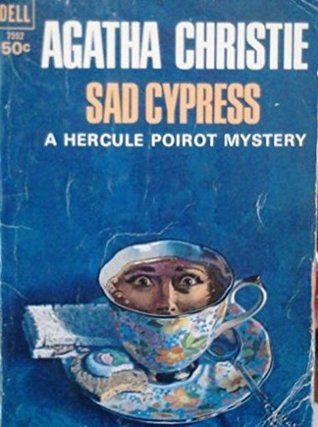
 Sad Cypress (the title is taken from Shakespeare) is an adroit little Poirot novel — the 22nd in the series, published in 1940.
It isn't in the league of the stunning Five Little Pigs (a masterpiece) or the fiendishly clever and groundbreaking ABC Murders, but it is neat, effective and, as usual for Christie, quite unguessable.
At the heart of the novel is Mary Gerrard, a beautiful and spirited young woman who is just about to set off on her path in life.
 If I have major reservation about the book, it's that I really wish Christie hadn't killed off Mary. I suppose it's a testament to the author's skill at bringing the character to life in the first place that I cared so much about the poor girl.
Rest assured I'm not giving anything away here by mentioning her death; we learn on the very first page of the book that Mary is dead and another young woman, Elinor Carlisle, is accused of murdering her.

And sitting in the court, watching Elinor, is none other than Hercule Poirot.
Apart from this brief appearance at the beginning, we won't see Poirot again until page 83. In the meantime Christie establishes the situation and the characters.
 And the plot.
Once more poison is to the fore, and Christie's knowledge in this area — or at least, her research into it — is impressive: the plot of Sad Cypress hinges on the difference between two kinds of morphine.
 At stake — and serving as one possible motive for murder — is a large fortune left behind by a sick old lady, Elinor's aunt. The book is set in motion (after that short court-room flash-forward) by an absolutely fantastic anonymous letter — Christie is so good at writing in the voice of unsavoury characters: "there's Someone sucking up to your aunt."
 The anonymous letter hints that Elinor's aunt might be about to leave her entire fortune to Mary Gerard, the daughter of a servant. Well, we can't have that, can we?
 In short order, the plot is writhing like a nest of snakes. Christie absolutely wrings
the reader with suspense — the old lady has had a serious stroke and is unable to
express her wish for how her will should be made out.
And indeed her niece Elinor may be trying to
deliberately thwart her...
In short order, the plot is writhing like a nest of snakes. Christie absolutely wrings
the reader with suspense — the old lady has had a serious stroke and is unable to
express her wish for how her will should be made out.
And indeed her niece Elinor may be trying to
deliberately thwart her...
 Knowing in advance that Mary is going to die makes the unfolding story horrible — almost painful — to read. Poor Mary. (Reflecting on the dead girl's considerable beauty, Poirot observes, "with that there are always complications." Indeed.)
 Soon enough Mary Gerard's gone, dispatched by poison (morphine in a fish-paste sandwich; that's a new one) and Elinor is in the frame for her murder. Everyone thinks she did it...
Except Poirot.
I know the prevailing wisdom is that I'm not supposed to like Poirot, or at least I'm supposed to regard him with affectionate contempt, as a crude caricature. But he's really starting to grow on me.
Soon enough Mary Gerard's gone, dispatched by poison (morphine in a fish-paste sandwich; that's a new one) and Elinor is in the frame for her murder. Everyone thinks she did it...
Except Poirot.
I know the prevailing wisdom is that I'm not supposed to like Poirot, or at least I'm supposed to regard him with affectionate contempt, as a crude caricature. But he's really starting to grow on me.
 I love his cool ruthlessness, his arrogance, and the way he's always one step ahead.
Sad Cypress builds up terrific suspense in the court room sequences towards the end, with Elinor in the shadow of the gallows.
 And Christie is as deft as ever — I absolutely never saw the truth about the killer coming... I still regret that she had to kill Mary, though.
(Image credits: The main image is a scan of my own, very battered copy with a Tom Adams cover painting. The other book covers are all from Good Reads. The Indonesian one is particularly brilliant in blending several crucial plot elements — the death's head to signify poison along with a tea cup, which is also a rose!)
And Christie is as deft as ever — I absolutely never saw the truth about the killer coming... I still regret that she had to kill Mary, though.
(Image credits: The main image is a scan of my own, very battered copy with a Tom Adams cover painting. The other book covers are all from Good Reads. The Indonesian one is particularly brilliant in blending several crucial plot elements — the death's head to signify poison along with a tea cup, which is also a rose!)
 This is the first play of Agatha Christie's which I've reported on. And it's devastatingly good. I think it's the best one I've read by her — and I read it in a collection which also includes The Mousetrap and Ten Little Indians.
 It was first staged in 1960 and it's based on her 1942 novel Five Little Pigs (known in America by the superior title Murder in Retrospect), which not coincidentally, is my favourite Christie novel so far.
I say "not coincidentally" because the story is indelible and gripping. It is also powerfully simple.
Carla Crale is a beautiful young woman who wants to clear her mother's name. Her mother was tried for murder and found guilty of killing her husband, Carla's father Amyas Crale.

Amyas Crale (I just can't get enough of that name) was a famous and hugely talented painter. Vain and egotistical, he is also irresistible to women and never hesitated to have affairs outside of his marriage.
And his wife, Caroline, tolerated these. Sort of...

But Amyas went too far when he brought his bewitching young mistress Elsa into the family home so he could paint her against the magnificent sea view there — fashioning a masterpiece, incidentally. But a masterpiece that would be the last thing he ever did.
During the hot summer days at the Crales' idyllic country house in Devonshire, the tension ratchets up. Caroline knows all too well what is going on. Even before Elsa blithely announces — to Caroline's face — that she's going to take her husband away from her.

But Amyas has no patience with this fraught domestic drama — he just wants to finish his painting — "when I'm painting nothing else matters — least of all a pair of jealous, quarrelling women."
Here, and elsewhere, Agatha Christie shows her psychological insight and her ability to create strikingly authentic characters. Amyas Crale is utterly true to life both in his single minded devotion to his art, and his technical discussion of it.
 When his model Elsa wants to put on a sweater because she's cold, he growls "Oh no you don't. It'll change all the tones of the skin." Christie has clearly done her research.
But painting your gorgeous young mistress on a hot summer day while your beautiful spurned wife is watching from the house is thirsty work. And Amyas demands a cold beer.
When his model Elsa wants to put on a sweater because she's cold, he growls "Oh no you don't. It'll change all the tones of the skin." Christie has clearly done her research.
But painting your gorgeous young mistress on a hot summer day while your beautiful spurned wife is watching from the house is thirsty work. And Amyas demands a cold beer.
He gets one. Spiked with conine, a lethal "pure alkaloid" (again with the research, Agatha) derived from hemlock.
 And, not knowing he's dying, he slowly and painfully finishes his painting while everyone else — including his killer — is inside the house having lunch.
Sixteen years later, his daughter wants to find out who really put the poison in his beer.
It's a superb and unforgettable story, studded with beautifully evoked and distinctive characters.
 The book the play is based on is a Hercule Poirot novel. And the first thing Christie did when adapting it for the stage was to eliminate Poirot entirely from the narrative. Yup, him and his little grey cells are just gone.
Which at first sounds crazy — remove the detective from a detective story?— but it makes absolute sense.
 Of course, there are some kinds of detective stories where the hero rescues women from death, beats up bad guys, defeats the evil scheme and generally provides important turning points in the plot.
But in
this kind, where the key thing is solving the puzzle, the detective is a viewpoint character. He doesn't
actually do anything in the story except elicit facts and draw a
conclusion.
The investigation Poirot did in the book is handed over in the play to a young lawyer Carla consults, Justin Fogg.
 Christie makes some other canny — indeed quite brilliant decisions — I was particularly delighted that she eliminated Carla's drip of a fiancé. In the book he is boringly perfect, and exists almost entirely offstage, only turning up at the end to be "tall, square jawed" and have "steady grey eyes."
In the play the fiancé is a creep who doesn't deserve Carla. And Justin the lawyer, who has quite naturally fallen for her, is determined to take her away from the creep.
Christie makes some other canny — indeed quite brilliant decisions — I was particularly delighted that she eliminated Carla's drip of a fiancé. In the book he is boringly perfect, and exists almost entirely offstage, only turning up at the end to be "tall, square jawed" and have "steady grey eyes."
In the play the fiancé is a creep who doesn't deserve Carla. And Justin the lawyer, who has quite naturally fallen for her, is determined to take her away from the creep.
 Thus Christie threads a satisfying love story through the mystery and adds another layer of pleasure for her theatre audience. (And people like me who read the play.)
The novel concludes with all of the witnesses (which is to say, the suspects) returning to the house where it happened and reconstructing that fateful day. In the book this is done in dialogue.
Thus Christie threads a satisfying love story through the mystery and adds another layer of pleasure for her theatre audience. (And people like me who read the play.)
The novel concludes with all of the witnesses (which is to say, the suspects) returning to the house where it happened and reconstructing that fateful day. In the book this is done in dialogue.
 In the play, with her peerless instincts as a dramatist, Christie has the events actually acted out in flashback, with the actress playing Carla now in the role of her mother Caroline.
Incidentally, the solution to the mystery is unpredictable, logical and stunning in the best Agatha Christie tradition.
But that, to me, is secondary compared to the sheer genius involved in her construction of the dazzling original novel, and then her deconstruction of it to refashion into this staggeringly clever play.
 Dame Agatha, take a bow. My hat is off to you.
(Image credits: The purple Samuel French cover is from Barnes and Noble. The striking purple People's Theatre poster with the sealed envelope is from North East Theatre Guide. The Hamburg Players poster is from their own website. The Southwick Players handbill ("Pit your wits against Christie!") is from their archive. The lovely Teatro Impulso poster — is that an Augustus John painting? – is from News Sicilia. The Therry Dramatic Society poster with the backward arrows is from the Adelaide Theatre Guide. The nice 1920s style Rockville Little Theatre poster is from the RLT website. The Official Agatha Christie Theatre Company poster is from No More Workhorse. The image of Lysette Anthony in her 1960s chic is from All Edinburgh Theatre.)
Dame Agatha, take a bow. My hat is off to you.
(Image credits: The purple Samuel French cover is from Barnes and Noble. The striking purple People's Theatre poster with the sealed envelope is from North East Theatre Guide. The Hamburg Players poster is from their own website. The Southwick Players handbill ("Pit your wits against Christie!") is from their archive. The lovely Teatro Impulso poster — is that an Augustus John painting? – is from News Sicilia. The Therry Dramatic Society poster with the backward arrows is from the Adelaide Theatre Guide. The nice 1920s style Rockville Little Theatre poster is from the RLT website. The Official Agatha Christie Theatre Company poster is from No More Workhorse. The image of Lysette Anthony in her 1960s chic is from All Edinburgh Theatre.)
 Murder on the Orient Express is the tenth Hercules Poirot novel, published in 1934.
  The story begins beautifully and concisely and evocatively: "It was five o'clock on a winter's morning in Syria."

 And Mary Debenham, a pretty young English woman who displays an "almost feverish anxiety" when it looks like she might miss the train.
  Whereas in Death in the Clouds a poison dart dispatched a passenger in broad daylight, this time there is a murder in the middle of the night. A stabbing.
 And his formidable intellect begins to make itself evident. "Poirot's eyes... were bright and sharp like a bird's."
  And then the solution comes to him. "His eyes opened. They were green, like a cat's."