skip to main |
skip to sidebar
 Sad Cypress (the title is taken from Shakespeare) is an adroit little Poirot novel — the 22nd in the series, published in 1940.
It isn't in the league of the stunning Five Little Pigs (a masterpiece) or the fiendishly clever and groundbreaking ABC Murders, but it is neat, effective and, as usual for Christie, quite unguessable.
At the heart of the novel is Mary Gerrard, a beautiful and spirited young woman who is just about to set off on her path in life.
 If I have major reservation about the book, it's that I really wish Christie hadn't killed off Mary. I suppose it's a testament to the author's skill at bringing the character to life in the first place that I cared so much about the poor girl.
Rest assured I'm not giving anything away here by mentioning her death; we learn on the very first page of the book that Mary is dead and another young woman, Elinor Carlisle, is accused of murdering her.

And sitting in the court, watching Elinor, is none other than Hercule Poirot.
Apart from this brief appearance at the beginning, we won't see Poirot again until page 83. In the meantime Christie establishes the situation and the characters.
 And the plot.
Once more poison is to the fore, and Christie's knowledge in this area — or at least, her research into it — is impressive: the plot of Sad Cypress hinges on the difference between two kinds of morphine.
 At stake — and serving as one possible motive for murder — is a large fortune left behind by a sick old lady, Elinor's aunt. The book is set in motion (after that short court-room flash-forward) by an absolutely fantastic anonymous letter — Christie is so good at writing in the voice of unsavoury characters: "there's Someone sucking up to your aunt."
 The anonymous letter hints that Elinor's aunt might be about to leave her entire fortune to Mary Gerard, the daughter of a servant. Well, we can't have that, can we?
 In short order, the plot is writhing like a nest of snakes. Christie absolutely wrings
the reader with suspense — the old lady has had a serious stroke and is unable to
express her wish for how her will should be made out.
And indeed her niece Elinor may be trying to
deliberately thwart her...
In short order, the plot is writhing like a nest of snakes. Christie absolutely wrings
the reader with suspense — the old lady has had a serious stroke and is unable to
express her wish for how her will should be made out.
And indeed her niece Elinor may be trying to
deliberately thwart her...
 Knowing in advance that Mary is going to die makes the unfolding story horrible — almost painful — to read. Poor Mary. (Reflecting on the dead girl's considerable beauty, Poirot observes, "with that there are always complications." Indeed.)
 Soon enough Mary Gerard's gone, dispatched by poison (morphine in a fish-paste sandwich; that's a new one) and Elinor is in the frame for her murder. Everyone thinks she did it...
Except Poirot.
I know the prevailing wisdom is that I'm not supposed to like Poirot, or at least I'm supposed to regard him with affectionate contempt, as a crude caricature. But he's really starting to grow on me.
Soon enough Mary Gerard's gone, dispatched by poison (morphine in a fish-paste sandwich; that's a new one) and Elinor is in the frame for her murder. Everyone thinks she did it...
Except Poirot.
I know the prevailing wisdom is that I'm not supposed to like Poirot, or at least I'm supposed to regard him with affectionate contempt, as a crude caricature. But he's really starting to grow on me.
 I love his cool ruthlessness, his arrogance, and the way he's always one step ahead.
Sad Cypress builds up terrific suspense in the court room sequences towards the end, with Elinor in the shadow of the gallows.
 And Christie is as deft as ever — I absolutely never saw the truth about the killer coming... I still regret that she had to kill Mary, though.
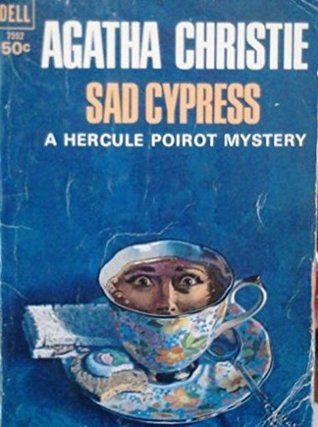
(Image credits: The main image is a scan of my own, very battered copy with a Tom Adams cover painting. The other book covers are all from Good Reads. The Indonesian one is particularly brilliant in blending several crucial plot elements — the death's head to signify poison along with a tea cup, which is also a rose!)
And Christie is as deft as ever — I absolutely never saw the truth about the killer coming... I still regret that she had to kill Mary, though.
(Image credits: The main image is a scan of my own, very battered copy with a Tom Adams cover painting. The other book covers are all from Good Reads. The Indonesian one is particularly brilliant in blending several crucial plot elements — the death's head to signify poison along with a tea cup, which is also a rose!)
 This is the first play of Agatha Christie's which I've reported on. And it's devastatingly good. I think it's the best one I've read by her — and I read it in a collection which also includes The Mousetrap and Ten Little Indians.
 It was first staged in 1960 and it's based on her 1942 novel Five Little Pigs (known in America by the superior title Murder in Retrospect), which not coincidentally, is my favourite Christie novel so far.
I say "not coincidentally" because the story is indelible and gripping. It is also powerfully simple.
Carla Crale is a beautiful young woman who wants to clear her mother's name. Her mother was tried for murder and found guilty of killing her husband, Carla's father Amyas Crale.

Amyas Crale (I just can't get enough of that name) was a famous and hugely talented painter. Vain and egotistical, he is also irresistible to women and never hesitated to have affairs outside of his marriage.
And his wife, Caroline, tolerated these. Sort of...

But Amyas went too far when he brought his bewitching young mistress Elsa into the family home so he could paint her against the magnificent sea view there — fashioning a masterpiece, incidentally. But a masterpiece that would be the last thing he ever did.
During the hot summer days at the Crales' idyllic country house in Devonshire, the tension ratchets up. Caroline knows all too well what is going on. Even before Elsa blithely announces — to Caroline's face — that she's going to take her husband away from her.

But Amyas has no patience with this fraught domestic drama — he just wants to finish his painting — "when I'm painting nothing else matters — least of all a pair of jealous, quarrelling women."
Here, and elsewhere, Agatha Christie shows her psychological insight and her ability to create strikingly authentic characters. Amyas Crale is utterly true to life both in his single minded devotion to his art, and his technical discussion of it.
 When his model Elsa wants to put on a sweater because she's cold, he growls "Oh no you don't. It'll change all the tones of the skin." Christie has clearly done her research.
But painting your gorgeous young mistress on a hot summer day while your beautiful spurned wife is watching from the house is thirsty work. And Amyas demands a cold beer.
When his model Elsa wants to put on a sweater because she's cold, he growls "Oh no you don't. It'll change all the tones of the skin." Christie has clearly done her research.
But painting your gorgeous young mistress on a hot summer day while your beautiful spurned wife is watching from the house is thirsty work. And Amyas demands a cold beer.
He gets one. Spiked with conine, a lethal "pure alkaloid" (again with the research, Agatha) derived from hemlock.
 And, not knowing he's dying, he slowly and painfully finishes his painting while everyone else — including his killer — is inside the house having lunch.
Sixteen years later, his daughter wants to find out who really put the poison in his beer.
It's a superb and unforgettable story, studded with beautifully evoked and distinctive characters.
 The book the play is based on is a Hercule Poirot novel. And the first thing Christie did when adapting it for the stage was to eliminate Poirot entirely from the narrative. Yup, him and his little grey cells are just gone.
Which at first sounds crazy — remove the detective from a detective story?— but it makes absolute sense.
 Of course, there are some kinds of detective stories where the hero rescues women from death, beats up bad guys, defeats the evil scheme and generally provides important turning points in the plot.
But in
this kind, where the key thing is solving the puzzle, the detective is a viewpoint character. He doesn't
actually do anything in the story except elicit facts and draw a
conclusion.
The investigation Poirot did in the book is handed over in the play to a young lawyer Carla consults, Justin Fogg.
 Christie makes some other canny — indeed quite brilliant decisions — I was particularly delighted that she eliminated Carla's drip of a fiancé. In the book he is boringly perfect, and exists almost entirely offstage, only turning up at the end to be "tall, square jawed" and have "steady grey eyes."
In the play the fiancé is a creep who doesn't deserve Carla. And Justin the lawyer, who has quite naturally fallen for her, is determined to take her away from the creep.
Christie makes some other canny — indeed quite brilliant decisions — I was particularly delighted that she eliminated Carla's drip of a fiancé. In the book he is boringly perfect, and exists almost entirely offstage, only turning up at the end to be "tall, square jawed" and have "steady grey eyes."
In the play the fiancé is a creep who doesn't deserve Carla. And Justin the lawyer, who has quite naturally fallen for her, is determined to take her away from the creep.
 Thus Christie threads a satisfying love story through the mystery and adds another layer of pleasure for her theatre audience. (And people like me who read the play.)
The novel concludes with all of the witnesses (which is to say, the suspects) returning to the house where it happened and reconstructing that fateful day. In the book this is done in dialogue.
Thus Christie threads a satisfying love story through the mystery and adds another layer of pleasure for her theatre audience. (And people like me who read the play.)
The novel concludes with all of the witnesses (which is to say, the suspects) returning to the house where it happened and reconstructing that fateful day. In the book this is done in dialogue.
 In the play, with her peerless instincts as a dramatist, Christie has the events actually acted out in flashback, with the actress playing Carla now in the role of her mother Caroline.
Incidentally, the solution to the mystery is unpredictable, logical and stunning in the best Agatha Christie tradition.
But that, to me, is secondary compared to the sheer genius involved in her construction of the dazzling original novel, and then her deconstruction of it to refashion into this staggeringly clever play.
 Dame Agatha, take a bow. My hat is off to you.
(Image credits: The purple Samuel French cover is from Barnes and Noble. The striking purple People's Theatre poster with the sealed envelope is from North East Theatre Guide. The Hamburg Players poster is from their own website. The Southwick Players handbill ("Pit your wits against Christie!") is from their archive. The lovely Teatro Impulso poster — is that an Augustus John painting? – is from News Sicilia. The Therry Dramatic Society poster with the backward arrows is from the Adelaide Theatre Guide. The nice 1920s style Rockville Little Theatre poster is from the RLT website. The Official Agatha Christie Theatre Company poster is from No More Workhorse. The image of Lysette Anthony in her 1960s chic is from All Edinburgh Theatre.)
Dame Agatha, take a bow. My hat is off to you.
(Image credits: The purple Samuel French cover is from Barnes and Noble. The striking purple People's Theatre poster with the sealed envelope is from North East Theatre Guide. The Hamburg Players poster is from their own website. The Southwick Players handbill ("Pit your wits against Christie!") is from their archive. The lovely Teatro Impulso poster — is that an Augustus John painting? – is from News Sicilia. The Therry Dramatic Society poster with the backward arrows is from the Adelaide Theatre Guide. The nice 1920s style Rockville Little Theatre poster is from the RLT website. The Official Agatha Christie Theatre Company poster is from No More Workhorse. The image of Lysette Anthony in her 1960s chic is from All Edinburgh Theatre.)
 Us is the innocent sounding title for the new film by Jordan Peele, the genius (I don't think that's too strong a word) who brought us the astonishing Get Out.
Get Out was a razor sharp thriller which trod the borderline between acute social commentary and science fiction. It was reminiscent of John Frankenheimer's Seconds, although it was more darkly funny and more deeply satirical.
For me, the one flaw with Get Out was its more blatant 'genre' aspects — the rather outrageous science fiction/fantasy/horror plot elements. Its greatest strength was its critique on race in America.
 Well, Peele's new film doesn't have much at all to say specifically about race in America (although it made a fascinating double feature the same day I saw it with Green Book), whereas it moves explicitly and emphatically into the genre zone.
In other words, the new film emphasises what I regarded as the weaknesses of Get Out and discards the strengths. So you might think I didn't like it. But I loved it.
 Us is a remarkable and disturbing movie which will grip you from the very opening scenes where a little girl gets lost at a fun fair, and you expect the most horrific consequences — and you're right, but not in any way you could imagine.
Peele is uniquely talented. Once again, the brilliant precision of his film-making combined with the audacious strangeness reminded me of Roman Polanski.
 I don't want to give too much away about the movie — just allow me to urge you to see it — but I will say that it plays with notions of symmetry and duality and concurrence.
There is a recurring motif of a biblical quotation, Jeremiah 11:11 and at one point a digital clock radio reads 11:11. Seeing the film a second time (how appropriate) I began to notice how subtly Peele has woven this theme in — in the background we hear about a baseball game tied 11:11.
I don't want to give too much away about the movie — just allow me to urge you to see it — but I will say that it plays with notions of symmetry and duality and concurrence.
There is a recurring motif of a biblical quotation, Jeremiah 11:11 and at one point a digital clock radio reads 11:11. Seeing the film a second time (how appropriate) I began to notice how subtly Peele has woven this theme in — in the background we hear about a baseball game tied 11:11.
 But never mind the subtleties, let's talk about the overt aspects of the film. Us is both laugh-out-loud funny, in a very dark way ("I've got the highest kill count in the family") and utterly terrifying — both by means of physical brutality and psychological creepiness.
And the performances are astounding — particularly Lupita Nyong'o. Since I'm not going to give too much away, you'll have to go to the movie to see what I mean.
But never mind the subtleties, let's talk about the overt aspects of the film. Us is both laugh-out-loud funny, in a very dark way ("I've got the highest kill count in the family") and utterly terrifying — both by means of physical brutality and psychological creepiness.
And the performances are astounding — particularly Lupita Nyong'o. Since I'm not going to give too much away, you'll have to go to the movie to see what I mean.
 Also deserving mention is the luminous photography of Mike Gioulakis, the hellishly unsettling music score by Michael Abels, and a very strange guest appearance by a whole bunch of white rabbits.
(Image credits: six posters from Imp Awards. The one with the three faces is from Notre Cinema. The disturbing image of the distorted face little girl is by Scott Saslow and is a fan art poster from Indie Wire. The Rorschach-looking grey one is again a fan poster, this one by Alex Lanier and is also from Indie Wire.)
 This is the 25th Poirot novel, published in 1942 and the sixth one to come my way* — and it's fabulously good. Easily the best I've read so far.
To start with, it is also the basis of a really superb 1960 stage play by Christie called Go Back for Murder, which is a much better title than Five Little Pigs (so is Murder in Retrospect, a rare example of me preferring an American title for a Christie novel).
I loved that play, which I also just finished read, so it's certainly predisposed me in favour of this novel.
 For another thing, Five Little Pigs is a cold-case story, dealing with a killing which took place 16 years earlier. And these are always fascinating, with their need to dig into the past and reinterpret situations, and of course their hints of a terrible miscarriage of justice...
Or, as Poirot puts it, "That was my task — to put myself in reverse gear, as it were, and go back through the years and discover what really happened."
For another thing, Five Little Pigs is a cold-case story, dealing with a killing which took place 16 years earlier. And these are always fascinating, with their need to dig into the past and reinterpret situations, and of course their hints of a terrible miscarriage of justice...
Or, as Poirot puts it, "That was my task — to put myself in reverse gear, as it were, and go back through the years and discover what really happened."

This is a bit of a departure for Poirot, which is one of the wonderful things about Christie. Although she wrote dozens of novels about her detective, she didn't allow them to fall into a standard pattern.
 She'd constantly vary the kind of plot — locked room, serial killer, cold case — and also the narrative style — it's often first person narration by one of Poirot's 'Watson' surrogates, but here it's more like an omniscient narrator or what we'd call a close third person.
(But, crucially, we are never allowed to know what Poirot is thinking. Because that would reveal the truth too soon, and spoil the fun.)
She'd constantly vary the kind of plot — locked room, serial killer, cold case — and also the narrative style — it's often first person narration by one of Poirot's 'Watson' surrogates, but here it's more like an omniscient narrator or what we'd call a close third person.
(But, crucially, we are never allowed to know what Poirot is thinking. Because that would reveal the truth too soon, and spoil the fun.)
 Christie was always willing to experiment, and that keeps her work fresh.
This book is also marked by some wonderful dialogue as when a distinguished lawyer talks of someone having "joined the great majority" (i.e. died).
And the characters are genuinely memorable.
Christie was always willing to experiment, and that keeps her work fresh.
This book is also marked by some wonderful dialogue as when a distinguished lawyer talks of someone having "joined the great majority" (i.e. died).
And the characters are genuinely memorable.
 Five Little Pigs (I hate that title) tells the story of Amyas Crale — great name — a hugely talented but relentlessly womanising painter who was allegedly poisoned by his wife during a memorable summer when he brought his mistress into his home to paint her.
The painter, the wife, the mistress, all are impressively real and vivid.
Five Little Pigs (I hate that title) tells the story of Amyas Crale — great name — a hugely talented but relentlessly womanising painter who was allegedly poisoned by his wife during a memorable summer when he brought his mistress into his home to paint her.
The painter, the wife, the mistress, all are impressively real and vivid.
 The novel is set in motion by Crale's daughter, Carla, who was rushed out of the country as a child after her father's killing, and raised in Canada. But her mother arranged for Carla to receive a letter when she turned 21, declaring her innocence.
And Carla believes her. So she goes back to England (goes back for murder) and hires Hercule Poirot.
 And Poirot begins to probe into the past.
This is a book which will linger in your memory long after you finish it. The arrogance — and genius — of Amyas the painter...
The determination of his sensual young mistress, Elsa, to steal him out from under the very nose of his wife — and the way she is "insolent with triumph" when she thinks she has succeeded...
Then her "frantic unrestrained grief" after the poisoning. And how she dies inside because of the death of her lover. "Big grey eyes — like dead lakes," says Poirot.
 And here is how Elsa describes her love affair with Amyas: "happiness isn't quite the word. It was something deeper and more frightening than that." Christie really is a good writer.
You won't forget this book — the hot summer day, the brilliant painting coming to life on the canvas, the vicious sexual tension in the household, the glass of beer, poisoned with the extract of hemlock...
 Poirot pieces together what happened all those years ago by interviewing everyone present, including the governess, Mrs Williams who is a lucid feminist and coldly intelligent, saying "I admire self control."
As
each of the witnesses give their statements, their characters are
beautifully delineated. Christie's characterisation is of a very high
order here.
Poirot pieces together what happened all those years ago by interviewing everyone present, including the governess, Mrs Williams who is a lucid feminist and coldly intelligent, saying "I admire self control."
As
each of the witnesses give their statements, their characters are
beautifully delineated. Christie's characterisation is of a very high
order here.
 The very ending of the book — and I don't just mean the revelation of the culprit — is stunningly good. The last couple of sentences are absolutely brilliant. This is a first class piece of writing.
If you've never read an Agatha Christie, I'd recommend starting with this one. I have many, many of her novels yet to go... but it wouldn't surprise me if this was her best.
(*You can also read my discussion of The Murder of Roger Ackroyd, Murder in Mesopotamia, The ABC Murders, Cards on the Table and Death in the Clouds.)
(Image credits: The main image, another ravishing Tom Adams cover painting for a Fontana edition, is my own copy which I scanned myself. The remaining covers are all from Good Reads, including another of the Indonesian series, of which I'm increasingly fond — white covers with a bold splash of red — and the lovely vintage Portuguese Coleccao Vampiro edition.)
 Dumbo was, as you know, a classic Disney cartoon released in 1941. It was primarily written by Joe Grant and Dick Huemer, based on a slender and obscure book for children by Helen Aberson and Harold Pearl.
The new film which is now in your cinemas — though not for long, judging by the lukewarm response — is written by Ehren Kruger, a prolific screenwriter with a special line in fantasy material. I thought his spooky story Skeleton Key (2005) was terrific and his quirky heist movie Reindeer Games (2000) very nearly terrific (one twist too many in its twisty plot).
Dumbo was, as you know, a classic Disney cartoon released in 1941. It was primarily written by Joe Grant and Dick Huemer, based on a slender and obscure book for children by Helen Aberson and Harold Pearl.
The new film which is now in your cinemas — though not for long, judging by the lukewarm response — is written by Ehren Kruger, a prolific screenwriter with a special line in fantasy material. I thought his spooky story Skeleton Key (2005) was terrific and his quirky heist movie Reindeer Games (2000) very nearly terrific (one twist too many in its twisty plot).
 And the new Dumbo is, of course, directed by Tim Burton. Which is why I bothered going to see it in the first place.
This 2019 Dumbo is not a great picture. But neither is it the glum failure I expected from the early sections of the film — like the flapping-eared pachyderm himself, the movie manages to pull out of its death plunge and, if not exactly go soaring, at least achieve flight.
And the new Dumbo is, of course, directed by Tim Burton. Which is why I bothered going to see it in the first place.
This 2019 Dumbo is not a great picture. But neither is it the glum failure I expected from the early sections of the film — like the flapping-eared pachyderm himself, the movie manages to pull out of its death plunge and, if not exactly go soaring, at least achieve flight.
 Those early sections set up the characters, and the circus they work in. And it's all as dull as ditch water. Danny DeVito fails to charm, and his antics with a mischievous monkey are just pitiful.
But the central character is Colin Farrell as Holt Farrier, a cowboy star in the circus who has just returned from World War One missing an arm. Holt's scarred-veteran backstory is almost the only interesting and effective thing about the character — although Farrell looks surprisingly great in clown makeup.
 Holt's wife, who used to ride horses with him in their act, died of the Spanish Flu while he was away, but Holt is reunited with his son and his daughter Milly. Milly is played by Nico Parker and she is striking — one of those slightly scary, not quite human looking kids you find in Tim Burton movies.
Milly is the only major female character in the first part of the film and she isn't enough. It badly needs a strong, grown up female lead.
 The only successful scene in this early section is a rather heart rending depiction of Dumbo separated from his mother which, tellingly, not only closely follows the same sequence in the original 1941 cartoon but is also scored with the song which accompanied it — the gorgeous 'Baby Mine'. (Here is Bonnie Rait's fabulous version of it. Please buy a copy.)
(Later on we almost, but not quite, get a version of 'Pink Elephants on Parade'; which is sort of this movie in a nutshell — it's almost but not quite.)
 But things pick up considerably when Michael Keaton arrives on the scene as V. A. Vandervere, a sinister and eccentric impresario who wants to do a Svengali number on the little flying elephant.
Best of all, Vandervere is accompanied by his slinky girlfriend — in the best Tim Burton slinky-girlfriend tradition — Colette, played by Eva Green
 Colin Farrell snaps awake at this point, as well he might. Eva Green is absolutely magnificent and pretty much single-handedly saves this movie.
She's a sexy French acrobat with a Louise Brooks hairdo and carloads of attitude. She's supposed to do a double act with Dumbo when he's relocated to Vandervere's Atlantic City theme park — sort of Disneyland's evil twin.
Various complications ensue, with Eva Green always fantastically watchable and compelling, and proving what a fine actress she is.
 Keaton
is also good value in these sequences, and he has some priceless
dialogue. When he first sees Colette and Dumbo's double act, supervised
by Holt, he bursts out, "You beautiful one-armed cowboy, you've made me a
child again!"
At the end, Dumbo is thankfully reunited with his mother and Danny DeVito's circus thankfully ceases to exploit animals.
Keaton
is also good value in these sequences, and he has some priceless
dialogue. When he first sees Colette and Dumbo's double act, supervised
by Holt, he bursts out, "You beautiful one-armed cowboy, you've made me a
child again!"
At the end, Dumbo is thankfully reunited with his mother and Danny DeVito's circus thankfully ceases to exploit animals.
In the final scenes, Dumbo and mum rejoin an elephant herd in the beautiful basin of majestic waterfalls in the Indian jungle. Dumbo soars over them in the company of flamingos and, just for a moment, the movie soars too.
 You can see why Burton was attracted by Ehren Kruger's somewhat dark take on this story, with its evil-Walt Disney villain and his evil-Disneyland (which burns down at the end.)
The script is full of interesting decisions, but seemed to me astonishingly under developed, especially from such a talented and experienced screenwriter as Kruger.
Just to give one example, Farrell doesn't just have a daughter, Milly, he also has a son. But I've said almost nothing about him because he has almost nothing to do in the movie. He has no presence or role in the story and is completely expendable.
 Removing this character would have immeasurably strengthened the script. Giving Farrell just the one child — all that's left of his family — would have raised the stakes.
It would have magnified his predicament, and also Milly's isolation, when he finds he isn't up to being a father.
Removing this character would have immeasurably strengthened the script. Giving Farrell just the one child — all that's left of his family — would have raised the stakes.
It would have magnified his predicament, and also Milly's isolation, when he finds he isn't up to being a father.
And that isolation could have driven Milly into a deeper friendship with Dumbo — both of them forsaken by their parents — and made for an entirely more compelling movie.
 Oh well, maybe Kruger (who was also the producer) got a note from the studio insisting that he include a young boy in the story, to allegedly guarantee appeal to all kids, everywhere.
It's just the sort of stupid note a studio would give.
I wouldn't recommend you see Dumbo in the cinema, but when it's available for home viewing you might want to rent a copy. I'd advise you to skip through the early part of the film, except for that lovely sequence with the song 'Baby Mine', and start watching at the point where Michael Keaton and Eva Green turn up.
Oh well, maybe Kruger (who was also the producer) got a note from the studio insisting that he include a young boy in the story, to allegedly guarantee appeal to all kids, everywhere.
It's just the sort of stupid note a studio would give.
I wouldn't recommend you see Dumbo in the cinema, but when it's available for home viewing you might want to rent a copy. I'd advise you to skip through the early part of the film, except for that lovely sequence with the song 'Baby Mine', and start watching at the point where Michael Keaton and Eva Green turn up.
Approached in that way, I think you'll enjoy it.
(Image credits: A remarkable 20 posters to be found at good old Imp Awards.)
 Sad Cypress (the title is taken from Shakespeare) is an adroit little Poirot novel — the 22nd in the series, published in 1940.
 If I have major reservation about the book, it's that I really wish Christie hadn't killed off Mary. I suppose it's a testament to the author's skill at bringing the character to life in the first place that I cared so much about the poor girl.
 And the plot.
 At stake — and serving as one possible motive for murder — is a large fortune left behind by a sick old lady, Elinor's aunt. The book is set in motion (after that short court-room flash-forward) by an absolutely fantastic anonymous letter — Christie is so good at writing in the voice of unsavoury characters: "there's Someone sucking up to your aunt."
  The anonymous letter hints that Elinor's aunt might be about to leave her entire fortune to Mary Gerard, the daughter of a servant. Well, we can't have that, can we?
 In short order, the plot is writhing like a nest of snakes. Christie absolutely wrings
the reader with suspense — the old lady has had a serious stroke and is unable to
express her wish for how her will should be made out.
In short order, the plot is writhing like a nest of snakes. Christie absolutely wrings
the reader with suspense — the old lady has had a serious stroke and is unable to
express her wish for how her will should be made out.  Knowing in advance that Mary is going to die makes the unfolding story horrible — almost painful — to read. Poor Mary. (Reflecting on the dead girl's considerable beauty, Poirot observes, "with that there are always complications." Indeed.)
  Soon enough Mary Gerard's gone, dispatched by poison (morphine in a fish-paste sandwich; that's a new one) and Elinor is in the frame for her murder. Everyone thinks she did it...
 And Christie is as deft as ever — I absolutely never saw the truth about the killer coming... I still regret that she had to kill Mary, though.