skip to main |
skip to sidebar
 Widows is potent material. It was the writing debut of former actress Lynda LaPlante and she did a fantastic job. Its first — and possibly still finest — incarnation was as British TV mini-series in 1983.
The concept is simple, and brilliant. A gang of crooks die during a heist. Their widows band together to pull off one last big score, using a plan left by the dead criminal mastermind...
A considerable success back in '83, Widows also had quite an afterlife. There was a sequel, Widows 2 in 1985, a sequel called She's Out in 1993, and an American mini-series ("They took over the family business and made out like bandits") in 2002.
It's great material and I was delighted to hear it was being made into a new feature film. I was less delighted when I learned the director was Steve McQueen.
Widows is potent material. It was the writing debut of former actress Lynda LaPlante and she did a fantastic job. Its first — and possibly still finest — incarnation was as British TV mini-series in 1983.
The concept is simple, and brilliant. A gang of crooks die during a heist. Their widows band together to pull off one last big score, using a plan left by the dead criminal mastermind...
A considerable success back in '83, Widows also had quite an afterlife. There was a sequel, Widows 2 in 1985, a sequel called She's Out in 1993, and an American mini-series ("They took over the family business and made out like bandits") in 2002.
It's great material and I was delighted to hear it was being made into a new feature film. I was less delighted when I learned the director was Steve McQueen.
 McQueen (Shame, 12 Years a Slave) comes from a high-art background and I don't think he really understands drama, or perhaps even film. However, there's no denying he made one genius decision early on — to chose Gillian Flynn as his co-writer on the project.
Flynn wrote the novel Gone Girl and also the screenplay for the David Fincher film adaptation, both of which are stupendous. For Widows she brings a lot of richness and depth to the script, but there's a little too much coincidence in the plot for my liking.
 The new film is well worth seeing, but it's frustrating. Every time it really starts to burn with excitement, McQueen throws a shovel full of sand on the fire, so to speak. The trouble is, he's trying so hard to be arty...
For example, there's a whirling circular tracking shot which makes the audience feel sea sick.
And also a fixed camera sequence, shot continuously and in real time, where we are stuck outside a car and unable to see the people speaking inside — a corrupt politician Jack Mulligan (Colin Farrell) and his decorative fixer Siobhan (Molly Kuntz).
There's some great dialogue here but it just doesn't work because we can't see Mulligan or Siobhan. It's an amazingly frustrating scene, and seems to break basic rules of film making.
 Now, this was a careful and deliberate decision by McQueen, who wanted to show what a short drive it is from a poverty-stricken neighbourhood of Chicago to Mulligan's posh suburban home.
Fair enough. Keep the camera mounted on the hood of the car. But don't make the vehicle a chauffeur driven limo with opaque smoked glass windows. Make it a car with windows we can see through and stick Farrell and Kuntz in the front — it makes perfect sense that Mulligan would drive himself in a less flashy vehicle, because he's just put on his man-of-the-people act.
 As I say, Widows is frustrating. It's good, but it could have been great. Art films and thrillers need not be incompatible — look at John Boorman's Point Blank, a movie which shows just how far short Widows falls short.
(Image credits: Very thin pickings — just three variations of effectively the same poster — at Imp Awards. The Blu-ray cover of the original British mini series is from Network, who have a great catalogue and frequent sales. The poster for the 2002 US remake of the mini-series — which was directed by Geoffrey Sax, a very nice chap — is from IMDB.)
 One of my all time favourite movies is David Fincher's version of The Girl with the Dragon Tattoo. Expertly scripted by Steve Zaillian, it was supposed to be the first of three films based on Stieg Larsson's Millennium trilogy, charting the adventures of Lisbeth Salander, the eponymous tattooed girl.
However, Fincher's film wasn't considered lucrative enough by the bean counters, so the sequels never materialised. Which, considering the quality of the first movie, was heartbreaking.
Well, now we move from broken hearts to dropping jaws as, to my astonishment, a sequel does turn up — seven years later. And, against all the odds, it's a worthy successor.
 I say against all the odds because Fincher isn't involved, the cast and crew are entirely different, and it isn't even based on a Stieg Larsson novel.
After Larsson's appallingly unjust early demise it looked like the Millennium series would be truncated at three volumes. But, modern publishing and eternal human greed being what they are, a dead author was no serious obstacle and another Swedish journalist, David Lagercrantz, was commissioned to continue the adventures of Lisbeth Salander.
I say against all the odds because Fincher isn't involved, the cast and crew are entirely different, and it isn't even based on a Stieg Larsson novel.
After Larsson's appallingly unjust early demise it looked like the Millennium series would be truncated at three volumes. But, modern publishing and eternal human greed being what they are, a dead author was no serious obstacle and another Swedish journalist, David Lagercrantz, was commissioned to continue the adventures of Lisbeth Salander.
I never bothered reading his 2015 novel, The Girl in the Spider's Web, but I was sufficiently intrigued by the movie version starring Claire Foy to catch an early screening.
 And it completely knocked me out. It's a true sequel to the 2011 film, clearly showing the influence of David Fincher's work, right from the nightmarish James Bond style title sequence.
The film is brilliantly directed by Fede Alvarez who smartly channels Fincher's sensibility. Alvarez previously co-wrote and directed the 2013 remake of The Evil Dead, which was sort of okay, and the suspense thriller Don't Breathe, which was absolutely terrific (one of my runners-up for the best films of 2016).
The other screenplay credits on The Girl in the Spider's Web are both British scriptwriters: Jay Basu who worked on the fun little sports drama Fast Girls and Steven Knight, who is one of my heroes. Knight wrote the big screen masterpieces Locke and Allied and created the TV show Peaky Blinders.
 The music for The Girl in the Spider's Web is by Alvarez's regular composer Roque Baños and the cinematographer is another frequent collaborator Pedro Luque — and the film looks magnificent.
Claire Foy is superb as Lisbeth Salander in the new film. She has the same Goth waif quality as Rooney Mara did in Fincher's movie — both of them quite different from the admirable Noomi Rapace in the 2009 Swedish film version.
 The Girl in the Spider's Web sets Salander in opposition to her sister Camilla (Sylvia Hoeks), who is a kind of anti-Lisbeth, very girlie, with her longer blonde hair and all dressed in white. Hoeks is great casting; she was superlative and scary as Luv the replicant in Blade Runner 2049. (She looks so different here that I didn't recognise her.)
The film has has some flaws. Its plot revolves around a cyber MacGuffin which puts the world at risk (yawn). And there's a scene where Salander disables the bad guys' car, leaving them helpless; it's an ideal opportunity to finish them off, but she doesn't.
 The Lisbeth Salander I know wouldn't have hesitated. But this seems to be a deliberate decision, with Salander for the most part stalking through the story and applying non-lethal weapons on her adversaries. But the film is none the worse for that.
In fact, it's stupendous. A dark Christmas delight. I urge you to see it.
Now... I have to go and see it again myself. And check out Lagercrantz's novel.
(Image credits: a fine selection of stylish posters at Imp Awards.)
 Glendon Swarthout is an intriguing American novelist whose diverse books have often been filmed — indeed I wrote about Tommy Lee Jones's striking adaptation of The Homesman last year.
Bless the Beasts and Children was also turned into a movie. I haven't seen it (though I've owned a copy of the soundtrack album since I was a kid).
Glendon Swarthout is an intriguing American novelist whose diverse books have often been filmed — indeed I wrote about Tommy Lee Jones's striking adaptation of The Homesman last year.
Bless the Beasts and Children was also turned into a movie. I haven't seen it (though I've owned a copy of the soundtrack album since I was a kid).
Bless the Beasts begins at a dude ranch in Arizona where difficult boys are sent by their rich parents. It focuses on the most problematical of the problem kids, a group of misfits and outcasts who share a cabin — and also share the contempt of the others.

It tells a classic quest story, with the kids escaping from the ranch in the middle of the night and going on a mission. We only gradually learn what that mission is. It turns out to be a fairly horrifying one.
They are headed for a national park where there is an annual slaughter of buffalo. Yes, that's right, the iconic beast of the American West. For dubious reasons their population is deemed in need of regular culls.
And it's not as though the "hunters" have to track the buffalo down or anything like that. The poor animals are just driven into a pen from which there is no escape and the "sportsmen" (and women) shoot at them at such close range they can't miss — although the animals are frequently grievously wounded and a long time dying.
 The kids share in the horror felt by the reader (or at least by this reader) and the novel is an animal rights and eco-activist milestone. Indeed there was quite an outcry when the book (and film) appeared, from the vast swathes of people who had no idea such butchery was taking place — and wanted it to stop.
Glendon Swarthout often writes beautifully about the wild, ancient landscape he clearly loves. The Mogollon Rim is described as "inconceivable and paleozic"; the Grand Canyon is all "fossil silence and echo".
He also writes movingly of "the stench and desperation of the beasts" and of how the kids, attempting to rescue the buffalo, are surrounded by the creatures who crowd around: "the breath of innocent animals blessed them."
 I have somewhat less admiration for Swarthout's attempt to conjure up teenage slang: "Cool it, or the shooters'll be down here triggering us" Triggering? But there's no denying how invested I was in these characters, and their mission. And when their leader says, as they set off to save the beasts, "Good luck. To us and them," I was moved.
The edition of the book I read featured an extremely useful introduction in which Glendon Swarthout is quoted making the very perceptive point that his novel is kind of an anti-Lord of the Flies... he isolates a group of young boys and instead of descending into savagery they rise to heroism.
 As a bitter footnote, I have to tell you that Swarthout's book didn't put a stop to this practice. The "hunt" continues, in a modified fashion: as first State game rangers accompanied the brave hunters "to deliver a quick-kill shot to any poor animal which a nervous marksman had only wounded."
More recently the brave shooters were required to hunt on foot, and their prey is no longer penned up in front of an audience. "The buffalo now have the privilege of being blasted to bits in private just like every other American game animal."
(Image credits: The book covers are from Good Reads.)
As a bitter footnote, I have to tell you that Swarthout's book didn't put a stop to this practice. The "hunt" continues, in a modified fashion: as first State game rangers accompanied the brave hunters "to deliver a quick-kill shot to any poor animal which a nervous marksman had only wounded."
More recently the brave shooters were required to hunt on foot, and their prey is no longer penned up in front of an audience. "The buffalo now have the privilege of being blasted to bits in private just like every other American game animal."
(Image credits: The book covers are from Good Reads.)
 The big question is, how did Ira Levin dare to write Rosemary's Baby?
Rosemary's Baby was published in 1967. Up to this point in his career, Levin had already experienced considerable success. His first novel, A Kiss Before Dying, had created a big splash in 1954, and remained in print selling strongly.
He'd also made his mark writing television scripts and, even more so on Broadway, with two hit comedies.
The big question is, how did Ira Levin dare to write Rosemary's Baby?
Rosemary's Baby was published in 1967. Up to this point in his career, Levin had already experienced considerable success. His first novel, A Kiss Before Dying, had created a big splash in 1954, and remained in print selling strongly.
He'd also made his mark writing television scripts and, even more so on Broadway, with two hit comedies.
So, with a classic crime novel under his belt and some hilarious and highly successful shows... Was the natural next move Rosemary's Baby?
 Well, a suspense novel absolutely made sense — A Kiss Before Dying was a masterpiece of suspense. But what about a suspense novel which was also a full-blown story of the supernatural?
Absolutely not...
Well, a suspense novel absolutely made sense — A Kiss Before Dying was a masterpiece of suspense. But what about a suspense novel which was also a full-blown story of the supernatural?
Absolutely not...
Novels of the supernatural had climbed the bestseller lists before, notably the works of Dennis Wheatley. But such books pretty much resided in a genre ghetto. They were horror stories.
And unlike crime — which has always been respectable, indeed is regarded right up there with real literature — horror was as disreputable as fantasy or science fiction.
 And science fiction, with a few very rare exceptions, was the kiss of death in the marketplace, both then and now. (Note how Rosemary's Baby is described as a "suspense thriller" on the Fawcett cover... no hint of horror or "genre".)
The most striking precursor of Rosemary — and a superb novel in its own right — is Fritz Leiber's Conjure Wife, which like Levin's novel locates its tale of dark magic in a mundane and realistic setting (in this case amidst the academic rivalries of an American university town).
 But Conjure Wife was packaged and marketed in paperback as a pulp horror confection (the cover shown here calls it "Science Fantasy"). Not much chance of critical respect or breakthrough bestseller status for poor, much-deserving Mr Leiber.
Rosemary's Baby, on the other hand was aimed squarely at the mainstream. How did Levin and his publisher's make such a shrewd move?
Well, there were precedents. Ray Russell's 1962 novel The Case Against Satan was a tale of demonic possession which anticipated William Peter Blatty by about ten years, and it had received respectful reviews and respectable sales, propelled by a blurb from Ian Fleming.
 But when Russell's novel appeared in paperback, it was packaged as a sensational and lurid story.
Unlike Rosemary's Baby, which was given classy and restrained art based on the hardcover design.
And then there was Shirley Jackson's The Haunting of Hill House, which was a big success in 1959. Indeed, Barbara Nelson in the Library Journal explicitly compared Rosemary's Baby at the time of its publication to the work of Jackson.
But as the title indicates, Shirley Jackson's novel was a haunted house story following in the classic tradition.
But when Russell's novel appeared in paperback, it was packaged as a sensational and lurid story.
Unlike Rosemary's Baby, which was given classy and restrained art based on the hardcover design.
And then there was Shirley Jackson's The Haunting of Hill House, which was a big success in 1959. Indeed, Barbara Nelson in the Library Journal explicitly compared Rosemary's Baby at the time of its publication to the work of Jackson.
But as the title indicates, Shirley Jackson's novel was a haunted house story following in the classic tradition.
Nobody was getting knocked up by Satan in Shirley Jackson's book
 Interestingly, when it was first published, Rosemary's Baby was nominated for an Edgar Alan Poe award for outstanding crime (in this case presumably suspense) fiction. Levin's debut, A Kiss Before Dying had actually won an Edgar.
But Rosemary's Baby is a tale of the supernatural, and unashamedly so. Ira Levin showed great courage in crossing the line into this genre. And his publishers, Random House, are to be applauded for supporting him so effectively.
Because at this time no one was putting horror stories in tasteful covers (like Burnt Offerings, published six years after Rosemary, in 1973) and thereby targeting a mass audience.
Interestingly, when it was first published, Rosemary's Baby was nominated for an Edgar Alan Poe award for outstanding crime (in this case presumably suspense) fiction. Levin's debut, A Kiss Before Dying had actually won an Edgar.
But Rosemary's Baby is a tale of the supernatural, and unashamedly so. Ira Levin showed great courage in crossing the line into this genre. And his publishers, Random House, are to be applauded for supporting him so effectively.
Because at this time no one was putting horror stories in tasteful covers (like Burnt Offerings, published six years after Rosemary, in 1973) and thereby targeting a mass audience.
 There was no thriving category of mainstream supernatural fiction.
Levin invented it with his novel — and The Exorcist, Audrey Rose,
Burnt Offerings, Carrie and hundreds of others owe him a huge debt.
Oh, and in answer to the question we began with... I think there was only one reason Ira Levin wrote Rosemary's Baby. Because the idea had seized him, and he was passionate about it — and having a hell of a good time writing it. All of which shows in the superlative quality of the book, which I'll discuss in my next post.
Meanwhile, for anyone interested in the specific genesis of this novel and the ideas behind it, there is an outstanding website at Ira Levin Org. That's where I got the handwritten note by Levin showing the first, you'll excuse the expression, seed of Rosemary's Baby.
There was no thriving category of mainstream supernatural fiction.
Levin invented it with his novel — and The Exorcist, Audrey Rose,
Burnt Offerings, Carrie and hundreds of others owe him a huge debt.
Oh, and in answer to the question we began with... I think there was only one reason Ira Levin wrote Rosemary's Baby. Because the idea had seized him, and he was passionate about it — and having a hell of a good time writing it. All of which shows in the superlative quality of the book, which I'll discuss in my next post.
Meanwhile, for anyone interested in the specific genesis of this novel and the ideas behind it, there is an outstanding website at Ira Levin Org. That's where I got the handwritten note by Levin showing the first, you'll excuse the expression, seed of Rosemary's Baby.
 (Image credits: the lovely, and beautifully designed Fawcett cover, with its Freudian penetration of the 'O' by the 'R', is from the Internet Archive. The Devil Rides Out is from The Dennis Wheatley Project (an excellent site). The American paperback of Case Against Satan is from Flickr. Conjure Wife is from Battered, Tattered, Yellow and Creased. The Haunting of Hill House is from Too Much Horror Fiction, a useful and insightful blog. As mentioned, the Ira Levin handwritten note is courtesy of the absolutely excellent Ira Levin Org. Burnt Offerings is from Good Reads. The red Dell cover, the first paperback incarnation, is also from Good Reads. Both of these latter covers, incidentally, are designed by the great Paul Bacon.)
 The Bad Seed is a classic of crime and suspense fiction which has some notable similarities to Ira Levin's A Kiss Before Dying.
They were published within a year of each other (1953-1954), both enjoyed immediate commercial and critical success — Levin's book won an Edgar award. March's was nominated for the National Book Award.
The Bad Seed is a classic of crime and suspense fiction which has some notable similarities to Ira Levin's A Kiss Before Dying.
They were published within a year of each other (1953-1954), both enjoyed immediate commercial and critical success — Levin's book won an Edgar award. March's was nominated for the National Book Award.
Both novels have been filmed twice (The Bad Seed also became a successful stage play), both have remained constantly in print, and both books are masterpieces.
 Also, both are stories about psychopaths who kill ruthlessly for gain.
But The Bad Seed is inevitably horrifying and heartbreaking in a way that A Kiss Before Dying isn't.
I say inevitably because the psychopathic killer in March's novel is an 8 year old girl, and the story is told from the point of view her mother, who gradually discovers the truth about her beloved daughter.
Also, both are stories about psychopaths who kill ruthlessly for gain.
But The Bad Seed is inevitably horrifying and heartbreaking in a way that A Kiss Before Dying isn't.
I say inevitably because the psychopathic killer in March's novel is an 8 year old girl, and the story is told from the point of view her mother, who gradually discovers the truth about her beloved daughter.
Christine Penmark is the mother and March brings her to life swiftly and economically. Christine is beautiful and a bit otherworldly and her peaceful existence is about to be filled with confusion and torment.
 Near the beginning of the story we find her languidly holding her toothbrush "as though she were not quite decided what to do with it." Near the end she is holding a gun "as though she did not understand its purpose."
But the really indelible character is, of course, the homicidal child Rhoda, who is like a "pet that can never be quite domesticated", suffering her mother's kisses and caresses but profoundly unable to understand them. She responds with "a calculated simulation of affection."
Near the beginning of the story we find her languidly holding her toothbrush "as though she were not quite decided what to do with it." Near the end she is holding a gun "as though she did not understand its purpose."
But the really indelible character is, of course, the homicidal child Rhoda, who is like a "pet that can never be quite domesticated", suffering her mother's kisses and caresses but profoundly unable to understand them. She responds with "a calculated simulation of affection."
 Rhoda is a star pupil and avid attender of Sunday school, where she studies the bible and has a "strange affinity for the cruelties of the Old Testament."
On the surface she is a perfect little goody-two-shoes and most grownups adore her. However, at school "the other pupils both feared and detested Rhoda."
Quite right, too.
Rhoda is a star pupil and avid attender of Sunday school, where she studies the bible and has a "strange affinity for the cruelties of the Old Testament."
On the surface she is a perfect little goody-two-shoes and most grownups adore her. However, at school "the other pupils both feared and detested Rhoda."
Quite right, too.
 In many ways the book is a pitiless as its monstrous child. There
is no escape for Rhoda's mother. In the very first sentence of the book we
are presented with Christine and told this is "the day of her last happiness." And Marsh tightens
the screws on his unfortunate heroine remorselessly.
In many ways the book is a pitiless as its monstrous child. There
is no escape for Rhoda's mother. In the very first sentence of the book we
are presented with Christine and told this is "the day of her last happiness." And Marsh tightens
the screws on his unfortunate heroine remorselessly.
Even as the truth begins to dawn on her, she tells herself that it's "her duty to protect the child, to make every allowance for her."
 March shrewdly equips Christine with friends and neighbours who are amateur experts on psychology and true crime, providing her with the clues she needs to work out the terrible reality of Rhoda's nature.
There is no way this can end well, and it doesn't. But it makes for riveting reading along the way.
(Image credits: all the covers are from Good Reads. Except for the Penguin in its classic green crime fiction livery, which is a scan of my own copy. I particularly like the Chinese edition, with a cover which is very true to the story, and the English hardback, which features an illustration by Robin Jacques including Leroy the janitor who is one of the few adults to see through Rhoda.)
 What a book! Published in 1953, A Kiss Before Dying is a milestone of suspense and crime fiction, and a remarkable debut.
But what really drives other writers nuts is that Ira Levin was only 24 when the book came out, and therefore even younger when he wrote it.
A Kiss Before Dying is the story of a handsome, hard working, ambitious young man. In some ways he's an all-American boy, dreaming very big dreams. Indeed, with his systematic plan of self improvement and his "completely objective list of his qualities, abilities and talents" he's like the Great Gatsby's psychopathic twin.
What a book! Published in 1953, A Kiss Before Dying is a milestone of suspense and crime fiction, and a remarkable debut.
But what really drives other writers nuts is that Ira Levin was only 24 when the book came out, and therefore even younger when he wrote it.
A Kiss Before Dying is the story of a handsome, hard working, ambitious young man. In some ways he's an all-American boy, dreaming very big dreams. Indeed, with his systematic plan of self improvement and his "completely objective list of his qualities, abilities and talents" he's like the Great Gatsby's psychopathic twin.
 Psychopathic because he'll stop at nothing to get what he wants.
And his shortcut to the good life is his scheme to marry the pretty young daughter of a copper tycoon (the company is called Kingship Copper — what a great name).
Psychopathic because he'll stop at nothing to get what he wants.
And his shortcut to the good life is his scheme to marry the pretty young daughter of a copper tycoon (the company is called Kingship Copper — what a great name).
 She's the perfect target because of her "passive, orphan hunger" for love, and her emotional vulnerability which, he reflects "had something to do with the coldness she felt towards her father."
He's profoundly psychologically acute (as is Levin) and is meticulously cunning and manipulative, pumping his victim for information so he can draw up a list of his future father in law's likes and dislikes.
She's the perfect target because of her "passive, orphan hunger" for love, and her emotional vulnerability which, he reflects "had something to do with the coldness she felt towards her father."
He's profoundly psychologically acute (as is Levin) and is meticulously cunning and manipulative, pumping his victim for information so he can draw up a list of his future father in law's likes and dislikes.
 But what really drives this novel is the fact that Leo Kingship has three daughters, which leads to an intricate and nail-biting narrative. I'm being a bit coy here because I don't want to give too much away...
Besides strong sales (it's never been out of print), the book received rave reviews. Drexel Drake in the Chicago Sunday Tribune called it a "remarkably constructed story" and Anthony Boucher in the New York Times described its "technical whodunit tricks as dazzling as anything ever brought off."
But what really drives this novel is the fact that Leo Kingship has three daughters, which leads to an intricate and nail-biting narrative. I'm being a bit coy here because I don't want to give too much away...
Besides strong sales (it's never been out of print), the book received rave reviews. Drexel Drake in the Chicago Sunday Tribune called it a "remarkably constructed story" and Anthony Boucher in the New York Times described its "technical whodunit tricks as dazzling as anything ever brought off."
 What they are talking about is Ira Levin's use of unnamed first person narrative to allow the killer to hide in plain sight. When the story's viewpoint then switches to other characters we have no idea who the bad guy is. Or rather, we have some idea, which begins to ratchet up the suspense...
If you haven't read this book, Levin builds in some stunning surprises. Unless some idiot ruins it for you with spoilers — and I don't intend to be that idiot — you are in for a real treat.
 In fact, even if you have read it, it's likely to prove satisfyingly shocking. This was at least my third reading, but details had grown sufficiently vague for me to still be floored by one of Levin's greatest twists.
Since the story is told from three different viewpoints in three sections (one for each sister), the style of the book is allowed to change, smoothly and naturally.
 The first part is a chilling internal portrait of the killer — full of slippery self justification. He's a perfectly realised character, narcissistic ("He ran his hand over his hair, wishing there were a mirror"), pitiless and implacable.
The second is a sort of a girl-detective story with a plucky young woman doing some "very cautious Sherlocking." She's smart and appealing and very switched on — she's "seen too many movies where the heroine" foolishly confronts the bad guy and comes to a sticky end. (Interesting that this was already such a cliché in the early 1950s.)
The first part is a chilling internal portrait of the killer — full of slippery self justification. He's a perfectly realised character, narcissistic ("He ran his hand over his hair, wishing there were a mirror"), pitiless and implacable.
The second is a sort of a girl-detective story with a plucky young woman doing some "very cautious Sherlocking." She's smart and appealing and very switched on — she's "seen too many movies where the heroine" foolishly confronts the bad guy and comes to a sticky end. (Interesting that this was already such a cliché in the early 1950s.)
 The third section of the book moves to a marvellously evoked New York City (Levin clearly loves his home town) where the killer thinks his goal is at last within reach. He's exultant. "Was there ever such a perfect day?" he asks, foreshadowing the title of a future novel by Levin.
 But it's not that simple, chum, and the story becomes a nerve-wracking game of cat and mouse, and also a moving tale of loss as the final thrusts in this chess game are played out, at an immense cost to all concerned.
A Kiss Before Dying is a great crime novel and a classic of suspense fiction. But it's deeper than that. It's ultimately a human tragedy about a father who unknowingly condemns his daughters to a horrible fate, and three girls who just wanted to find love.
You won't be able to put it down, or forget it once you finish it.
But it's not that simple, chum, and the story becomes a nerve-wracking game of cat and mouse, and also a moving tale of loss as the final thrusts in this chess game are played out, at an immense cost to all concerned.
A Kiss Before Dying is a great crime novel and a classic of suspense fiction. But it's deeper than that. It's ultimately a human tragedy about a father who unknowingly condemns his daughters to a horrible fate, and three girls who just wanted to find love.
You won't be able to put it down, or forget it once you finish it.
 This post is
part of a series I'm writing on the complete works of Ira Levin — nine
out of ten cats recommend his fine novels! The introduction to this
series can be found here. Next up, Rosemary's Baby.
This post is
part of a series I'm writing on the complete works of Ira Levin — nine
out of ten cats recommend his fine novels! The introduction to this
series can be found here. Next up, Rosemary's Baby.
(Image credits: Most of the covers are from Good Reads — the Turkish edition recycles a Tom Adams cover painting for an Agatha Christie book, The Seven Dials Mystery. The Corsair edition with the purple cover is from Hachette Australia. And the Signet with the red cover, the first paperback edition, is from Captain Ahab's Rare Books at ABE. The dustjacket of the original hardcover is from Facsimile Dust Jackets, which is a great resource and a wonderful idea. The photo of the discerning pussy cat inspecting Mr Levin's oeuvre is by yours truly.)
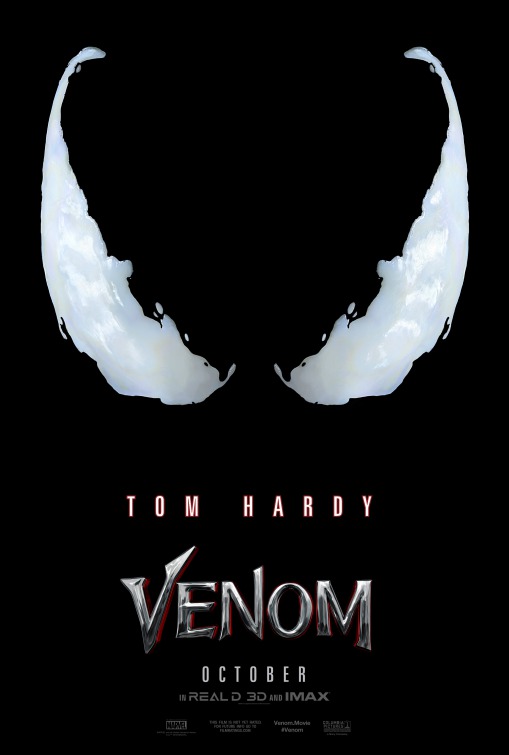
 Venom is a absolutely not any kind of a great movie. But it is vastly better than the trailer for it suggests. Which isn't difficult, because the trailer for Venom must rank as one of the worst of all time...
Not least because it includes the last scene of the film, and the final punchline, with the effect that viewers who have seen the trailer, which will be most of them, finish watching the film on a flat and disappointing note. Nice work, guys.
 The trailer also manages to make Tom Hardy look like an idiot, which is unfair since he's a fine actor and here manages to turn in an effective and sympathetic performance in a thankless role as Eddie Brock, a crusading journalist who becomes infected with an alien symbiote or parasite.
The film is a tad confused about what a "symbiote" is (the word suggests a symbiotic relationship, which is decisively different from parasitism), but that's the least of its problems...
The trailer also manages to make Tom Hardy look like an idiot, which is unfair since he's a fine actor and here manages to turn in an effective and sympathetic performance in a thankless role as Eddie Brock, a crusading journalist who becomes infected with an alien symbiote or parasite.
The film is a tad confused about what a "symbiote" is (the word suggests a symbiotic relationship, which is decisively different from parasitism), but that's the least of its problems...
Venom is fast moving and efficient thanks to director Ruben Fleischer (Zombieland, Gangster Squad) and a strong cast, including Michelle Williams as Eddie's love interest Anne Weying, Riz Ahmed as the bad guy and Jenny Slate as a conflicted scientist working for the bad guy.
 The bad guy being a super rich new-tech entrepreneur. A cliché which dates back at least to 2013's Cloudy with a Chance of Meatballs 2, where the heavy Chester V was a fun parody of Steve Jobs. Since then the fun has been wearing rather thin, though.
But Venom's real Achilles heel are the special effects used to create Venom and his fellow aliens — lashing tentacles, gleaming pseudopods, gaping maws full of razor sharp teeth...
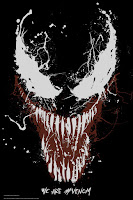 These are truly shameful, utterly inadequate and look seriously dated already. In a few years' time they will seem as antiquated and clunky as Donkey Kong game footage from 1981, though without the retro charm.
The script for this Marvel comic adaptation is basically an echo of Nigel Kneale's 1953 Quatermass Experiment – spacecraft returns to earth with alien entity which takes possession of a human. It's by the writing team of Jeff Pinkner & Scott Rosenberg, who worked on the excellent Jumanji: Welcome to the Jungle, with a rewrite by Kelly Marcel.
 I actually met Kelly Marcel because I worked with her dad Terry on a TV show called Dark Knight (no, not that one). She's proving to be one of the most successful British writers in Hollywood, with credits including the adaptation of Fifty Shades of Grey (yes, that one).
 Venom's best feature is the bickering dialogue between Eddie and the monstrous Venom, whose voice he hears in his head — and which sounds to me like Tom Hardy doing a decent monster voice, with some processing on it.
This is not a movie for the ages but it's a businesslike and professional piece of work and, as I said, far better than the meretricious trailer would lead you to believe.
(Image credits: Plenty of posters at Imp Awards, thank you.)
 Widows is potent material. It was the writing debut of former actress Lynda LaPlante and she did a fantastic job. Its first — and possibly still finest — incarnation was as British TV mini-series in 1983.
 McQueen (Shame, 12 Years a Slave) comes from a high-art background and I don't think he really understands drama, or perhaps even film. However, there's no denying he made one genius decision early on — to chose Gillian Flynn as his co-writer on the project.
 The new film is well worth seeing, but it's frustrating. Every time it really starts to burn with excitement, McQueen throws a shovel full of sand on the fire, so to speak. The trouble is, he's trying so hard to be arty...
 Now, this was a careful and deliberate decision by McQueen, who wanted to show what a short drive it is from a poverty-stricken neighbourhood of Chicago to Mulligan's posh suburban home.
 As I say, Widows is frustrating. It's good, but it could have been great. Art films and thrillers need not be incompatible — look at John Boorman's Point Blank, a movie which shows just how far short Widows falls short.