Sunday, 5 August 2012

Farewell My Lovely... Pilcrow

What is a pilcrow? It's a paragraph marker. It tells you where a paragraph ends. Or begins. Depending on your point of view. It looks like this. They are a nice way of breaking up blocks of text without making the text look ragged.

The idea is that they allow the reader's eye to find where the paragraph breaks are, while preserving the integrity of the block of text.

They're useful f
or liner notes on LPs, CD booklets, that sort of thing. Short sections of text which are part of a graphic layout.

They allow the
text to be treated as a single design element.

You wouldn't want to read an entire book where pilcrows are used — though early books were indeed printed that way. To me they seemed perfect for the small blocks of text used in a blog.

However, I've been advised to stop using them (by a trusted friend) because they make the blog less readable.

Well, since I did a big publicity push for my new novel (see my blog entry for Operation Herod), the last thing I wanted was a less-readable blog.


So now it's farewell little pilcrow. I'll miss you. Sob. Choke.

(I'm going to go on using you on my music blog, though! He said defiantly.) And here's a last blast of them:

Saturday, 4 August 2012

Operation Herod: "Mr Bond, I would like you to meet Dr Strangelove..."

I've always wanted to write something in the tradition of the great sixties spy thrillers.

Think the 007 movies or Peter O'Donnel's wonderful Modesty Blaise stories.

Adam Hall's Quiller adventures, or Len Deighton's Ipcress File and its sequels...

Indeed, I wanted Operation Herod's cover to evoke Raymond Hawkey's stylish milestones for Deighton.

(Kudos also to our lovely designer Vikki.)

What story lurks beneath this cover?

Well, let me ask you this:

What makes for a memorable Bond movie?

A wise man once said, the two most important elements are the villain — who was it going to be this time? A Goldfinger? Or maybe a Blofeld? —

And the big action set-piece at the end:

Perhaps we feel like a helicopter assault on a mountain fortress today?

So I set about dreaming up a villain (or, in this case a villainess). And a big blast of high octane action to pay off the story.

And, since I'd admired the Modesty Blaise thrillers as much as Bond, I also set about planning some O'Donnell-style narrative surprises.

Plus, me being me, I needed a spark of satire.

Think Dr Strangelove or the original, brilliant
Richard Condon version of The Manchurian Candidate. It's a thriller, but it's funny as well as scary. And a little bit mind-blowing.

Now, thanks to Endeavour Press, here it is.

(Available soon from all good global marketing corporations named after South American rivers.)

Update: now available from Amazon here.

Tuesday, 17 April 2012

The Way Home: Pelecanos Strikes Again

Having read The Sweet Forever (see the entry for April 1st) I was delighted to stumble on another crime novel by George Pelecanos. It is a recent piece of work, published in 2008, whereas The Sweet Forever dates from some ten years earlier. Once again it deals with the consequences of stumbling on a substantial cache of money belonging to some very unpleasant people. Beyond that, though, The Way Home could hardly be more different than its predecessor. Its depiction of incarceration is remarkable, enlightening, and refreshingly free of cliche. And I loved the scene where the old guard nicknamed Shawshank calls to task the troubled-teen-fiction novelist who has come to condescendingly lecture to the inmates; he shows up the guy's work as a meretricious string of clichés. Once again the story is set in Washington DC, a locale which Pelecanos deftly and vividly brings to life. Chandler had Los Angeles, George V. Higgins had Boston. Pelecanos has Washington. It's a highly accomplished novel. Whereas The Sweet Forever had a ragged, badass vibe, The Way Home possesses a smooth cool precision. It also features some magnificently drawn bad guys. In the ten years between the two books, Pelecanos has clearly advanced as a writer — which is to take nothing away from The Sweet Forever, which I loved. And, like the earlier book, The Way Home moves grippingly towards a hellish and brutal climax. I couldn't put it down. My only grouse? Of course, there has to be one: the boring, generic crime novel cover art on the UK edition. This was a let down after the terrific graphics which adorned my copy of The Sweet Forever. Anyway, I'm now actively looking for anything Pelecanos has written, and I advice you to do the same. (The splendid portrait of Pelecanos is by April Saul / Getty Images and accompanies an interview with Pelecanos in the Los Angeles Times. Click on the image to go to it.)

Sunday, 1 April 2012

Quality Crime Fiction — The Sweet Forever by George Pelecanos

To be truthful, I picked up this novel simply because I liked the cover art. A crime thriller with an LP on the front is right up my street. But then I filed the book away on a shelf and only picked it up again recently because I needed something to read on public transport, and it would fit in my jacket pocket. Little did I know. Now I wish I'd picked it up years ago. It's superb. Pelecanos's writing brings to mind the great WR Burnett. In fact, it brings to mind Chester Himes rewritten by WR Burnett. It has the intense, vivid low lifes and street culture of Himes. But it's also a well organised and convincingly authentic thriller, like Burnett wrote. In other words, fantastic stuff. Its apocalyptic climax also calls to mind James Ellroy's LA Confidential, at least in the screen adaptation by Curtis Hanson and Brian Helgeland. Set in Washington in the late 1980s, it turns out that The Sweet Forever is the third book in a sequence called the DC Quartet. I'm now going to be checking out the other titles in the series. Indeed, anything else written by Pelecanos has now got my full attention. The Sweet Forever begins with Eddie Golden, something of a loser of an appliance installer, lucking into a bag of drugs money. If you can call that luck. Eddie isn't really avaricious. He just wants to impress his girlfriend Donna. But the people Eddie has ripped off (and they definitely see it as being ripped off) are very nasty indeed. And you soon have a sick feeling in the pit of your stomach that bad things are going to happen. And they turn out to be worse than you could imagine. One of the virtues of Pelecanos is his great, often faultless, dialogue. He has a wonderful ear. No wonder he was snapped up to write scripts for The Wire (and The Pacific). But his ability as a novelist is beyond question. He writes tight, evocative prose. And he can certainly make you wince. In the early sections of The Sweet Forever I was rather at sea, though. There's this issue about names. Pelecanos has a lot of characters, and he throws them at you all at once. I found there were too many people with too many names. Sometimes he'd refer to a character by his first name, sometimes by the last name. I was once reading a novel by Robert Ferrigno, another terrific American crime novelist. I reached the violent climax of the book and suddenly froze. I had to flip back 50 pages to work out who the hell he was talking about. It turned out that a character who'd been referred to by their surname for virtually the entire novel was suddenly being called by their first name (or vice versa). Needless to say, the slam bang ending was somewhat compromised. Clear, memorable and unambiguous naming of characters matters. Back to Pelecanos and The Sweet Forever. I don't want to make a major beef about this, but for this reader there were some confusingly similar names. Ladies and gentlemen of the jury I give you Anthony Taylor and Alan Rogers. And Marcus Clay and Clarence Tate. My brain, at least, tended to short circuit on these. And there were not enough nicknames or simple memory hooks. Anthony Taylor begins promisingly as the Kid in the Raiders Jacket and for my money should have remained as such. Ironically these problems pretty much vanish in screenwriting – the eye can immediately recognise the characters, the mind can sort them out, and the audience can get on with enjoying the story. Still more ironically, the same problem rear up even more seriously in the screenplay itself, where it's absolutely crucial for the reader (often a bored script executive) to remember who everybody is, and not be confused. Vivid names and designations are crucial. The Kid in the Raiders Jacket would stay that in a script. Pelecanos is big on sport, basketball in particular which adds a layer of authenticity to the story. Although it left this reader cold, it helps to define the time and place and characters. Speaking of sport, Pelecanos also occasionally passes around the viewpoint of his characters like a basketball. Initially this was jarring to me. I like to stick with one character's point of view, and if a change is necessary I like it to start with a new chapter. Not instantly knowing whose viewpoint is telling the story can lead to rapid dissipation of reader empathy. But as I grew familiar with Pelecanos's characters and was gripped by his story (and boy, is it gripping) any such concerns fell away. This book is an engrossing read. As with the sport, there is a lot of talk about the popular music of the period. Just about the only recording artist among these that I could stomach is Prince. But that isn't the point. Discussion of the music scene brings the period to life, even if we can't stand the songs, fashions or haircuts any more. The Sweet Forever is compelling and readable and completely delivers the goods. Near the end, as the shit hits the fan and the drug killings start, it suddenly introduces a host of new characters. I gather these are Pelecanos regulars from his other books. Readers familiar with them won't have any problems. But for a novice like me, the abrupt appearance of important new characters who are crucial to the climax is jarring. A classic example of this is Peter Driscoll's The Wilby Conspiracy, a terrific thriller set in Apartheid South Africa concerning a cache of diamonds. It's a memorable, well written action novel and I recommend it most highly. But on page 225 (of 256) a major new character is introduced and plays an important part in the climax. No screenwriter would be allowed to get away with that. But even the late introduction of Nick Stefanos (about whom Pelecanos has written a series of novels) and Vietnam vet Adamson can't slow down or diminish the explosive climax of The Sweet Forever. Stunning. The great cover art, which set the whole ball rolling for me, is credited simply to Keenan. I am going to confidently assert this is Jamie Keenan. With my fingers firmly crossed.

Saturday, 17 March 2012

Chandler in the Telegraph — a Playback Mystery

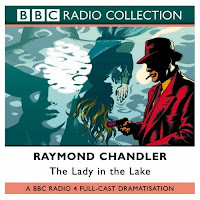
Venturing out on a rainy Saturday to the shops I ran into a friend on the bus. He gave me a hot tip, which I now pass on to you. All this week the Daily Telegraph (please don't stop reading at this point) are giving away free copies (ah, I thought that might pique your interest) of the CDs of Radio 4's Raymond Chandler dramatisations (there, I knew I'd get you in the end). What made this irresistible to me is the fact that half of the recent (2011) Radio 4 Chandler adaptations were written by my friend and colleague the extremely talented Stephen Wyatt. Now here comes the mystery. It seems that some of the Telegraph Chandler CDs come from this recent series. But others — including The Big Sleep and The Long Goodbye — are the BBC dramatisations written by Bill Morrison, which mostly seem to date from the late 1970s. But until each disc appears, I can't be sure which is which. Thanks, Stephen, now I'm stuck with buying this, ahem, conservative broadsheet. Just for the record, the 2011 series consisted of eight shows which were: The Big Sleep, The Lady in the Lake, Farewell My Lovely, Playback, The Long Goodbye, The High Window, The Little Sister and Poodle Springs (the last named you may not be familiar with — it was an unfinished Chandler novel completed some decades after his death by Robert B. Parker). Of these, Stephen Wyatt scripted Lady in the Lake, Little Sister, Long Goodbye and Playback. (The other scripts were written by Robin Brooks, who did the magnificent Radio 4 I, Claudius adaptation.) Playback is a particular favourite of mine because it occasioned a discussion (all right, argument) between Stephen and I about who killed whom in the novel — reminiscent of Jules Furthman, Leigh Brackett and William Faulkner being baffled over The Big Sleep when they were adapting it for Howard Hawks. Speaking of screenwriters, Stephen was also responsible for a pair of stunning plays about Chandler in Hollywood for Radio 4, both of which deserve to win a slew of awards. They are Double Jeopardy, about Chandler and Billy Wilder and Strangers on a Film, about Chandler and Hitchcock. Patrick Stewart is terrific as Chandler in both of them. I've illustrated this post with an image of the covers which the Telegraph has apparently commissioned especially for this offer. These are imaginative, true to the stories and make strong use of graphics. No credit for the artist or artists, but if I find out I'll let you know. (Genuinely nice job, guys. Much appreciated. It makes me glad I didn't make any cheap "Torygraph" cracks in this piece.) Incidentally, these covers are considerably nicer than some of the official BBC releases on CD, though I do really like the 1999 Long Goodbye and Big Sleep shown here. The 2011 Radio 4 series featured two late Chandler rarities — Playback and Poodle Springs — and I don't think these have ever been adapted before. So I suspect the Telegraph discs will be these, including Stephen's Playback, which is out on Thursday. So you must buy that one, then read the novel and compare the two. Then you can join in the debate about who the hell killed which character and what happened when what's-his-name went over the balcony and all that. I look forward to the shouting. The real mystery about the Telegraph CDs is that they seem to have opted for Poodle Springs over The Little Sister, which isn't one of the seven titles on offer. Weird. There's certainly nothing wrong with Poodle Springs, which is available on Friday, but it is a curiosity, whereas The Little Sister is a classic. Anyway, full details of the Telegraph offer can be found here. But get your skates on, the Big Sleep and Farewell My Lovely already out as I write this. And if you're after the complete 2011 series by the splendid A-team of Stephen Wyatt and Robin Brooks, look no further than here.
Thursday, 5 May 2011

Denis McLoughlin and Dinosaurs

In a brief pause during the writing of my new novel, which along with various TV scripts and some film rewriting, has kept me madly busy in the last few months (apologies for lack of blogs) I got an email alert from eBay. I was delighted to see the book illustrated here. I placed a bid and was even more delighted when I won it. Michelle, my lovable postie just delivered it, and it now resides proudly on my coffee table (a table that's never known any actual coffee but is overburdened with books and CDs). It features a cover by one of my all time favourite illustrators, the great British Noir artist Denis McLoughlin. I first became acquainted with his amazing colour illustrations through his covers for the crime thrillers published by Boardman Books. He is also famed for his Buffalo Bill Wild West Annuals, of which I have a few. But I wasn't aware of these Okay Adventure Annuals. From what I've seen, each year featured a different genre (eg explorers in Africa), but I was lucky enough to glom this particular specimen, with its science fiction theme. Not only does it feature great art, but it also embodies one of my mottoes for life: never go hunting for dinosaurs unless you've got some grenades in the jeep.

Friday, 24 September 2010

Downton Abbey by Julian Fellowes

When I heard that Ben Aaronovitch had been invited to the BFI screening of Downton Abbey, my immediate reaction was to try to wangle an invitation for myself. It wasn't the exclusive pre-screening drinks or the lavishly catered afterparty that attracted me — or only to the extent that they boded well for networking. Ben has had great interest in his soon to be bestselling series of novels and I've been commissioned to write an episode of Midsomer Murders. So now seemed like a good time to go networking. Ben had garnered his invitation through the good offices of Carnival, one of the great British independent TV companies. They were responsible for Simon Moore's Traffik, which remains a high water mark for television drama. So of course I wanted to lig along. It
sounded like fun. Ben didn't have any trouble wangling me an invitation. I arrived at the BFI fashionably on time and Ben introduced me to Gareth Neame, former head of drama at the BBC and now a honcho at Carnival. Also, a man who clearly has an eye for writing, given that's he had the uncommon good sense to commission Julian Fellowes. The pre-screening drinks were scheduled to commence a full hour and a quarter before the screening. I arrived wondering how I could possibly fill that yawning void of time. But as interesting people surged into the bar we introduced ourselves around and ate the little cheese biscuits provided (black napkins — classy touch). Ben was soon deep in schmoozing mode and I set about striking up a conversation with the nearest beautiful woman — who proved to be an internet executive. Before you knew it, it was time for the screening. We filed into NFT 1. This is one of the finest cinemas in London, with certain towering caveats. For a start it was designed by someone who clearly thought the sightlines for a movie are the same as for live theatre. Oh no, my friend, I am afraid to tell you that they're not.This is why great swathes of the seats on the left and right of the screen give a weirdly angled view with fatal quantities of parallax and distortion. And don't even get me started about the time they screened Barry Lyndon. At the end of Kubrick's misty masterpiece, after 184 minutes of film, the projectionist was still trying to get the focus right. Stanley would have been foaming at the mouth. Anyway, like I said, certain caveats. But if you're lucky enough to be sat in the sweet spot in the centre aisle, the NFT1 is a great cinema. And when Ben and I consulted our tickets we found we were seated dead centre. And the dishy internet exec was in the row behind us. There was a good humored sense of excitement, a subdued buzz in the audience as the lights went out. Julian Fellowes wrote Gosford Park, a film for which he won the Oscar. And like Gosford, Downton Abbey concerns an English stately home and the people who live in and their servants, and it's dynamite. We're instantly acquainted with a large cast of characters and immediately made to care about them. The way Fellowes channels our sympathies is masterful. Plus that redhaired undermaid is really cute. After the triumphant screening there's a Q&A. It's obvious Downton Abbey is going to be a huge hit. Not least in America. At the after party, attended by cast and crew plus numerous hangers on (me, for instance) we meet Andrew Morgan, who worked with us on Doctor Who, directing Ben's Dalek story. "Canapes?" says Andrew, "I thought they said cannabis!" We also meet a Tierra del Fuegian banjo player who is the only person present who isn't ecstatic about Downton Abbey. He dismisses it with lofty contempt. I listen politely to his specious vapourings before moving off. I make a point of meeting Julian Fellowes, who it turns out is an old friend of Andrew Morgan. We chat briefly and I convey my great admiration for his script . "Well done on the Midsomer," he tells me. Walking back along the Thames around midnight, the bright circle of the London Eye looming in the night above, I reflected that it was a great TV drama and a great evening. My only regret is that I didn't speak to the redhaired undermaid — or punch the Tierra del Fuegian banjo player.