skip to main |
skip to sidebar
 You can't copyright a title. Which is just as well, because this is the third or fourth movie to be called The Girl on the Train. It's based on a bestselling crime novel of the same title by Paula Hawkins, which rather rode on the coat tails of Gillian Flynn's Gone Girl — a vastly superior work.
I haven't read Hawkins's novel but, as is so often the case, I've heard a BBC Radio 4 adaptation of it. And that was sufficient to expose fatal, basic structural problems with the story.
This is a whodunnit in which it's entirely obvious, almost from the get-go, who done it. The movie perhaps does a better job of, briefly, fooling the audience. But even here the bad guy might as well be wearing a sign around his neck saying "I'm the killer".
 The other problem with the narrative is that the grand action climax is disappointingly ho-hum. Small beer indeed.
So what's left? Hawkins's novel does present a powerful portrait of a troubled, disintegrating woman. And it makes deft use of our deeply-programmed fear of babies being harmed.
The movie makes effective use of the latter, but the former is overdone to the point of being tiresome. With unflattering make up and hair — to signal that she’s an unhappy alcoholic — Emily Blunt looks like she’s escaped from a zombie movie.
 But director Tate Taylor, who also directed the outstanding James Brown movie Get on Up, has injected some memorable moments — there's a terrific bit involving a drop of water.
And there's a well wrought script by Erin Cressida Wilson, who has some excellent screenwriting credits, from Secretary and Chloe to Men, Women and Children. All memorable films.
The ad campaign uses the slogan "What did she see?" which unfortunately brings to mind Rear Window, a short story by Cornell Woolrich, unforgettably filmed by Alfred Hitchcock. Unfortunately because The Girl on the Train just isn't in that league.
But director Tate Taylor, who also directed the outstanding James Brown movie Get on Up, has injected some memorable moments — there's a terrific bit involving a drop of water.
And there's a well wrought script by Erin Cressida Wilson, who has some excellent screenwriting credits, from Secretary and Chloe to Men, Women and Children. All memorable films.
The ad campaign uses the slogan "What did she see?" which unfortunately brings to mind Rear Window, a short story by Cornell Woolrich, unforgettably filmed by Alfred Hitchcock. Unfortunately because The Girl on the Train just isn't in that league.
 The original novel was set in England. It's survived its translation to America without any major damage.
But this is still an ultimately second-rate psychological thriller, and when set beside the magnificent film of Gone Girl, it pretty much ceases to exist.
(Image credits: a paucity of posters at Imp Awards — though there are some stylish ones, as you can see.)
The original novel was set in England. It's survived its translation to America without any major damage.
But this is still an ultimately second-rate psychological thriller, and when set beside the magnificent film of Gone Girl, it pretty much ceases to exist.
(Image credits: a paucity of posters at Imp Awards — though there are some stylish ones, as you can see.)
 It's been a busy summer and I haven't been able to get to the cinema as much as I would like.
So I've had to really pick and chose which movies to see, and the first casualty was the usual slew of comic-inspired blockbusters. I missed the new X-Men, for instance.
But the one comic book feature I was not going to miss was Suicide Squad. Because it's the work of David Ayer, who has made a number of films I really admire.
It's been a busy summer and I haven't been able to get to the cinema as much as I would like.
So I've had to really pick and chose which movies to see, and the first casualty was the usual slew of comic-inspired blockbusters. I missed the new X-Men, for instance.
But the one comic book feature I was not going to miss was Suicide Squad. Because it's the work of David Ayer, who has made a number of films I really admire.
 Check out the ruthless police story End of Watch, the neglected apocalyptic Schwarzenegger thriller Sabotage or, most recently, his magnificent tank war movie Fury.
So I am downcast to report that Suicide Squad is a real dud, a complete disappointment, and I'd advise you avoid it. And David Ayer has to take full responsibility, since he wrote and directed it, based on characters from the DC Comics universe.
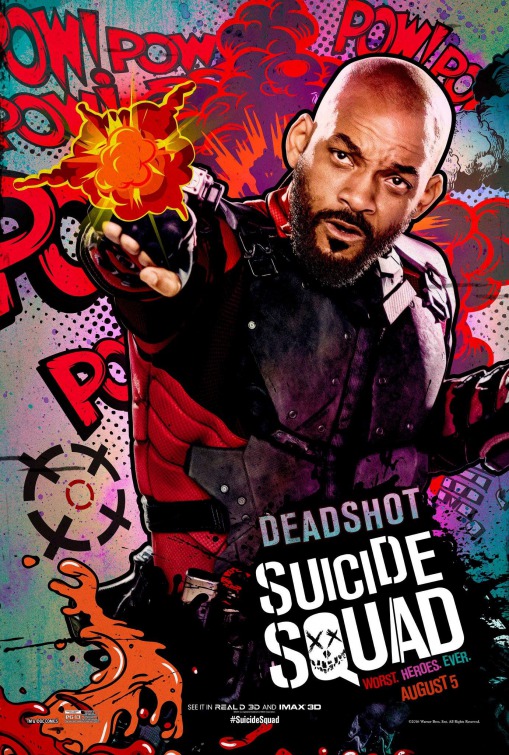
 The premise of Suicide Squad is essentially The Dirty Dozen with supervillains. Here the various bad-guys-turned-good-guys include Will Smith as Dead Shot, Cara Delevingne (so wasted in Face of an Angel) as the Enchantress, with Margot Robbie as Harley Quinn.
And a movie where even a sluttily dressed Margot Robbie's eventually becomes tiresome is a genuine failure. But all her character seems to do is pose with a baseball bat and display a perpetual smirk.
The premise of Suicide Squad is essentially The Dirty Dozen with supervillains. Here the various bad-guys-turned-good-guys include Will Smith as Dead Shot, Cara Delevingne (so wasted in Face of an Angel) as the Enchantress, with Margot Robbie as Harley Quinn.
And a movie where even a sluttily dressed Margot Robbie's eventually becomes tiresome is a genuine failure. But all her character seems to do is pose with a baseball bat and display a perpetual smirk.
 Anyway, these troublemakers are freed from prison by government suit Amanda Waller (played by Viola Davis, essentially reprising her role from Black Hat, a vastly superior film) so they can deal with extraordinary threats.
This is where the movie's problems begin — the threat in question is Enchantress herself, who has gone rogue. Before they can deal with her, the squad first has to rescue a mysterious high value asset... who turns out to be Amanda Waller.
Anyway, these troublemakers are freed from prison by government suit Amanda Waller (played by Viola Davis, essentially reprising her role from Black Hat, a vastly superior film) so they can deal with extraordinary threats.
This is where the movie's problems begin — the threat in question is Enchantress herself, who has gone rogue. Before they can deal with her, the squad first has to rescue a mysterious high value asset... who turns out to be Amanda Waller.
 In other words, there really is no story. Just a plot which incestuously recycles its own elements. The result is dull and airless. And the fight scenes are just terrible. The squad slogs through ranks of literally faceless villains — lumpy, anonymous monsters.
And the audience just doesn't care, doesn't care, doesn't care... Or at least, I didn't. I kept falling asleep during the pointless mayhem.
In other words, there really is no story. Just a plot which incestuously recycles its own elements. The result is dull and airless. And the fight scenes are just terrible. The squad slogs through ranks of literally faceless villains — lumpy, anonymous monsters.
And the audience just doesn't care, doesn't care, doesn't care... Or at least, I didn't. I kept falling asleep during the pointless mayhem.
 There is a brief moment when it looks like the
movie is going to come to life as helicopters plough into towering black clouds of
smoke above a city to the strains of ‘Spirit in the Sky’ by Norman Greenbaum. But it fails
to ignite.
Even the film score, by Steven Price, who did great work on Gravity and Fury, didn't appeal.
There is a brief moment when it looks like the
movie is going to come to life as helicopters plough into towering black clouds of
smoke above a city to the strains of ‘Spirit in the Sky’ by Norman Greenbaum. But it fails
to ignite.
Even the film score, by Steven Price, who did great work on Gravity and Fury, didn't appeal.
 The only time when the film really finds its feet is when
master assassin Will Smith starts talking to his young daughter about
sniper ballistics, but that’s a few moments before the end credits roll.
(Image credits: The posters are from Imp Awards where there were no less than 49 on offer. Which called to mind the immortal words of Dashiell Hammett's Sam Spade: "The cheaper the hood, the gaudier the patter.")
The only time when the film really finds its feet is when
master assassin Will Smith starts talking to his young daughter about
sniper ballistics, but that’s a few moments before the end credits roll.
(Image credits: The posters are from Imp Awards where there were no less than 49 on offer. Which called to mind the immortal words of Dashiell Hammett's Sam Spade: "The cheaper the hood, the gaudier the patter.")
 Nerve gets off to a somewhat wobbly start thanks to its Poochie-esque attempt to be down with the kids.
At first it’s all computer screens, in the manner of Unfriended or Friend Request, though perhaps with less justification, and pop songs. Tedious, terrible pop songs.
Most of these excesses soon settle down, though the inferior music continues unabated throughout. However… the film itself is actually cleverly plotted and gripping.
It concerns the eponymous game, which is sort of a truth-or-dare. Though this computer version solely consists of the dares.
Nerve gets off to a somewhat wobbly start thanks to its Poochie-esque attempt to be down with the kids.
At first it’s all computer screens, in the manner of Unfriended or Friend Request, though perhaps with less justification, and pop songs. Tedious, terrible pop songs.
Most of these excesses soon settle down, though the inferior music continues unabated throughout. However… the film itself is actually cleverly plotted and gripping.
It concerns the eponymous game, which is sort of a truth-or-dare. Though this computer version solely consists of the dares.
 I really like the fact that Nerve is contained and small scale, set around Staten Island and New York City, and what is genuinely terrific is the way they smoothly scale up the dares to a dangerous level.
What begins with kissing a stranger in a diner rapidly escalates to riding a motorcycle with a blindfolded driver at 60mph.
It's a nice script by Jessica Sharzer, who has written extensively for the TV series American Horror Story.
I was intrigued to see that it was based on a novel by Jeanne Ryan.
I really like the fact that Nerve is contained and small scale, set around Staten Island and New York City, and what is genuinely terrific is the way they smoothly scale up the dares to a dangerous level.
What begins with kissing a stranger in a diner rapidly escalates to riding a motorcycle with a blindfolded driver at 60mph.
It's a nice script by Jessica Sharzer, who has written extensively for the TV series American Horror Story.
I was intrigued to see that it was based on a novel by Jeanne Ryan.
 I haven't read the book, but it's perceived purely as young adult fiction in the classic mould, with an isolated teen female protagonist narrating in the first person.
Personally, I saw it as a taut, clever high-concept computer thriller, a kind of descendent of 1997's The Game.
And it's genuinely, deeply, nail-bitingly suspensful. But then I don't like heights... (I was amused that the parental advisory at the beginning of the movie warning that it depicts "imitable behaviour". I don't plan to imitate it any time soon.)
I haven't read the book, but it's perceived purely as young adult fiction in the classic mould, with an isolated teen female protagonist narrating in the first person.
Personally, I saw it as a taut, clever high-concept computer thriller, a kind of descendent of 1997's The Game.
And it's genuinely, deeply, nail-bitingly suspensful. But then I don't like heights... (I was amused that the parental advisory at the beginning of the movie warning that it depicts "imitable behaviour". I don't plan to imitate it any time soon.)
 It also features lovely colour
cinematography by Michael Simmonds.
The cast is led by Emma Roberts playing Vee (for Venus), the classic isolated teen female protagonist. Though she's only isolated for about five minutes. Interestingly Roberts also starred in American Horror Story.
If you see Nerve, be sure and stay for the end titles, which are beautifully
designed.
(Image credits: a large selection of posters at Imp Awards, though the "streaking" one is a bit misleading.)
It also features lovely colour
cinematography by Michael Simmonds.
The cast is led by Emma Roberts playing Vee (for Venus), the classic isolated teen female protagonist. Though she's only isolated for about five minutes. Interestingly Roberts also starred in American Horror Story.
If you see Nerve, be sure and stay for the end titles, which are beautifully
designed.
(Image credits: a large selection of posters at Imp Awards, though the "streaking" one is a bit misleading.)
The Mechanic began life as an original script in the seventies by top screenwriter Lewis John Carlino. Its first incarnation was a 1972 version with Charles Bronson as the meticulous professional assassin and Jan-Michael Vincent as his ambitious and ultimately treacherous young apprentice.
 In 2011 there was a remake, scripted by Carlino but rewritten by Richard Wenk (The Equalizer) and starring Jason Statham as our friendly neighbourhood hitman and Ben Foster (so great recently in Hell or High Water) as his AAUTYA.
That film was clearly something of a success because we now have a sequel. Our dour hero is still listening to vinyl. And wastefully blowing up his high end hi-fi with high explosive booby traps.
The opening sequence of the new movie is just great, though, with a cute female assassin (memorably played by Thai actress and pop singer Yaaying Rhatha Phongam) trying to draw a gun on Statham in a mountaintop bar-and-grill in Rio.
 Bad guys get their face sizzled on the aforementioned grill. Our hero escapes on the roof of a cable car as bullets fly around him, before hitching a ride on a hang glider.
This is a picaresque movie composed of self contained setpieces, most of them centering on the evil arms dealers Statham has been contracted to kill.
I like the breezy way we jet around the world to beautiful locations. Thailand is particularly striking.
The logic is for shit, though. The Mechanic is pressured (they’ve kidnapped his love interest Jessica Alba) into undertaking a series of hits which must look like accidents.
Bad guys get their face sizzled on the aforementioned grill. Our hero escapes on the roof of a cable car as bullets fly around him, before hitching a ride on a hang glider.
This is a picaresque movie composed of self contained setpieces, most of them centering on the evil arms dealers Statham has been contracted to kill.
I like the breezy way we jet around the world to beautiful locations. Thailand is particularly striking.
The logic is for shit, though. The Mechanic is pressured (they’ve kidnapped his love interest Jessica Alba) into undertaking a series of hits which must look like accidents.
 But it turns out there’s no particular reason for them to look like accidents. And he doesn’t try very hard to achieve this anyway. The drilled swimming pool in the sky is a lot of fun, however.
There’s also a weird bit where he tries to rescue Jessica from the bad guys, fails, and then courtesy of a fade out and a voice over, he’s back on the job as if nothing happened. I suspect a major re-edit.
But it doesn't matter, Tommy Lee Jones is sheer joy when he turns up as a hip arms dealer with a soul patch and rose tinted glasses.
But it turns out there’s no particular reason for them to look like accidents. And he doesn’t try very hard to achieve this anyway. The drilled swimming pool in the sky is a lot of fun, however.
There’s also a weird bit where he tries to rescue Jessica from the bad guys, fails, and then courtesy of a fade out and a voice over, he’s back on the job as if nothing happened. I suspect a major re-edit.
But it doesn't matter, Tommy Lee Jones is sheer joy when he turns up as a hip arms dealer with a soul patch and rose tinted glasses.
 The writing credits for the new film are a bit of a mess — they vary according to where you look, at the poster or on the internet. But some things are clear. Lewis John Carlino is gone, save for a "characters created by" credit.
And Richard Wenk is gone entirely. The main talent involved now is Philip Shelby, who recently wrote the absolutely brilliant Survivor. He's a terrific writer and I'm pleased to see him getting what I hope is a lucrative payday.
The writing credits for the new film are a bit of a mess — they vary according to where you look, at the poster or on the internet. But some things are clear. Lewis John Carlino is gone, save for a "characters created by" credit.
And Richard Wenk is gone entirely. The main talent involved now is Philip Shelby, who recently wrote the absolutely brilliant Survivor. He's a terrific writer and I'm pleased to see him getting what I hope is a lucrative payday.

The other writers who are credited (depending on where you look) are Tony Mosher and the team of Rachel Long and Brian Pittman.
In any case, despite the tortuous rewrites and re-edits, Mechanic Resurrection is fast-moving, semi-coherent fun and there's the potential here for an inventive, guilty-pleasure pulp franchise.
(Image credits: The Resurrection poster is from Imp Awards. The 2011 Mechanic poster is also from Imp Awards. The 1972 poster is from Amazon.)
 By remaking one of the great classics of cinema you are "cruising for a bruising" as we used to say, when we were young hoodlums.
My heart certainly sank when I saw the poster, and the CGI-infested trailer, for the new version of Ben-Hur.
So I'm a little chagrined to report that the movie is way better than I expected.
By remaking one of the great classics of cinema you are "cruising for a bruising" as we used to say, when we were young hoodlums.
My heart certainly sank when I saw the poster, and the CGI-infested trailer, for the new version of Ben-Hur.
So I'm a little chagrined to report that the movie is way better than I expected.
 Although the two leads, Jack Huston as Judah Ben-Hur and Toby Kebbell as Messala Severus, are quite unknown — at least to me — they both turn out to be good actors.
And I found this remake altogether entertaining, vivid and immersive. The sea battle sequence with galley slave Ben-Hur escaping from a sinking ship is just terrific. And the screenwriters (John Ridley of 12 Years a Slave and Oliver Stone's U-Turn, and Keith Clarke who wrote The Way Back for Peter Weir) have actually done an interesting and imaginative job.
Although the two leads, Jack Huston as Judah Ben-Hur and Toby Kebbell as Messala Severus, are quite unknown — at least to me — they both turn out to be good actors.
And I found this remake altogether entertaining, vivid and immersive. The sea battle sequence with galley slave Ben-Hur escaping from a sinking ship is just terrific. And the screenwriters (John Ridley of 12 Years a Slave and Oliver Stone's U-Turn, and Keith Clarke who wrote The Way Back for Peter Weir) have actually done an interesting and imaginative job.
 One improvement over the Lew Wallace novel is that the friendship between Ben-Hur and Messala has been built up strongly at the beginning. Since they're going to end up as deadly enemies, this is crucial. And there's a terrific sequence at the start of the film — we begin with the chariot race between Ben and Messala and then do a neat dissolve to them, as young men and friends, racing horses in the desert.
Indeed the movie features some very
pretty horses. So I didn’t object to the CGI chariot
race, because at least it meant these horses weren’t really getting hurt. (I
hope.)
One improvement over the Lew Wallace novel is that the friendship between Ben-Hur and Messala has been built up strongly at the beginning. Since they're going to end up as deadly enemies, this is crucial. And there's a terrific sequence at the start of the film — we begin with the chariot race between Ben and Messala and then do a neat dissolve to them, as young men and friends, racing horses in the desert.
Indeed the movie features some very
pretty horses. So I didn’t object to the CGI chariot
race, because at least it meant these horses weren’t really getting hurt. (I
hope.)
 One small weakness of the film is Morgan Freeman in his patented role as Wise Old Man. Much worse is the religious subplot, meretriciously built up to appeal to the American Christian market...
There is some justification for this, though. After all Lew Wallace’s novel, involves a great deal of biblical guff — it's subtitled A Tale of the Christ.
One small weakness of the film is Morgan Freeman in his patented role as Wise Old Man. Much worse is the religious subplot, meretriciously built up to appeal to the American Christian market...
There is some justification for this, though. After all Lew Wallace’s novel, involves a great deal of biblical guff — it's subtitled A Tale of the Christ.
 But the movie really shoots itself in the foot with a scene of a Roman Legionnaire being struck dumb in awe by Jesus’s incredible charisma. This is almost identical to — and almost as hilarious as — a priceless scene in the Coen brothers’ Hail Caesar featuring George Clooney. Although in the case of Ben-Hur the humour is utterly unintentional.
Nonetheless, to my considerable surprise, this remake is worth a look.
(Image Credits: Rich pickings at Imp Awards.)
 Before I blog about the new movie of Ben-Hur I thought it would be useful to go back to the source material, a novel written in 1880 by Lew Wallace.
Wallace is an interesting character. He was a Union general in the Civil War and later became governor of New Mexico.
His love of historical adventure novels by the likes of Alexandre Dumas — especially The Count of Monte Cristo — fed his desire to be a writer himself.
Before I blog about the new movie of Ben-Hur I thought it would be useful to go back to the source material, a novel written in 1880 by Lew Wallace.
Wallace is an interesting character. He was a Union general in the Civil War and later became governor of New Mexico.
His love of historical adventure novels by the likes of Alexandre Dumas — especially The Count of Monte Cristo — fed his desire to be a writer himself.

He took his first crack at writing a novel when he was 16. That book wouldn't be published for another 30 years. It dealt with Cortez's subjugation of Mexico. And while it quite well received, it was with his second historical novel that Wallace truly hit the jackpot.
Ben-Hur, like The Count of Monte Cristo, is a novel of a wronged man's revenge. It was an epic set in biblical times, and indeed it pretty much invented the genre of the biblical epic. The book slowly and inexorably began to rack up huge sales.

By end of the 19th Century Ben-Hur had overtaken Harriet Beecher Stowe's Uncle Tom's Cabin as the best selling American novel of all time. It held that record until Margaret Mitchell's Gone with the Wind was published in 1936.
But with the release of the Charlton Heston movie of Ben-Hur in 1959, Lew Wallace's novel once again clawed its way back to the number one slot. These massive sales were always helped along, no doubt, by the heavily Christian elements of the book and the fact that America is a strongly religious country.
I have to confess that this aspect of the book — and the fact that it's five or six hundred pages long and written over a century ago by a yankee general — have so far conspired to prevent me reading it.
 But I have listened to this monumental BBC radio adapation, in four 50-minute episodes, expertly dramatised by Catherine Czerkawska. And it really brought home how central the iconic chariot race is to the story.
I mentioned that this is a story of revenge. And it's fascinating that Ben-Hur chooses to get even with his arch enemy Messala by racing him in the arena — planning not just to humiliate him by beating him to the finishing line, but also destroying him financially through betting against him.
But I have listened to this monumental BBC radio adapation, in four 50-minute episodes, expertly dramatised by Catherine Czerkawska. And it really brought home how central the iconic chariot race is to the story.
I mentioned that this is a story of revenge. And it's fascinating that Ben-Hur chooses to get even with his arch enemy Messala by racing him in the arena — planning not just to humiliate him by beating him to the finishing line, but also destroying him financially through betting against him.
 This is so much more interesting than the usual sword-wielding gladiatorial confrontation. And what's more, it's true to life, given how fanatical the ancient Romans were about horse races and betting on them.
Plus I also liked the fact that the horses are named after stars... Poetic, and apt given that their Arab owner would have spent his life staring up into the clear desert skies at night.
(Image credits: I ransacked Good Reads, where there are more than 500 editions listed. Oddly enough I couldn't find the lovely Signet Classics white cover there, though. I got that from ABE.)
 Other than its boringly generic title, this is a masterpiece in every regard. The critics are scratching their heads, wondering why it's so great and calling it a "sleeper hit". The reason they are so perplexed, and it's taken them by surprise, is because they can't read down the credits far enough to see who wrote it.
(At least, that's the case with English language critics — dig the French poster which gives full credit to the writer!)
The brilliant screenplay for Hell or High Water is by Taylor Sheridan (sometimes spelled Tayler Sheridan), who was responsible for Sicario, perhaps the finest film of last year.
(I only say 'perhaps' because that was the same year that Steve Jobs hit the screens, another supreme example of screenwriting.)
Other than its boringly generic title, this is a masterpiece in every regard. The critics are scratching their heads, wondering why it's so great and calling it a "sleeper hit". The reason they are so perplexed, and it's taken them by surprise, is because they can't read down the credits far enough to see who wrote it.
(At least, that's the case with English language critics — dig the French poster which gives full credit to the writer!)
The brilliant screenplay for Hell or High Water is by Taylor Sheridan (sometimes spelled Tayler Sheridan), who was responsible for Sicario, perhaps the finest film of last year.
(I only say 'perhaps' because that was the same year that Steve Jobs hit the screens, another supreme example of screenwriting.)
 Hell or High Water is a gritty crime thriller which tells the story of two 21st Century Texas rangers on the trail of two bank robbers.
It conjures up shades of W.R. Burnett and features what may well be Jeff Bridges’s best performance ever. The movie delivers on exhilarating action and unbearable suspense.
Hell or High Water is a gritty crime thriller which tells the story of two 21st Century Texas rangers on the trail of two bank robbers.
It conjures up shades of W.R. Burnett and features what may well be Jeff Bridges’s best performance ever. The movie delivers on exhilarating action and unbearable suspense.
But where it really scores is characterisation. We gradually discover that the two punks hitting the banks (Chris Pine and Ben Foster) are brothers, and then we learn what really motivates them... suddenly the whole film becomes deeper and more powerful.
 (There's a subtle and deeply moving moment where, in a beat up trailer, we see an old black and white photo of the two renegades as gap-toothed, tousle-haired young boys.)
And Sheridan doesn't skimp on the cops, either. The relationship between Marcus (Bridges) and Alberto (Gil Birmingham) is beautifully developed and moves in a startling direction. This a genre movie which offers us both non-stop excitement and a profound emotional experience. What begins as an Elmore Leonard crime spree ends up as The Last Picture Show.
Come to think of it, this is also the best performance I've ever seen by Chris Pine. Or Ben Foster (whom I last registered in The Mechanic and Contraband). And, although this is a writer-centric blog, full credit must also be given to the director David Mackenzie.
 A Brit, Mackenzie was responsible for one of the best films of 2013, Starred Up, which features a similar aesthetic of realistic, grimy, everyday brutality. There is one sequence in Hell or High Water which is particularly brilliantly staged — a violent encounter at a gas station which is all done in one shot, without any camera moves.
But if I'm going to start talking about individual scenes, we'll be here all day. The whole movie is outstanding.
I was on the edge of my seat for almost the entire picture, my heart in mouth, wondering how it was going to turn out. I can't remember the last time I was so invested in a film — I cared very deeply about what happened.
And, without giving anything away, I can tell you that the ending is very satisfying indeed.
 This is a magnificent movie and I can't recommend it highly enough. Race to the cinema and see it today.
(Image credits: three of the movie posters are from Imp Awards — and that French one will gladden the hearts of writers everywhere. As will the painted one I found on Indie Wire. The poster covered with laudatory quotes — all well earned — is from Flick Direct. That's all folks. For now. Go see the damned movie.)
This is a magnificent movie and I can't recommend it highly enough. Race to the cinema and see it today.
(Image credits: three of the movie posters are from Imp Awards — and that French one will gladden the hearts of writers everywhere. As will the painted one I found on Indie Wire. The poster covered with laudatory quotes — all well earned — is from Flick Direct. That's all folks. For now. Go see the damned movie.)
 You can't copyright a title. Which is just as well, because this is the third or fourth movie to be called The Girl on the Train. It's based on a bestselling crime novel of the same title by Paula Hawkins, which rather rode on the coat tails of Gillian Flynn's Gone Girl — a vastly superior work.
 The other problem with the narrative is that the grand action climax is disappointingly ho-hum. Small beer indeed.
 But director Tate Taylor, who also directed the outstanding James Brown movie Get on Up, has injected some memorable moments — there's a terrific bit involving a drop of water.