skip to main |
skip to sidebar
 In a sense, True Romance is Quentin Tarantino's first movie.
Yes, it appeared in 1993, a year after Reservoir Dogs, but it was the first script he sold while he was still trying to get a foothold (no fetish gag intended) in the movie industry.
Of course, True Romance is not directed by Tarantino but by Tony Scott.
 Nonetheless I was eager to watch this movie as part of my personal Quentin Tarantino film festival, prompted by an excellent new book about Tarantino.
As a consequence I'm now watching or rewatching all of his work, including more peripheral items like this, which as I say was written by Tarantino while being directed by Tony Scott.
 Scott is often dismissed as being a glitzy and superficial director, and indeed he is said to have given Tarantino's script a fairy tale gloss here...
But in fact True Romance is very impressive in its opening sequences for the grim and gritty reality of its vision of wintry Detroit — we see homeless men standing huddled by a fire of scavenged wood.
 Admittedly, there is one major false note, when we are treated to a white-trash-poetry voice-over from Patricia Arquette which is a shameless rip off of Terrence Malick's Badlands.
Indeed, so shameless that it is accompanied by a Hans Zimmer theme that explicitly reference's Malick's use of Carl Orff's music in the earlier film.
 But there are other aspects of True Romance that make an immediate impact and linger vividly in the memory — the beauty of the cinematography by Jeffrey Kimball (Tony Scott movies always had virtuosic visuals). And the sheer quality of the cast.
 Of course we have Christian Slater and Arquette as the young lovers at the centre of the story, Clarence and Alabama.
But rapidly added to the roster are the likes of Gary Oldman, Dennis Hopper and Christopher Walken.
Essentially the story is boy meets girl and fall in love, boy discovers girl is a hooker hired as a birthday present for him, boy goes to shoot girl's pimp (a scarily dreadlocked Oldman), and boy inadvertently ends up with a suitcase full of high grade cocaine...
 So Clarence and Alabama high tail it out of Detroit with the suitcase of coke, heading for their destiny in the golden west.
Which in a way is a pity, because sunny Los Angeles won't match up to the gorgeously photographed urban decay of Detroit.
 And indeed, the best scene in the movie is in the Detroit section. It features Clarence's dad (Dennis Hopper) fearlessly — and ultimately fatally — facing down the mafia don played by Christopher Walken. (The don wants his coke back.)
This is the most memorable sequence in the movie. Edgy and funny, enlightening, scathing and scary, it is fantastically acted by Hopper and Walken.
And brilliantly written by Tarantino, an early marker of his talent and still a career highlight.
Although the movie never equals this high point in the LA section, it remains at the very least solidly entertaining and effective.
I enjoyed it a great deal as did Tarantino — he regards it as a legitimate part of his filmography.

Unlike Natural Born Killers, which I will be writing about here soon.
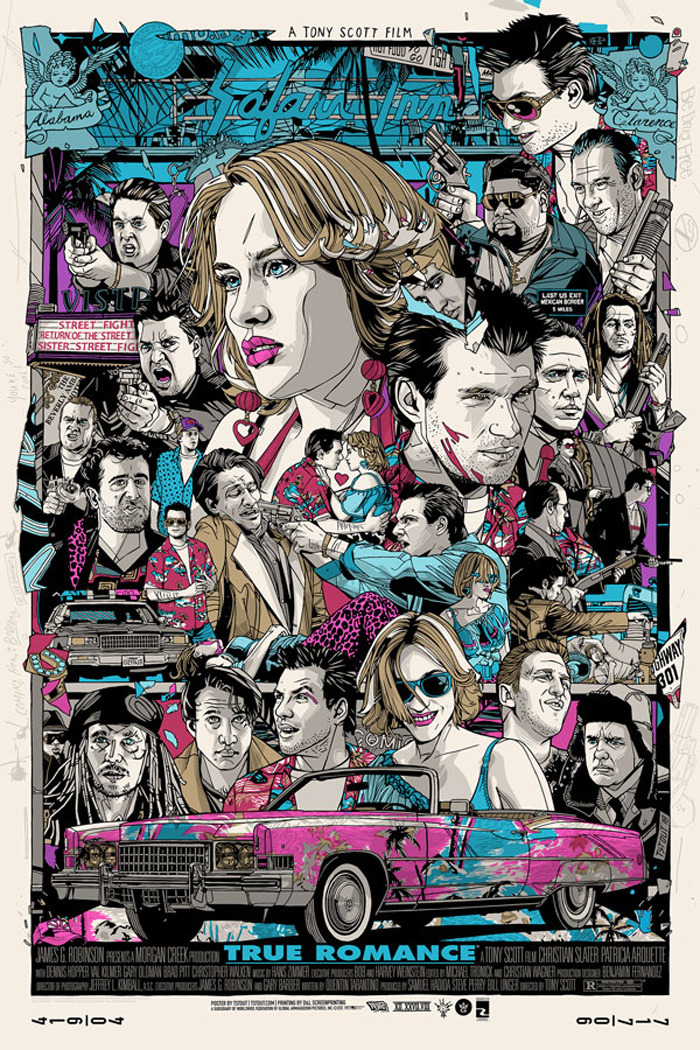
(Image credits: Only two posters at Imp Awards, so I was delighted to find the terrific Tyler Stout comic book style one at Slash Film and four more at Alternative Movie Posters, by a highly talented crew: Robert Sammelin, Matt Ryan Tobin, Gabz and Gabinet. In fact, the Robert Sammelin one is so cool that I made it the main image for this post. The Japanese one comes from L'Imagerie Gallery. Oh yes, and the James Rheem Davis slightly Warhol style one with the yellow background is from Inside the Rock Poster.)
 I had very low hopes for this Harley Quinn movie, because the first one was so bad...
Suicide Squad was just wretched. Which was odd, because its writer and director — David Ayer — is very talented indeed.
But Ayer specialises in war movies and cop dramas, at which he excels. The format of a successful comic book film apparently eluded him. Suicide Squad was an assembly line of pointless fights with anonymous monsters.
 The only good and memorable thing in it was Margot Robbie as Harley.
Now Robbie is back not just as the star but also the producer of Birds of Prey. And the new movie is, to borrow its own language, fantabulous. I was knocked out, and more than a little surprised.
 Margot Robbie is a big fan of Quentin Tarantino, and Tarantino's influence shows in Birds of Prey, which partakes of the primary-colour pop-culture ultraviolence and fractured timeline of his films such as Kill Bill.
And, unusually for a comic book movie, it has a genuine engine to drive its drama, in the aching injustice of the way women are treated by men.
 At first it looked like this film had stacked the deck by making its male characters two-dimensional caricatures (some might say it would be poetic justice if it had, and fair payback)...
But then Ewan McGregor's ludicrously camp portrayal of the bad guy suddenly began to work — when he shows Black Canary (Jurnee Smollett-Bell) his collection of shrunken heads — "Look at their little ears!" he enthuses.
 And Margot Robbie as Harley Quinn is a constant delight. When she's deprived of her post-hangover breakfast bacon and egg roll, we feel for her. "You killed my sandwich," she tells the cop who tackles her.
Soon it's payback time for the "pigs" — as Harley calls them — in the shape of a terrific and non-lethal attack that she mounts on a police station.
 Birds of Prey is, admittedly, basically a string of fight scenes. But they're really good fight scenes, and there's much more real emotion underpinning them than you normally get.
And that's not the only real emotion in the movie. The deprived lives of the characters are amusingly highlighted in a poignant gag whereby Cassandra (Ella Jay Basco) reveals that she actually thinks Wal Mart is a "fancy ass" store — and so does Harley.
 There's also a double betrayal at the heart of the movie that actually hurts.
None of which gets in the way of the fight scenes. The big climactic battle at the fun house near the end of the movie really works. It's not only a great location — eye popping pop-art sets courtesy of designer K.K. Barrett — but there's genuine force in the confrontation.
 Because it's women uniting against the men who have harmed them and oppressed them. And in case that sounds dull and worthy, it's anything but. It's great fun. ("Sexy and bullet proof," says Harley as she equips one of her comrades with a bullet proof vest.)
 A genuinely effective grand finale for a comic book movie is a tremendously rare thing. Even the otherwise perfect Wonder Woman failed at this — it had a dreary battle with an end of level monster for its climax.
But Birds of Prey succeeds absolutely. And it coasts down beautifully afterwards through some excellent smaller action scenes and some great character stuff — "You slippery fingered little turd," says Harley with admiration to Cassandra, the teenage pickpocket. Then later, as she buys margaritas for her crew, "You drink, right, kid?"
 There's even a touching moment when Harley's reunited with her pet hyena, Bruce. Plus she gets her breakfast sandwich after all.
Birds of Prey is written by Christina Hodson (Bumblebee) and directed by Cathy Yan.
With women writing, producing and directing, this distaff DC blockbuster really delivers the goods.
(Image credits: That's what we like to see. A choice of no less than 18 posters at Imp Awards.)
 Kristen Stewart is on a roll, and she's come a long way from the days of the Twilight movies — when her sulky persona was so hilariously lampooned in Vampires Suck.
Now, however, she's a genuine high voltage movie star and I've been knocked out by her ever since I saw Seberg, a terrific low profile film which was one of the finest of 2019.
Now she's back in Underwater, still sporting her short blonde hair — in fact it's even shorter — and looking gamine and great. Indeed, she's the main reason to watch this movie.
Underwater could have been terrific if it had followed what seemed to be its initial trajectory: a gritty account of an industrial disaster on a mining station at sea, like a kind of futuristic version of Deepwater Horizon — which was a memorable film.
 And maybe there was an early draft of the script where that was the idea. But pretty soon the monsters start turning up... and very un-frightening CG creations they prove to be.
 Although, in fairness, when the Big Bad arrives, it is actually pretty impressive. But not enough to save the movie.
The problem here is, we have quite an engaging cast of characters, with some fine actors, notably Stewart as the engineer and Vincent Cassel as the captain...
And the audience's sympathy is very much with them in their struggle to survive the collapse of their underwater station...
But once those rather routine monsters enter the story, it's hard to maintain much belief or engagement.
 The movie looks magnificent, with great production design. Although, as you can see, it couldn't have existed without Ridley Scott's Alien, still exerting an enormous influence 40 years on.
As a matter of fact, Underwater is a kind of sub-aquatic Alien, though without the devastating nemesis necessary to drive the plot.
 Still, Kirsten Stewart is supremely watchable and pretty much carries the entire film. We care about her even when the threat is dumb computer generated monsters.
The for Underwater script is by Brian Duffield, who worked on Jane Got a Gun, with a rewrite by Adam Cozad whose credits include Jack Ryan: Shadow Recruit.
It was directed by William Eubank who overdoes the murky, half-seen underwater menace. It's occasionally not clear what is going on.
 What is clear though, is that Kristen Stewart is a star to watch. And Underwater is worth watching, too, providing you go in with fairly low expectations.
Not quite seven miles deep, but fairly low...
(Image credits: Only three posters at Imp Awards. So I've supplemented then with some stills from Hollywood Life, and the French landscape poster from Scifi-Movies.)
 At first 1917 looks like it's going to be the finest movie about World War One since Stanley Kubrick's Paths of Glory. Indeed the smoothly tracking camera that follows our protagonists through the trench system is reminiscent of one of the most striking features of Kubrick's film.
But 1917 is a very different proposition. Whereas Paths of Glory was a political film, and indictment of the whole military system, 1917 is very much on the personal level, staying close to two ordinary soldiers, Blake and Schofield (Dean-Charles Chapman and George MacKay).
 And I do mean close, 1917 is designed to look like one continuous tracking shot depicting our heroes' harrowing adventures in real time as the two men race against the clock to save hundreds of their comrades who are walking into a trap.
1917 takes its cue from Christopher Nolan's Dunkirk, immersing the audience in a nightmare reality and tightening the screws. Thomas Newman's impressive music has a similar impact to Hans Zimmer's in Dunkirk and Lee Smith who edited 1917 also edited Dunkirk.
And while 1917 is doing its continuous-tracking, real-time thing it is absolutely gripping and looks like it's shaping up to be a masterpiece.
 But about halfway through the movie our hero is knocked unconscious and the screen goes black. When Schofield wakes up and the story resumes, the film has effectively come to a halt and needs to start again from scratch.
All the earlier momentum is squandered and the intense emotional engagement of the audience needs to be built up again. And it never really is...
 It doesn't help that the incidents in the second half of the movie are bizarre, far fetched and unconvincing in comparison to the riveting first half.
1917 is a good film, but it could have been a great film. It the story could have been designed so that it was all set in real time, and all shot like a continuous take, I believe it would have been an unforgettable masterpiece.
Even as it stands, though, I found it to be more human and moving than Dunkirk, with more engaging and memorable characters – Andrew Scott (the Priest from Fleabag) is particularly brilliant in the role of Lieutenant Leslie. The script is by the director Sam Mendes in collaboration with Krysty Wilson-Cairns, who worked on the TV show Penny Dreadful. It was inspired by the experiences of Mendes's grandfather.
(Image credits: a mere four posters available at the stalwart Imp Awards.)
 Knives Out is a sheer delight. It came out at the end of 2019 but I've only just caught up with it, so I'll be placing it among my favourite films of 2020.
Knives Out is written and directed by Rian Johnson. I've admired his work from his first feature, Brick, which was a Dashiell Hammett crime drama cleverly mutated into a high school movie.
 Since then Johnson has made the time travel thriller Looper, which I liked, and The Last Jedi, which I liked even more.
But I think Knives Out is his finest movie yet. It's an intricately plotted whodunit worthy of Agatha Christie.
 It's also a darkly funny comedy with some savage observations about the rich in America. It reminded me in many ways of Ready or Not, though there's no hint of the supernatural here, no whiff of brimstone.
 Knives Out tells the story of an ageing and fabulously wealthy patriarch, the wonderfully named Harlan Thrombey (Christopher Plummer), who dies under dubious circumstances after a family gathering.
 Harlan earned his fortune writing cunningly complex mystery novels and his apparent suicide soon reveals itself to be a murderous puzzle worthy of one of his books.
And there's no shortage of suspects... the Thrombey family is basically a nest of snakes.
 At the heart of the story is Marta Cabrera, Harlan's nurse and carer and one of the few people he likes and trusts.
Marta is played by the exquisite Ana de Armas, whom I last saw as Ryan Gosling's virtual girlfriend in Blade Runner 2049. She's a fabulous actress, with a great quality of warmth and empathy which she brings to her character here.
Which doesn't necessarily mean you should trust her... or anyone else in this lovingly convoluted plot.
 De Armas is Cuban, but it's a good question what nationality Marta is... in one of the running gags of the movie, all of the Thrombeys have a different notion of where she comes from. (Because they don't care enough to really find out.)
Among these wickedly amusingly and distinctly dubious characters comes a private detective, an eccentric genius again in the Agatha Christie tradition, a southern gentleman called Benoit Blanc, played with aplomb by Daniel Craig.
 And he's determined to find out what really happened on the night of Harlan Thrombey's death. What ensues is a beautiful series of twists and surprises, immaculately plotted by Rian Johnson, which will have you on the edge of the seat... where you will also do a lot of laughing.
 It's hard to say too much more about this joyful, ingenious romp without providing any spoilers, and I definitely don't want to do that...
But I will tell you that it features an hilarious car chase, and wonderful use of the Rolling Stones song Sweet Virginia in its closing moments.

Don't miss it.
(Image credits: A fine selection of posters at Imp Awards.)
 I am only now beginning to give Ira Levin's late novels the credit they're due.
One reason it's taken a while is because by this time Levin was such a consummate master of his craft.
His books are so beautifully and smoothly constructed, and make for such effortless reading, that there's a danger of underestimating their brilliance.
Published in 1997, Son of Rosemary is the final novel Ira Levin wrote — it's a great shame that he only ever gave us seven.
 (I
should say at this point that if you haven't read Rosemary's Baby you
should go away and do that before continuing here — this post is full of
spoilers.)
 Son of Rosemary is similar to Levin's penultimate novel Sliver (1991) in its focus on an older woman's involvement with a dangerously charming — and possibly just plain dangerous — younger man.
Except in this case the older woman is Rosemary from Rosemary's Baby and the young man is her demonic son, now grown to manhood.
 It's a short novel but it moves with a headlong velocity, starting with a brief passage in the present tense as a satanist dentist (yes, one of those) is killed — squished by a runaway taxi.
At that instant, and still on the first page of the novel, we cut to Rosemary awakening from a coma in a long-term care hospital.
 She has been released from a spell she was put under by the coven who engineered the conspiracy that ended with her becoming Satan's babymother.
The (fantastic and hilarious) ending of the first novel featured Rosemary coming to terms with this situation and turning into a doting mother of Andy, the devil's spawn.
 But the coven wanted her out of the way so they make sure the boy grew up evil. Hence the coma... which she has been in for 27 years.
This makes for a fantastically arresting and ingenious beginning for the sequel, with Rosemary's dawning horror as she realises how long she's been asleep.
 It's all beautifully and succinctly conveyed as Rosemary discovers that Andy has become a "charismatic leader and a great communicator."
Indeed, he's founded a kind of world religion. Andy seems kindly, compassionate, a bringer of peace...

Which causes Rosemary to reflect that, "Either she'd done a really super job of mothering during Andy's early years — or the coven had found a really super disguise for the son of Satan."
As the ferociously slick and streamlined story progresses, Andy reveals that he is not a good guy — and to her credit, Rosemary has been sceptical all along.
 The suspense, and the horror, grow until we reach the final sequence, Chapter 18 — or "6+6+6" as it is headed in the book — where the devil himself makes an appearance, sitting with his feet up and "eating caviar out of a pound tin with a spoon."
 The book is beautifully, economically, vividly written even its smallest details. Here's the description of champagne being poured into a glass: "the foam fizzed down into pale gold wine."
 And there's a wonderfully evocative sequence of Rosemary and Andy walking abroad in a snowbound New York without an entourage or bodyguards — like John Lennon and Yoko Ono.
This is a habit which of course proved tragically fatal for Lennon, and there's a scene in the book where Rosemary visits Lennon's memorial garden in Central Park — although I had no idea this is what it was until I read an explanation online.
 This is an example of Ira Levin leaving things unexplained because he wants the reader to do some work. He also includes a puzzle that runs throughout the book.
 This is a brain-breaker of an anagram: take "roast mules" and turn it into a common ten letter word that even children use.
I have to confess that I couldn't crack it. I ended up using the computer, and then kicked myself. I'd urge you to try and solve it without cheating...
The solution proves to be a brilliant metaphor for the dizzying ending of this unstoppably fabulous book.
(Image credits: a good selection of covers, some of them breathtakingly irrelevant, from Good Reads.)
 In a sense, True Romance is Quentin Tarantino's first movie.
 Nonetheless I was eager to watch this movie as part of my personal Quentin Tarantino film festival, prompted by an excellent new book about Tarantino.
 Scott is often dismissed as being a glitzy and superficial director, and indeed he is said to have given Tarantino's script a fairy tale gloss here...

 But there are other aspects of True Romance that make an immediate impact and linger vividly in the memory — the beauty of the cinematography by Jeffrey Kimball (Tony Scott movies always had virtuosic visuals). And the sheer quality of the cast.
 Of course we have Christian Slater and Arquette as the young lovers at the centre of the story, Clarence and Alabama.
 So Clarence and Alabama high tail it out of Detroit with the suitcase of coke, heading for their destiny in the golden west.
 And indeed, the best scene in the movie is in the Detroit section. It features Clarence's dad (Dennis Hopper) fearlessly — and ultimately fatally — facing down the mafia don played by Christopher Walken. (The don wants his coke back.)