Sunday, 24 November 2019

Midway by Wes Tooke

It's hard to get a movie like this right — a fact based war story with an epic scale which needs to balance thrills with historical accuracy. Just look at the terrible Pearl Harbour, directed by Michael Bay in 2001.

Midway covers similar material. It begins with the Japanese surprise attack on Pearl Harbour then, like the Michael Bay film, follows with the Doolittle raid — a revenge bombing attack by the US on Tokyo. (Is it wrong of me to note that Pearl Harbour was a military target but Tokyo was a civilian one?)

Midway, however, then progresses to the title incident, the Battle of Midway which I previously knew nothing about. The American navy sets a trap for the Japanese navy, luring them into an ambush near the Midway Islands and inflicting a major defeat on them.

So much for history — what is this film like? Well, it's really rather terrific. I was wary of it because it's directed by Roland Emmerich, whom I associate with empty, mindless spectacle (Godzilla, 10,000 BC).

But it turns out that he can also direct spectacle which is neither empty nor mindless. 
Midway is an admirable blend of large scale events and small human detail. It also does an impressive job of mixing explicit action with behind the scenes strategic planning and intelligence gathering.

All this is thanks to an excellent screenplay by Wes Tooke. With a track record in television drama, it's his first feature film script but I very much doubt it will be the last. This is an exceptional movie.

And perhaps the most unusual thing about Midway (and quite unexpected in a Roland Emmerich production) is the very refreshing strain of realism in the film. 

It really gets across how incredibly difficult it was to score a hit on your target — even a a target as big as a Japanese aircraft carrier — whether you're a submarine firing a torpedo or a dive bomber plunging nose first into a hellish maelstrom of anti-aircraft fire.

In fact, the film scores highly on authenticity throughout. Even some of the most outlandish incidents turn out to be historical fact — as discussed here.

In the end, though, one of the images that remains most strongly with me is the squadron of Japanese planes forlornly circling their destroyed ship like birds returning to find that their nest is gone...

(Image credits: a plenitude of posters at Imp Awards.)

Sunday, 17 November 2019

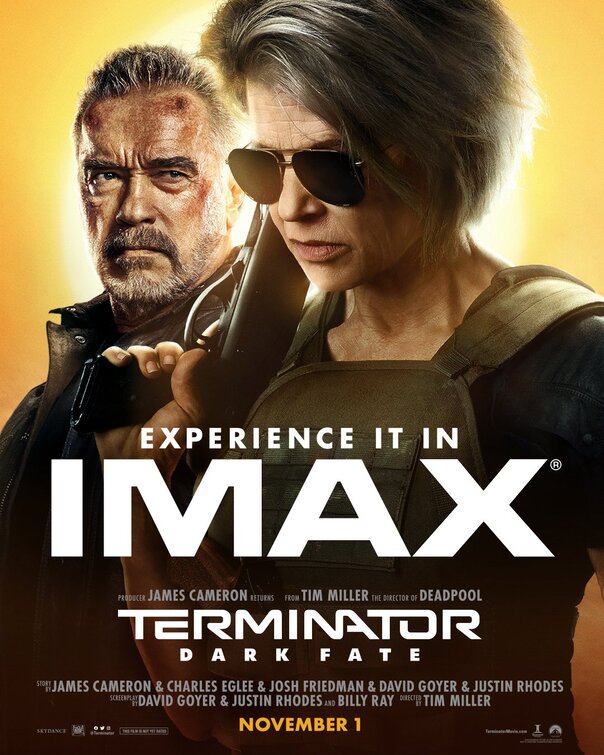
Terminator: Dark Fate by Goyer, Cameron et al

This new Terminator sequel is excellent, indeed the best since the first two movies, when James Cameron was supervising the franchise. Which shouldn't be a surprise, since Cameron is back on board, producing and writing an early draft of this film.

Dark Fate is immediately fresh and engaging, being set for a large part in Mexico and beginning in Mexico City (actually Madrid). It centres, as usual, on a killer robot sent from the future to assassinate a human being who is crucial to the fate of mankind.

In this case, the human is Dani (Natalia Reyes), a hardworking young woman who lives with her brother, her father and their dog Taco. Dani and her brother work on the assembly line at a car factory, where her brother has just been replaced by a robot ("The future," says a colleague) — a nice touch.

Meanwhile what appears to be a good terminator (like in the second film in the series) has been sent to protect Danni. I say "what appears" to be because Danni's protector is not a terminator at all, but actually a human being — like in the first film in the series. 

But in this case the protector has been augmented with technology as a kind of cyborg — thereby splitting the difference between the first two movies.

The cyborg is Grace, a young woman who arrives from the future, as is traditional in the series, with no clothes on. Causing the local Mexican cops to talk approvingly about "naked women who fall from the sky."

Grace is superbly played by McKenzie Davis, a Canadian actress who looks eerily like Armie Hammer's sister and who was also excellent in the role of Mariette in Blade Runner 2049. Mariette was a replicant, so let's hope Davis isn't going to be typecast.
 
In no time at all Dani's father and brother are dead and she is on the run with Grace doing her best to save her from the relentlessly pursuing REV-9 robot (an impressive Gabriel Luna).

Pretty soon, though, Grace herself needs saving, and in the nick of time we're treated to Linda Hamilton turning up, reprising her role as Sarah Connor.

The story then progresses around the adventures of these three women on the run. This strongly female slant also adds to the movie's freshness and it's altogether admirable.

Perhaps this should also be no surprise.

Because James Cameron has a laudable track record in presenting strong female characters. After all, he's the one who built the first Alien sequel around Ripley (Sigourney Weaver) and turned her into the first female action hero of blockbuster cinema.

With its Mexican setting, coyotes, a refugee train and interned migrants, Dark Fate develops like Sicario meets the Terminator. It has memorable characters and a fast moving plot which keeps ladling on the jeopardy.

It also keeps deftly blending the old and the new. After Sarah Connor turns up, quipping "I'll be back," we get Schwarzenegger himself, with a greying beard and a grizzled teddy bear look. It's kind of reassuring that his accent is still incomprehensible after all these years


Terminator: Dark Fate manages the difficult trick of both being great fun and, occasionally, deeply serious. 

It is a wholly satisfying film, and I left the cinema with that feeling you have when you've seen a good one.

I'm still worried about what happened to Taco the dog, though...

(Image credits: a healthy selection of posters at Imp Awards.)

Sunday, 10 November 2019

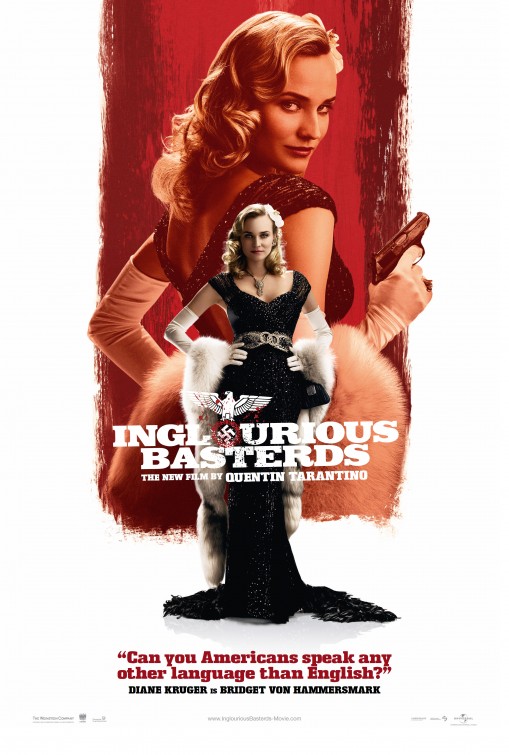
Inglourious Basterds by Quentin Tarantino

Quentin Tarantino's latest movie Once Upon a Time in Hollywood divided opinion — to say the least. But I really loved it. In fact, I loved it so much that it set me off on something of a Tarantino retrospective.

And this was my first stop. I saw Inglourious Basterds (yes, that is how it's spelled) on the big screen when it first appeared in 2009.

This was Quentin Tarantino's excursion into World War Two. Or his "guys on a mission" movie as he put it. And in my memory I had retained four things from the film... 

The excruciatingly suspenseful opening sequence in which a Nazi officer (Christoph Waltz) interviews a French farmer (Denis Ménochet) in his kitchen.

The wildly outrageous ending in which history is flagrantly — and rather hilariously — rewritten. (Something Tarantino would do again, to great and welcome effect in Once Upon a Time in Hollywood.)

And two episodes of truly unsettling violence. One involving a finger probing a wound and the other featuring a baseball bat.

In fact the baseball bat sequence was so brutal that it sort of turned me off this whole film and had caused me to downgrade it in my memory.

So it was very odd to watch the movie again and see how brief and fleeting that scene actually is. It had swollen to enormous proportions in my mind, but really it is hardly there at all... yet it had huge impact.

A disproportionate impact, since it caused me to underestimate this terrific, ferociously entertaining film which I now view as one of Tarantino's best. 

Among Inglourious Basterds' many virtues is the sheer speed and economy with which things are set up. 

We see Aldo Raine (Brad Pitt) telling a bunch of special recruits that they are going to be parachuted behind the lines in occupied France on a guerrilla mission to harass the Nazis.

And in the very next scene they are already there, well established, and their mission has been underway for some time.

Similarly, Archie Hicox (Michael Fassbender) is being briefed by top British brass (including Churchill) about his own espionage mission. And then, bang, we see him already linked up with Brad Pitt and his men in France and about to embark on a perilous rendezvous.

There then ensues another staggeringly suspenseful setpiece which culminates in tremendous violence. All admirably done and highly characteristic of Tarantino.

But in other ways Inglourious Basterds is distinctly different in his oeuvre, and indeed it's often overlooked when people are discussing his work. 

I recently heard a radio program where people were slagging Tarantino off for his supposedly stereotypical depiction of women — they're all hotpants-wearing bimbos, was the thrust of their commentary.

Which just isn't true. Or, rather, to build that case you need to ignore Inglourious Basterds for a start, which features a couple of powerful and unforgettable women, in the shape of Shosanna Dreyfus and Brigdet von Hammersmark

Classy and sophisticated heroines both, beautifully played by Mélanie Laurent and Diane Kruger, as a Jewish resistance fighter and a German film star respectively.

And they are balanced by a staggeringly evil villain in the twistedly charming Colonel Landa
perfectly brought to life by the great Christoph Waltz, who would go on to be tremendous again in another Tarantino movie, Django Unchained

Then there's the fantastic character of Fredrick Zoller, an engaging young German soldier who modulates from charming to monstrous, thanks to the considerable talent of Daniel Bruhl.

This is the first film I saw Bruhl in, and he's gone on to make his mark many times, notably in the fabulous Entebbe.

Inglourious Basterds is also a film which glories in film itself. It's no coincidence that much of the action, and the incendiary climax of this movie, takes place in a cinema.

It's also interesting to note how the film fits into Tarantino's body of work, looking ahead to Once upon a Time in Hollywood: one of the marketing slogans for Basterds was "Once upon a time in Nazi occupied France."

And at one point in the movie Pitt goes undercover by pretending to be a stuntman. Of course, in Once Upon a Time in Hollywood he is a stuntman.

What's more, both films feature villains who are so monstrous that fantastically vicious punishment can be meted out to them and the audience can watch with guilt-free pleasure.

Inglourious Basterds is a wonderful entertainment. In fact, it's a great war movie. Of course, it is utterly unrealistic — a complete fantasy — but that doesn't stop it being stupendously enjoyable. 

I have overcome my reservations about the brutality, but I do regret the body count, in the sense that the film is full of memorable characters and I wish more of them could have survived to the end credits.

You may think you don't like war films, or the work of Quentin Tarantino, but I would urge you to put your preconceptions on hold and give Inglourious Basterds a try.

You may want to look away when that baseball bat comes out, however.

(Image credits: a wealth of posters at the indispensable Imp Awards.)

Sunday, 3 November 2019

A Visit to Agatha Christie's The Mousetrap

 The Mousetrap is of course a murder mystery written for the stage by Agatha Christie. You knew that. And it is the most successful play in history (or stage production of any kind, I believe), having run continuously since 1952.

To illustrate this point in the foyer of the theatre there is a large sign with changeable numerals recording the number of performances of The Mousetrap that have taken place (well over 28,000).

I know all this because I went to see the play a couple of days ago. It was at the St Martin's Theatre, The Mousetrap's home for decades, but it wasn't the normal St. Martin's production that I saw, but rather a unique and different version.

Because, you see, I've been writing stage plays myself for years now, and as a result I've met a lot of very talented people, including an actor called Jamie Hutchins.

And Jamie Hutchins is appearing in a new Mousetrap production which is going on a tour of India this month (November 2019).

His company have been using the St Martin's Theatre for rehearsals. And this Friday they had a full dress rehearsal there — virtually indistinguishable from a full scale, finished production.

They invited an audience along to watch them perform. And I was lucky enough to be part of that audience. 

Which meant not only did we get to see a beautifully polished performance of this classic thriller, in the best seats in the house — we also had the privilege of a backstage tour afterwards...

We saw the fly tower with its mechanism for sending down a steady cascade of styrofoam pellets, to simulate snow falling outside a window with startling accuracy.

We saw the small room where actors had more of these styrofoam pellets scattered on their costumes, so they could make an entrance as if racing into the sanctuary of Monkswell* Manor guest house from a fierce blizzard.

We saw the long table with painted squares for each vital prop to reside in, ready to be deployed, like the newspaper reporting the murder which sets the story in motion. 

(There is also a gun, which is an especially crucial prop, and that has a place all its own, ready to be grabbed by the killer before they come on stage for the climax.)

And there was also this big, odd looking apparatus consisting of a cylinder of canvas lying on its side with a handle on it. When you turn it, it creates the whooshing sound of the eerie wind that persists throughout the play.


One of our party (not me) reached out to crank that handle, causing a stage technician to come running and intervene. "If you turn it the wrong way, all the damned canvas unwinds."

But we didn't just go backstage but also on stage. It was an extraordinary feeling to be standing in the set where the drama had just taken place, looking out at the seats of the theatre, past the dazzle of the lights.

On the mantelpiece of the set there's a clock which, like that canvas wind machine, has been doing service in this play since the very first performance. Thinking about the history associated with these objects is almost dizzying.

It was an extraordinary privilege to see this great play so beautifully performed, and then to cross over from the audience's point of view to that of the actors'.


On my way home on a dark, damp autumn evening, walking down grey pavements strewn with yellow leaves, I paused by the statue of Agatha Christie on Cranbourn Street and silently thanked her.

(Thanks too to Jamie, for making this happen. He is seen here (in the leather jacket) with me and his charming girlfriend Meena Begum on the set. My gratitude also to the multifariously gifted Conrad Blakemore for taking these photos. The other images are scans of the St Martin's Theatre flyer and a photograph of the Agatha Christie memorial, sculpted by Ben Twiston-Davies, taken from Bronze Age London. *The misspelling on the guest house sign is deliberate, a bit of comic business in the play.)

Sunday, 27 October 2019

A Fistful of Dollars by Leone, Catena, Gil et al

There was a remarkably prescient review in the show business newspaper Variety when this Sergio Leone western came out.

The reviewer not only recognising that it was something special, but also drew some very perceptive parallels with the James Bond films, which were still new on the scene.

I've just watched a Blu-ray of A Fistful of Dollars, complete with an excellent documentary track and featurette by Leone scholar Christopher Frayling, which takes note of those parallels...

From the violent, colourful graphics of the title sequence, through the unforgettable electric-guitar based score to the hip and cynical central character.

A Fistful of Dollars arrived like an earthquake and was a milestone in the history of popular cinema.

It's also a very low budget film, shot on an existing set of a Western street in Spain. The environment depicted is virtually a ghost town — not just because there's been so much killing in the backstory, but because the producers couldn't afford any extras.

I first saw this movie when I was a kid and I thought I remembered nothing about it, but I was surprised by how much came back to me and how quickly — like Eastwood's remark to the coffin maker, "My mistake, four," after he guns down some bad guys.

What I definitely hadn't forgotten though, was how the film was based on Dashiell Hammett's novel Red Harvest by way of Kurosawa's film Yojimbo.

In other words, A Fistful of Dollars rips off Yojimbo without credit and Yojimbo rips off Hammett without credit. (Maybe that's why there's no screenwriters named during the credit sequence on A Fistful of Dollars.)

Essentially this is a story about a smart, ruthless outsider who comes into a corrupt town and plays off the factions of bad guys against each other. In Hammett's original — and no one disputes that he originated the story — the outsider is a detective, the Continental Op.

In Kurosawa's film that figure is a samurai, in Leone's a gunfighter.

It's a testament to the strength of Hammett's concept that it works so well in these very different contexts.

It's also interesting to note that Dashiell Hammett never gave the Continental Op an actual name. Just like Eastwood's Man with No Name.

Despite its larcenous origins and its breadline budget, Fistful is a forceful and revolutionary film. Leone's direction, with its gigantic close ups and casual violence was something altogether new.

But the unsung hero of the movie is Carlo Simi, the production designer. His contribution to the film's visuals is considerable. (That dandelion fluff floating around in one scene was his idea. As were the windblown dead leaves in another.) Simi was also responsible for creating both the sets and the costumes — notably Eastwood's iconic poncho.

In this humble garment, never before worn by a Western hero, Eastwood has tremendous screen presence from the very first shot. He looks young, but haggard. And his stubble is again something entirely new.

Before this, the bad guys had stubble and the good guys were clean shaven.

Enio Morricone's music deftly shapes and punctuates the anecdotes of the film, brutal or funny. It's terrific and the fact that Morricone's name is hidden under a ridiculous pseudonym on the Blu-ray print is, I think, disgraceful.

Like the score, Clint Eastwood has a tremendous impact. He says very little, apparently having requested extensive cuts in the dialogue, but he's charismatic — and entirely convincing in the scene where he's beaten to a pulp. (One of the few other bits of the movie that I remembered.)

Eastwood in his poncho and Morricone's music add up to a fantastic blend, especially in the final confrontation when he comes walking out of a wall of smoke. And in this scene the poncho actually becomes a plot point, concealing a primitive bulletproof vest.

This movie is by no means perfect. It occasionally drags. Some of the story is ridiculous (no one would be fooled by those dead soldiers in the cemetery), there are often silly sound effects and laughable dubbing. But...

A Fistful of Dollars is unquestionably a classic. It changed the rules of the game and began a remarkable sequence of Sergio Leone westerns which would culminate in Once Upon a Time in the West.

(Image credits: More wonderful posters from the excellent site Movie Poster Shop. If I had the wall space I would be buying crazy amounts of these.)

Sunday, 20 October 2019

Straight Life by Art Pepper & Laurie Pepper

Harrowing and engrossing in equal measure, Straight Life tells the life story of Art Pepper, accurately described by Freddie Hubbard in the last pages of the book as "the greatest alto saxophone player in the world."

It's Pepper's virtuosic gift for music — he plays like an angel — which makes Straight Life worth reading. It's his ineradicable tendency for self destruction which makes it so hard to read. 

Art Pepper was a junkie — primarily heroin, but he was so addictive that almost any substance would do. As a result, he spent a huge portion of his career behind bars instead of making the priceless music which would have uplifted us all.

If you want to see what that life did to Pepper physically (though, miraculously, it didn't affect the music), just compare the cover photos of the handsome young man with the exhumed-corpse of later years.

Probably the dominant feeling I had, reading this book, is anger at a legal system which destroys someone just because they use a chemical to make themselves feel good. Is that really a criminal act?

Incidentally, I channelled some of this anger into my novel Written in Dead Wax, where my descriptions of the way the LA narcotics cops persecute jazz musicians was based on my readings about Art Pepper, Chet Baker and Gerry Mulligan.

We have Art Pepper's third wife, Laurie, to thank for this classic book. She constructed it from taped interviews with Art and other important figures in his life. 

Laurie also writes really well herself, as when she describes her husband on tour as being "droopily unhappy and unhelpful as a small child."

She had no illusions about Art, but loved him all the same, and that is what makes this book so superb. It does require the occasional reality check, though, since it so powerfully replicates the tunnel vision of its subject.

For instance, Art is amusingly scathing about his second wife Diane, often for good reason. She got him sent to prison, for a start. 

And the way he talks about her is bitterly hilarious. Describing his struggle with drugs, and comparing her with his beloved first wife, he says   “When I was with Patti I was using, so I certainly wasn’t going to stop for Diane.”

And the reader completely buys into this — until we realise that without Diane, his greatest album Art Pepper Meets the Rhythm Section would never have been recorded.

If you read Straight Life, and I urge you to do so, make sure you get one of the later printings which features not just the original text but also a useful introduction by Gary Giddins, and an absolutely priceless afterword by Laurie.

The book is peppered (sorry) with fascinating observations about music, like Art's comparison of Stan Kenton and Duke Ellington (they both "wrote for the individuals in the band instead of writing charts just with an anonymous band in mind").

Or how, when he sold his saxophones to pay for drugs he would still retain the mouthpiece because “with your own mouthpiece you have half the battle won”.

But because of Pepper's tormented life, this book is as relevant to anyone who wants to know about the penal system in America as it is to music lovers.

(Image credits: book covers from Good Reads. The LP cover of Rhythm Section — the first British issue of the album — is from the magnificent blog of my friend the London Jazz Collector.)