skip to main |
skip to sidebar
 Kingsley Amis was one of the most gifted of British novelists and he remains a firm favourite of mine. His career began with the resounding success of the riotous Lucky Jim in 1954.
Ending Up comes from 20 years later and has a very different mood to it. Lucky Jim was bright, optimistic, fizzing with energy and all about beginnings — setting off on the adventure of adult life.
As the title suggests, Ending Up is at the other end of things. It's about a collection of oldsters (a classic Amis term) who share a rather shambolic house called Tuppenny-hapenny Cottage where they are going to finish their confused, cantankerous, careworn days together.
 This may sound like boring or depressing material but in fact the book is addictively, effortlessly readable and grips like a thriller.
In his excellent biography of Amis, Zachary Leader accurately describes Ending Up as "a feast of malice and ill humour, one of the best and most artfully constructed of Amis's novels."
Leader also has some interesting things to say about the real world sources of Amis's fictional characters in this book, such as his mother-in-law Kit Howard, an unlikable woman if ever there was one. Amis described walking past her room as "shooting the rapids" — like everyone else, he was scared of being called inside.
Amis was living in a house in Hertfordshire with Kit, his wife Jane, her brother Colin, and the painter Sargy Mann. At one point Jane idly wondered what it would be like if they all stayed there and grew old together... Kingsley Amis took note of the idea and Ending Up was conceived.
 And very carefully conceived, too. Amis devised a meticulous plan for his story. which included 45 "ways to be annoying," all of which appear in the novel. He also drew floorplans of Tupenny-hapenny cottage and sketched a rudimentary timeline.
But it's in his carefully drawn characters where Amis really excels. Some of them are indeed annoying, but his central figure Bernard is pure evil.
I suppose you could merely say he's a complete bastard, but I think that fatally understates the case. Bernard lives to torment the other inhabitants of the house. He is terminally ill, and knows it, but this in no way excuses his behaviour or softens the reader's attitude to him. (At least, not this reader's.)
 So it is a tribute to Amis's considerable talent that he actually makes us feel sympathy for Bernard towards the end of the book.
But this emotional reaction was nothing compared to my utter delight when one of his evil schemes was thwarted. (Bernard was trying to deprive George, a bedridden invalid, of the beloved dog who keeps him company. I told you he was pure evil.)
Oddly, it is Marigold who foils George. I say oddly because Marigold, who was based on Kit Howard, is a dotty old racists with her own bizarre idiom (she refers to "blacks" — black people — as "blackle packles", for instance).
The other denizens of the house are the brave and resourceful George, felled by a stroke and struggling to overcome it; the alcoholic but likable Shorty and the hardworking, unappreciated and unloved Adela (a cruelly reimagined version of Amis's then wife, the distinguished novelist Elizabeth Jane Howard).
 Adela is Bernard's sister and he is particularly nasty where she's concerned: "He limped off to the kitchen in confident hope of an opportunity to ridicule and distress her."
In case this suggests that the book is a downer and too negative, let me quickly reassure you. It's actually hilarious, full of classic Amis moments:
"Eighteenth-century timber-frame was what she called the style of the house when asked, and sometimes when not."
"Outside the sun was shining on various items of vegetation."
" 'Yes,' said Tracy. She thought for a moment and added, 'Yes.' "
And then there's Tracy's horror at the thought of old people "fucking like a stoat at over seventy"...
 In his valuable introduction to the New York Review Books edition, Craig Dickson describes how "Throughout his oeuvre, irritation plays on the Amis landscape like sun on sea."
There's much more here than irritation here, though, or even brilliant comedy.
The ending of the book is a breathtakingly succinct multiple tragedy in which Amis dispatches his characters in a few short pages as if a savagely avenging fate had come calling for them.
This terse, dark, hilarious little book is a masterpiece.
(I've also posted about these other novels by Kingsley Amis: That Uncertain Feeling, I Like it Here, Take a Girl Like You and The Anti-Death League.)
(Image credits: The cover of the New York Review Books edition is my scan of my own copy. The other covers — including the Czech language one featuring an image of Amis himself — are from Good Reads. Thank you, Good Reads.)
 Well, this was a complete surprise... I only went to see the movie because (a) it was on at the right time to fit in with something else and (b) it was ending its run yesterday.
And also, and I suppose crucially, because I'm always up for a horror film, in the vain hope that it might be a good one. And this was.
Basically it's Groundhog Day re-purposed as a slasher movie. Every morning our heroine Tree Gelbman (played by Jessica Rothe) wakes up and lives through the same day, which culminates in her being killed by a masked assailant.
 She has to work out who her killer is, and thereby break the time-loop and resume her life. This is a perfectly workable premise for a horror movie, indeed it's a pretty nifty one. It's only demerit is that it's such a clear ripoff of Groundhog Day.
But it gets around this, and garners lots of brownie points, by openly acknowledging the influence ("You've never seen Groundhog Day?").
 I also really liked it because it has a story twist which was both unexpected and satisfying — tying up a bunch of loose-ends in the plot which I thought they were going to leave dangling.
Jessica Rothe is terrific. At first I didn't like her, but I was just making the rookie error of confusing the actress with the character she played. Tree Gelman is very unlikable, and Rothe does a great job of making this believable.
But as Tree's plight continues, her behaviour changes, and we warm to her — and Rothe gets to demonstrate the range of her talent.

The movie is written by Scott Lobdell who has a background in scripting Marvel comics, and TV animation series. He's done an excellent job here as has the director, Christopher Landon, who's done a lot of work (as a writer as well as a director) on the Paranormal Activity series.
These guys have come up with a very clever device: the movie is set at Bayview University (actually Loyola, New Orleans) and the football team is called the "Bayview Babies" and fans wear these cartoon baby-face masks.
The killer adopts one of these, and it's mega-creepy.
 The movie has its flaws. I mean, it's set in America, so all Tree has to do to defeat her killer is go down to the nearest gun shop and buy an assault rifle with her credit card and blow him to hell... but I'm willing to suspend my disbelief here.
Because it's an imaginative, fun little movie. And it has the best title sequence I've seen in a long time (which plays at the end of the film).
If you're a fan of horror movies, especially ones with an element of comedy, then I think you'll enjoy this. I'm only sorry I didn't see it in time to recommend it for Halloween.
 (Image credits: Not a happy day at Imp Awards, where I could only find two posters, the birthday cake and the baby mask with the cupcake and candle. So I had to ransack IMDB for the excellent black and white portrait of Jessica Rothe by Jan-Willem Dikkers. And then I found the rather nice comic-art style poster by Matt Robot is from Poster Spy. The nice knife = candle one by Alex CPS is also from Poster Spy. I think both these Poster Spy efforts are better than the official one. The DVD cover, which I think is also unofficial is from Cover City.)
 I've heard a number of interviews with Jo Nesbø and he's a smart, funny guy and clearly very talented. Having had one successful career as a rock musician, he commenced another one as a massively bestselling novelist.
But (and you knew there was a but coming...) I read his novel The Snowman and felt I'd wasted my time. The book features Harry Hole, a cliché embittered alcoholic cop with a trail of broken relationships, and pits him against a cliché sub-Thomas Harris serial killer.
I remember thinking that if I was going to read police procedurals I would have been a lot better off working my way through the writing of George Simenon, who is a genuine artist.
 But poor novels often make excellent movies. And when I learned that The Snowman was to be directed by Tomas Alfredson, I had high hopes. Alfredson made Tinker Tailor Soldier Spy, one of my favourite films of all time.
And he is an extraordinary film maker, attacking every scene with the intention of deepening its emotional impact and its meaning and elevating it to art. Alfredson clearly cares profoundly about creating real characters and a unique atmosphere to his films, instilling every shot with poetry.
But here his talent is utterly wasted. The movie looks great, with ravishing photography by Dion Beebe (Edge of Tomorrow), superbly effective music by Marco Beltrami and a fresh and interesting cast led by Michael Fassbender, looking great but smoking rather too much as Harry Hole.
 But the problem is the script. The team of writers here is impressive, too. It's led by Peter Straughan who worked on Tinker, Tailor and recently adapted Hilary Mantel's Wolf Hall for BBC Television. Also involved was Hossein Amini who recently did a fine job on Our Kind of Traitor (another John le Carré adaptation), and Søren Sveistrup, who created the Nordic noir classic TV serial The Killing.
So, a talented team. And they have radically altered the original novel, in much the same way that Scott Frank altered Lawrence Block's Walk Among the Tombstones — and with equally little success.
The story is now often quite different from the book. It's bloody complicated, but it still doesn't work. And there are some ridiculous failings in the script. For a start, Harry is ineffectual and unlikable.
And we're supposed to be emotionally invested in — wait for it — Harry's ex-girlfriend's teenage son. Seriously.
 The movie puts this kid into peril and expects us to be on the edge of our seats. But there's worse to come...
At the very end of the film the bad guy is dealt with in a deus ex machina fashion — he falls through thin ice into a freezing lake, while our hero looks helplessly on.
Come on chaps — this violates one of the cardinal commandments of screenwriting: "Thou shalt not take the resolution out of the hands of your hero."
Before that there's a final fight between Harry and the bad guy, the latter wielding a kind of electronic garrotte device which has to be the least useful and least frightening weapon ever devised for close quarters combat.
 And here Alfredson has to take some of the blame, too, because this fight is so confusingly shot that we have no idea that Harry gets his finger chopped off, presumably by the silly garrotte machine.
This is only made clear in a coda in which, ridiculously, Harry is seen tapping a coffee cup with his new metal finger as he volunteers for a new case against another harrowing psycho killer.
But don't worry. That sequel won't be coming your way any time soon.
(Image credits: not exactly a blizzard of posters, courtesy of Imp Awards.)
 Ah, now... this is one of my all time favourite John D. MacDonald novels and if you're thinking of dipping into the master's work, it's an excellent starting point.
It's a murder mystery, but a vividly different one. In its device of an insurance investigator for a hero it recalls The Brass Cupcake, although in this case our hero, Paul Stanial, is a private eye using the ruse of an insurance investigation to cover his real task.
He has been hired by the sister of a woman, Lucille Hanson, who drowned under mysterious circumstances. The description of the drowned Lucille has eerie echoes of All These Condemned.
 And the sequence where her drowning is recounted from a god's-eye point of view is reminiscent of a scene in Hannibal by Thomas Harris where the reader is invited to creep into Hannibal's lair and observe the monster at rest...
But Lucille's sister isn't buying the notion of accidental death, and she's right not to...
So she hires Stanial to find out what really happened at that isolated lake on a hot, silent afternoon.
MacDonald expertly evokes the "noontime simmer of May in Florida" outdoors and the "cold clinical breath of the air-conditioning" inside. Later the sound of the air conditioning in his motel makes our hero "feel as if the room were in transit, on some strange vehicle moving steadily through the night."
 It's in his characterisation where MacDonald really scores, though. Lucille's lover (and a suspect in her murder) Sam Kimber, is one of his finest creations. He's a ruthless man who's grown rich from dodgy land deals and has good reason to grin with a "wicked amiability."
And then there's Shirley
Feldman the university student, all of 19 years old, who is sleeping with Lucille's ex-husband. She is a great
character, vain and pretentious: "Does it sound too impossible for me to say I have a much
better mind?"
 Or Betty Schaud, a secretary, who has "all the social charm of the attendant in the gas chamber."
Or Kelsey Hanson, Lucille's lunk of an ex husband who "made love as if he was trying to get a berth on the olympic team."
But most of all, the villain of the piece, Angie Powell is a fabulous invention. (We learn quite early on that Angie is the killer, and move from mystery to suspense, so this isn't a spoiler.)
Angie is a gorgeous young woman, "a wide screen projection of a girl." Healthy, smart, athletic and hard working she's a fixture in her local bowling team and a regular church goer.
 She's also a monster, created by the horrific abuse wreaked upon her in childhood by her religious fanatic of a mother — who, in fairness, is the real monster, I guess. But it's Angie who kills, and then kills again and again, to cover her tracks.
Angie is an amazing creation. And I strongly suspect that she and her hideous mother were the direct inspiration for Carrie White and her horrid mom in Stephen King's Carrie.
In praising MacDonald's characterisation so extensively I don't want to suggest there's any weakness in the plotting or the narrative here. The novel moves with impressive and startling swiftness — making adroit and extensive use of dialogue (and correspondence) to tell the story.
I
love the way MacDonald relates his tale through a variety of techniques, from a
multiplicity of viewpoints. (Don't try this at home unless you're a very
skilled, experienced or gifted writer.)
 I really can't fully convey how terrific a novel this is without revealing so much that I'll spoil the experience of reading it. So instead I'll just urge you to do that — read it.
And end on the sobering observation that John D. MacDonald wrote dozens of such books, in the form of disposable mass market paperbacks. And that the creation of such agreeably compact masterpieces of popular fiction seem to be a lost art form.
(Image credits: The Cosmopolitan magazine cover (featuring the original serialisation of the novel) is from the wittily named Ephemera Forever. The book covers are from Good Reads.)
 Okay, I feel I owe you an apology. Because here I am again writing about another silly Marvel comic book movie. Believe me, I didn't want to...
But the damned things have been so good lately. The film makers have hit a sweet spot balancing humour and thrills.
And the result is a long run of Marvel adaptations which have been fresh and imaginative (Doctor Strange, Guardians of the Galaxy Vol. 2 and Spiderman: Homecoming have been three recent examples).
 And Thor: Ragnarok is no exception. As a matter of fact it won me over almost completely in just the first few moments. Because it's funny. Genuinely, richly, warmly funny.
Which is not to say it fails to deliver on thrills, suspense and occasionally very dark happenings. But humour is always an option, whether an evil superbeing has his big speech undercut by misbehaving equipment or the God of Thunder is ticked off because people keep getting his title wrong.
 Since I'm a writer myself this blog tends to be writer-centric. But due credit must be given here to the director of Thor: Ragnarok, one Taika Waititi, a New Zealander who was responsible for a very amusing 2014 faux-documentary about vampires (with a few werewolves thrown in) called What We Do in the Shadows.
No doubt Waititi's knack for comedy is a major reason that the new Thor movie is so good. But we should also acknowledge the three credited writers — Eric Pearson who worked on the Agent Carter TV show and Craig Kyle and Christopher Yost who co-created the animated Iron Man: Armoured Adventures TV series. Yost was also one of the writers credited on the second Thor movie, The Dark World.
 Where Thor: Ragnarok really scores, though, is in its fine cast. Chris Hemsworth as Thor and Tom Hiddleston as Loki have already established their value. But this time around they are joined by an eccentric Jeff Goldblum as the Grandmaster, who provides a lot of the movie's fun.
But it is Tessa Thompson (last seen by me in Veronica Mars) who really delights as a drunken Valkyrie, who is so soused that she falls over when she makes her grand entrance. Mark Ruffalo — when he's not a big green Hulk — is charmingly smitten with her, and one can only sympathise.
 Balancing the comedy is Cate Blanchett who as Hela pulls off the difficult task of making an evil super villain effective instead of silly. She is chillingly weird and dangerous, with just a subtle hint of humour.
So there you have it. Another Marvel movie which is well worth a look. My only complaint is that we never got to see Hela ride her giant Fenris wolf.
(Image credits: the posters are from Imp Awards, where Tessa Thompson as the Valkyrie is disappointingly under-represented.)
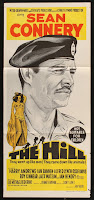
 This is a movie I remember seeing when I was a kid, and which I was delighted to find on DVD. It was Sean Connery's first attempt to break away from his James Bond persona.
And it was successful enough to get screened at the Cannes Film Festival. That recognition was well deserved. Connery is very impressive in it — indeed, The Hill is impressive all around.

It's an uncompromising story of brutality and the struggle for dominance in a British prison camp in North Africa in World War 2.
Now, there's no shortage of prisoner of war movies, but The Hill is unique as far as I know in depicting a punishment camp, i.e. a camp run by British soldiers for other British soldiers who have transgressed in some fashion.

The Hill of the title is a structure which has been deliberately built in the middle of the parade ground to provide a gruelling ordeal for the prisoners who are marched up and down it under the blazing desert sun.
The film is shot in beautifully gritty black and white by Oswald Morris using an amazingly mobile camera. Morris worked extensively with John Huston, shot Lolita for Stanley Kubrick and won a BAFTA for his work on The Hill.
The film is written by Ray Rigby won both the Cannes Film Festival Award and the Writers' Guild Award for his script and was further nominated for a BAFTA (he lost to Frederick Raphael for Darling).
 The film is credited as being based on a stage play by Ray Rigby and some chap called R.S. Allen. This is all a bit mysterious because Rigby was a British TV writer with extensive credits, including the very first episode of the original black & white Avengers.
Rigby gets sole screenplay credit on the movie, wrote an excellent novel based on the same material and actually spent time in field punishment detention centres which provided him with the experience to write such a convincing and powerful drama.

Which leaves us with the question, who the hell is R.S. Allen? According to IMDB and Wikipedia, he's an American who wrote TV shows like The Flintstones.
Now, it's not impossible that this is the guy in question, but I think it's more likely it's a further example of the internet thinking two people with the same, or similar, names are the same person. (I am often said to be Andrew Cartmell. I am not. He's a perfectly nice fellow and very talented. But I am not him.)

So, without airbrushing R.S. Allen out of history, let's celebrate the work of Ray Rigby. And also Sidney Lumet, a very talented American who does a wonderful job of directing this film.
The Hill was shot in the Spanish desert in Andalucía, which provides a very convincing substitute for North Africa. And the cast is impeccable. They all deserve praise...
 But I'm going to single out Ossie Davis, a distinguished African American actor (he also directed Cotton Comes to Harlem, the father of all Blaxploitation movies). In The Hill he does a very creditable job of portraying a West Indian soldier, convincing accent and all.
This movie still packs quite a punch today, with its depiction of cruelty and savagery in a military institution and the abrupt, remorseless ending is a knockout.
 It's a reminder of a time when movies had achieved a maturity which often seems lost in our current era of comic book blockbusters.
(Image credits: The vertical yellow poster is from Imp Awards. The horizontal black and white poster is from Ian Hendry official tribute site. The hilarious Australian poster featuring an almost totally irrelevant belly dancer is also from there. The horizontal red poster is from YouTube. The green vertical poster is from Ice Poster. The red vertical ditto. The DVD cover is from Amazon. The horizontal yellow poster is from Sombrero Books, also linked above, which has a very useful article about Ray Rigby. Thanks guys.)
 What a relief to report that this long awaited sequel — which could so easily have been a disaster — is terrific. You should rush to see it on the best screen available, and I do mean, rush, for reasons we will get to...
Discussing the origins of the new film in a Radio 4 interview, Ridley Scott modestly declares "I'm fundamentally the whole basis of the idea." These are words to fill one with dread. Because, however great a director he might be, Scott is a notorious destroyer of scripts.
However, in this case we owe him enormous thanks. Because, having had his fundamental, whole and basic idea, he was then responsible for hiring Hampton Fancher to write the film.
 Fancher is the man responsible for bringing Blade Runner to the screen in the first place, back in 1982. He optioned the Philip K. Dick novel and wrote a fascinating and vivid script. Later rewrites were done on the 1982 version by David Peoples, another superb writer, and the result was the original movie we love today.
This time around, according to Scott, Hampton Fancher wrote a 100 page novella which was the essence of the new movie and then a writer called Michael Green (Smallville, Logan) came in to develop it into a script.
 Judging by the final credits, though, Fancher then came back and rewrote Green. But however the process worked, the results are outstanding. And at least Philip K. Dick
gets a decent screen credit this time, instead of having his name buried
in the fine print at the end of the film (as was the case,
reprehensibly, in the original Blade Runner).
Meanwhile Ridley Scott was too busy to direct the movie — he was preoccupied with creating the awful Alien: Covenant — and so Denis Villeneuve was hired. Which is great news.
 Villeneuve is a wondrous director, and he was responsible for the drug thriller Sicario — one of my favourite movies of all time — and Arrival, a thoughtful and impressive science fiction film.
Villeneuve is a Canadian. As, oddly enough, is Ryan Gosling, who does a superb job in a similar role to Harrison Ford in the original.
 Indeed, Gosling has an odd and very effective resemblance to Ford. There are similar — and eerie — echoes with other members of the cast, notably the excellent Mackenzie Davis (another Canadian) who, in the role of the replicant "pleasure model" Mariette, strongly recalls Daryl Hannah as Pris in the original.
Gosling's portrayal of 'K' is really quite moving. The nameless K is a Blade Runner and a replicant and he is despised for being both these things. The one ray of light in his life is his 'girlfriend' Joi (Ana de Armas). But she is just a piece of software...
 The movie has been taken to task for Joi: she's said to be a typical piece of male wish fulfilment and objectification of women. But I read her character very differently.
K's life is desperately empty and meaningless. The fact that Joi is the only good thing in it — and she doesn't even exist — makes him a genuinely tragic figure.
 The cast is impeccable. Robin Wright plays K's ruthless, predatory boss. And Barkhad Abdi, who showed immense star power as a Somali pirate in Captain Philips, here provides a delightful, brief appearance as the wonderfully named Dr Badger.
Sylvia Hoeks plays an unforgetably deadly female replicant called Luv, and has a truly wonderful scene — and the best line in the film — when she saves K's ass while having her fingernails painted. She unleashes a remote drone strike on a bunch of assailants and, as a shaken K struggles to get back on his feet, she mutters disgustedly, "Just do your fucking job."
 And of course, it's no spoiler to tell you that Harrison Ford himself is back to do an agreeable reprise of his role as Deckard. He also has a very nice dog (I can't find the dog's name to credit) who likes to drink whiskey...
Jared Leto, however, is wasted as Niander Wallace, an all powerful billionaire who runs a business which is the equivalent of the Tyrell Corporation in the original. He has a couple of dull and pretentious scenes where he yacks on about how godlike he is.
 I suspect these scenes were Ridley Scott's big contribution to the movie. Because they are virtually identical to dull and pretentious scenes with godlike billionaires in the last couple of Alien pictures.
For some reason Scott has an obsession about this.
But this isn't Ridley Scott's film, it's Denis Villeneuve's, and Scott is to be congratulated for giving Villeneuve the freedom to do it in his own way.
Denis Villeneuve is a visionary film maker and he really delivers the goods here. He has some fascinating observations on the process of making Blade Runner 2049, and you can hear them in that same radio interview.
 For one thing, he makes the interesting point that in the the 1982 movie Ridley Scott reimagined Los Angeles as a kind of London — grey and pouring with rain.
And so Villeneuve has created a futuristic LA based on his native Montreal — desolate and covered with snow.
The visuals in the movie are utterly extraordinary. It's photographed by Villeneuve's regular cinematographer Roger Deakins and the "visual futurist" Syd Mead, who was responsible for so much of the look of the first film, is back again helping with the design.
 It's a long film — very nearly three hours — and although I balk at this kind of duration, I wouldn't say that this movie is ever actually slow. When it's not giving us action, it's providing thought provoking, and sometimes heart breaking moments.
Utterly wonderful stuff. But I have to warn you, both times I've seen it so far has been in a virtually empty cinema.
So you should hurry to see it on the big screen. Because it looks like Blade Runner 2049 is not a hit... But then neither was the original.
(Image credits: more posters than you can shake a replicant at, at Imp Awards.)
 Kingsley Amis was one of the most gifted of British novelists and he remains a firm favourite of mine. His career began with the resounding success of the riotous Lucky Jim in 1954.
 This may sound like boring or depressing material but in fact the book is addictively, effortlessly readable and grips like a thriller.
 And very carefully conceived, too. Amis devised a meticulous plan for his story. which included 45 "ways to be annoying," all of which appear in the novel. He also drew floorplans of Tupenny-hapenny cottage and sketched a rudimentary timeline.
 So it is a tribute to Amis's considerable talent that he actually makes us feel sympathy for Bernard towards the end of the book.
 In his valuable introduction to the New York Review Books edition, Craig Dickson describes how "Throughout his oeuvre, irritation plays on the Amis landscape like sun on sea."