skip to main |
skip to sidebar
 I'm not hugely fond of movie critics. I think in many ways they are the least qualified people to write about movies. Certainly their wrongheadedness — or mendacity — is often more spectacular than the blockbusters they're writing about.
And if any filmgoer is innocent enough to follow their recommendations they're likely to miss out on some splendidly entertaining movies and waste money — and time, a lot of time— on dreadful, grisly, pretentious junk. (Norwegian Wood and Melancholia, I'm looking at you here.)
 Consequently I take great delight in pointing out when the critics get it wrong. For example, in the current wave of summer popcorn flicks, the received wisdom that RED 2 or The Wolverine are duds is just plain wrong. RED 2 was delightful, brisk, non-stop entertainment and often hilarious, while The Wolverine was a classy and intelligent comic book thriller. More on The Wolverine in a posting near you.
 I was hoping I could offer a similar against-the-tide defence of The Lone Ranger. And for maybe the first hour and a half of this long (149 minute) film I thought I would. Johnny Depp is immensely entertaining, the film is frequently very funny, Hans Zimmer provides a notably effective score and it is really beautifully shot. I've admired the work of director Gore Verbinski since Mouse Hunt, and he does a beautiful job here. All of the acting is of a very high standard (Ruth Wilson is particularly affecting as a widow and mother).
Unfortunately, not since Thunderbirds has a film so profoundly misunderstood the basic appeal of its subject matter. Thunderbirds was a movie about an international rescue team which involved (almost) no international rescues. The Lone Ranger is a movie about a courageous masked law enforcer who does (virtually) no courageous masked law enforcing.
 Tonto gets to behave heroically. The Lone Ranger's brother gets to behave heroically. The Lone Ranger's brother's wife gets to behave heroically. Even Helena Bonham Carter as a one-legged procuress gets to behave heroically. But the Lone Ranger himself is a patsy, stooge and fall guy for virtually the entire length of the film.
The basic mistake made here is that the script sets out to rebalance the relationship of Tonto and the Ranger. By way of striking a blow for Native Americans, they depict Tonto as savvy and sussed while the Ranger is a hapless chump. And this is hilarious. Right up to the point where it fatally sabotages the film.
At last, about two hours into the movie, poor Armie Hammer is finally allowed to behave like a hero. He comes thundering in on his white horse with the full William Tell Overture blaring away magnificently. It's a great, stirring moment. But much too late.
Other problems with the film: To reinforce the Native-rights message there is a really shocking and inappropriate scene of Indian braves being slaughtered wholesale by a Gatling gun. This belongs in an entirely different movie, and does serious damage to the tone of this one.
 Then there's the way the story can't decide if it has a supernatural element or not. It begins to move in that direction (carnivorous rabbits — a delightful scene) but then loses its nerve.
Finally, even on a simple action-movie level, the script falls down. It begins with a spectacular chase scene on a train. And it ends with... another spectacular chase scene on a train. I mean, come on guys. I know it's the Old West, but what about river boats, paddle wheel steamers, hot air balloons, buffalo stampedes, wagon trains...? There are other cliches to explore when looking for action material.
 (Image credits: The poster with the badge on it is from Films Index. The Helena Bonham Carter poster is from Disney Dreaming. The poster of Carter, Hammer and Depp is from Roger Ebert. The posters of Ruth Wilson and Depp are both from the excellent and useful Imp Awards. The picture of Johnny Depp in his Tonto makeup and the Kirby Sattler painting ('I am Crow') on which it was based are both from Gawker.)
 These Marvel comic movies continue to surprise me. Their great strength is the quality of the writing. After years of fairly so-so films they started hiring some superlative screenwriters who were perfect for the task. First we had Joss Whedon's outstanding Avengers, then Shane Black's Iron Man 3 (which I wrote about here) and now The Wolverine.
I had low expectations of The Wolverine. The uninspired UK poster is a dull grey creation which features a Hugh Jackman who looks like he's in acute gastric distress (see below). I only went to the movie to kill time. But I discovered that it was tight, engaging and very smartly written. And at the end, as the credits rolled, I discovered why.
 The script was by Scott Frank (co-credited with Mark Bomback). Scott Frank is responsible for some of my favourite movies of all time, notably the best ever Elmore Leonard adaptations the delightful Out of Sight and Get Shorty.
 Obviously other talents helped turn The Wolverine into an intelligent thriller which exceeded all expectations. James Mangold is an interesting and talented director. But I can't help thinking that the decisive contribution was the writing of the canny, resourceful Scott Frank. If you're not familiar with his work, try the Elmore Leonard movies I mentioned, plus the interesting low budget thriller The Lookout, which Frank also directed.
 Three dimensional footnote: I found the 3D effects mediocre in The Wolverine (were they retrofitted to the movie?). They don't particularly lend anything to the experience, so I suggest you save some money and see it in 2D.
(Image credits: The "gastric distress" poster is from Forbes. The superior samurai-in-the-rain image (actually an animated campaign) is from Orange Co. The cute, sword wielding Rila Fukushima is from Sci-Fi Now. The Out of Sight poster is from Roger Ebert.)
 It's a bit late to comment on this particular summer blockbuster, but it's too good a film to be allowed to slip away unremarked.
I'm not a huge fan of comic book adaptations, so I sank into my seat at Iron Man 3 without high expectations. I had no idea who'd written the film, because the credits were lurking at the end of the picture. But by the time Tony Stark (Robert Downey Jr) advises a young boy who has been abandoned by his father, "Don't be a pussy. Fathers leave. Get over it," I knew I was in the hands of a master screenwriter.

And from there the movie gets even better. Certainly it delivered on the action set-piece front, but it was also wildly funny. Notably in the confrontation with Ben Kingsley, who plays master villain the Mandarin (renamed "the Man Darin" in the Chinese release print so as not to offend local audiences). The Kingsley sequences are priceless, but I can't tell you more without giving the game away.
Iron Man 3 is a little too long, and a little too laden with action, as is the wont of these blockbusters, but it's also terrific fun and one of the best films of the summer.

And the reason why was revealed at the end, when it turned out to be written by Shane Black (in collaboration with Drew Pearce). It was also directed by Mr Black.
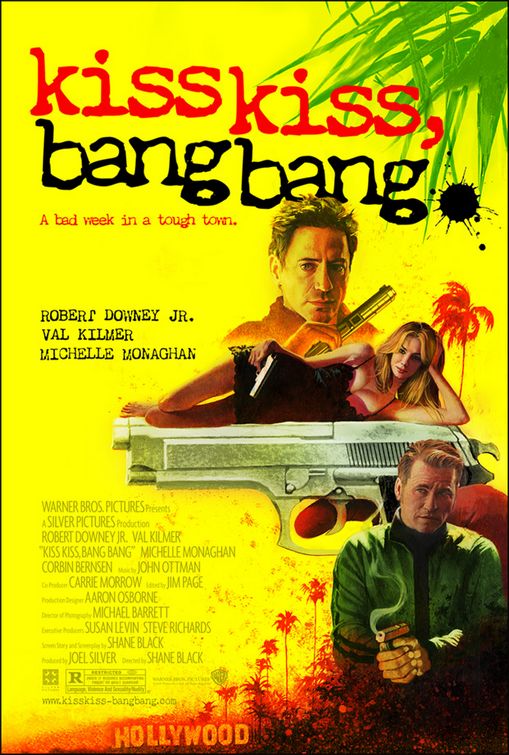
Shane Black is one of the best writers in Hollywood. Originally an actor, he turned to screenplays with huge success, earning millions for scripts like Lethal Weapon and The Last Boy Scout. But if you want to check out his work I recommend The Long Kiss Goodnight and Kiss Kiss Bang Bang (which he also directed).

Besides his Chandleresque sensibility (as evidenced by the title of Long Kiss), Shane Black's trademarks are great dialogue, violent action, strong characterisation, wild humour and truly creative use of profanity. On the subject of great dialogue — and profanity — in the Long Kiss Goodnight the private eye Mitch (Samuel L. Jackson) chides the foul mouthed heroine Samantha (Geena Davis) on her sudden penchant for swearing: 'When we first met, you were all like "Oh phooey, I burned the darn
muffins." Now, you go into a bar, ten minutes later, sailors come
runnin' out."

Or this exchange, from Kiss Kiss Bang Bang where our hero small time crook Harry meets homosexual LA private detective Gay Perry (Val Kilmer). Harry: "You still gay?" Gay Perry: "No, I'm hip-deep in pussy. I just liked the name so much I couldn't change it."
It's worth catching Iron Man 3 on the big screen. It's one of the few recent 3D pictures where the gimmick was effective. But even on DVD or Blu-ray, the excellent and often hilarious writing will shine through.
(Proud personal footnote. The Iron Man suit was co-built by my buddy FX wizard Lindsay MacGowan, with whom I worked on Doctor Who, back in the day.)

(Image credits: The poster featuring Downey and Paltrow is from GeekRest. The Paltrow poster is from the LA Times Hero Complex. The Ben Kingsley posters is from Flicks And Bits. The Long Kiss Goodnight is from DVD Release Dates. Kiss Kiss Bang Bang is from Imp Awards. The photograph of Downey and the suit is from Buzz Feed.)
 Paddy Chayefsky was perhaps the greatest American screenwriter. He started off in TV — in the golden days of live television. His celebrated and touching TV play Marty was made into a movie which won him the first of his three Oscars.
Chayefsky subsequently wrote a number of classic film scripts, perhaps most memorably the wonderful Network in which news anchorman Howard Beale (Peter Finch) suffers an unforgettable onscreen meltdown. His tirade "I'm as mad as hell and I'm not going to take this any more!" Is still frequently quoted (and misquoted, like "Play it again, Sam").
 But we're concerned here with another Chayefsky classic, Altered States (great title, by the way) in which rogue scientist Edward Jessup suffers a very different kind of meltdown. Using hallucinogenic drugs and an isolation tank (sounds like fun) he explores the outer boundaries of human consciousness. Or probes beyond the outer limits of the human mind — as the Corgi "supershocker" paperback cover would have it.
 Chayefsky wrote Altered States initially as a novel, impressively demonstrating that he was as talented in the prose form as he was in film or television scripts. And also, incidentally, that he was as adroit at writing science fiction as he was in any other genre. It's an impressive and gripping book, notable not least for its air of authenticity. It is stunningly well researched and, consequently, disturbingly plausible.
Which is why I was disappointed when, as a result of his reckless experimentation, Jessup transforms into an apelike prehuman. Don't get me wrong, I have no problem with him transforming into an apelike prehuman per se. I'm sort of all for it.
 The snag is that the prehuman is smaller than Jessup. Do you see the difficulty? What has happened to all that extra body mass? Especially when Jessup reverts back to his normal shape and size.
This is the catch with virtually all transformation and shape-changer tales. Some writers have made admirable attempts to deal with it. As far back as 1933 Guy Endore took the trouble to suggest a solution in his excellent novel The Werewolf of Paris. He proposed a kind of cloud of gas which followed the werewolf around, containing the excess mass which coalesced again when the wolf turned back into a man. Full points for trying, Guy!
 Mostly, though, writers just ignore the problem. Which bugs me. It really bugged me when I saw an episode of Fringe where there's a baby who grows into an old man in less than an hour. It also bugged me in an episode of a Doctor Who audio adventure. Luckily in the latter case I was script editing the story and I simply discussed it with my very talented writer, Marc Platt, and he set about fixing it.
Naturally, then, it bugged me in Chayefsky's novel. Especially so, since the book is otherwise so thoroughly, exhaustively and immaculately researched. So I breathed a sigh of relief when I got to page 135 where Jessup says "We're beyond mass and matter here, beyond even energy."
 Okay, it's totally a get-out clause. But it was a very welcome one, and it let me get on with enjoying the novel. And at least, like Guy Endore, Paddy Chayefsky was smart enough to see that there was a problem that needed fixing.
By the way, Altered States was turned into an interesting film, scripted by Chayefsky of course, and directed by Ken Russell. Chayefsky hated what Russell did with his brainchild and disowned the movie. But a lot of the quality of the book survives into the screen version and it is well worth seeing.
(Image credits: All the book covers are from Good Reads. God, that was easy! The non-official movie poster by JE Knight is from Minimal Movie posters.)
 I often remark that my favourite American novelist — perhaps my favourite novelist, full stop — is Tom McGuane. Recently, though, I've come to realise that he may well be tied for first place with his namesake, Tom Wolfe. Both these writers are wonderfully funny, highly intelligent and write splendidly and ironically, with great insight, about the nation they see changing around them. But in other ways they couldn't be more different.
McGuane writes slender volumes in which plots are few and far between. Wolfe's books are massive tomes, typically weighing in at around 700 pages, and they present a banquet of interweaving plots and subplots. But the density of those books does not lead to dullness. On the contrary, Wolfe is magnificently readable and these giant novels end far too soon for the reader. And then there's the long wait for the next one — in 25 years we've only had the privilege of four novels from Tom Wolfe.
 Wolfe began his career writing journalism and his books of essays and reportage are well worth reading, though like tiny hors d'oeuvres they may leave you hungry for more. His first substantial (ie long) full length book was the excellent The Right Stuff about the US space program. Just because this is a work of non fiction rather than a novel is no reason for you not to read it. Go on, read it now. I particularly loved the bit about the monkey.
Wolfe's novels are Bonfire of the Vanities, A Man in Full, I am Charlotte Simmons and now — hurray, a new Wolfe novel! — Back to Blood. It deals with social, sexual and racial tensions in Miami and like two of its predecessors has a crime at the heart of the story. Its main protagonist is Nestor Camacho, a young policeman of Cuban extraction who is ostracised by his community for doing his job. His neighbours begin avoiding him like the plague:
"Nestor could see Señor Ramos staring at him. The next thing he knew, Señor Ramos was turning towards his front door and snapping his fingers in an exaggerated display of having forgotten something — shoooop — he's back inside his casita."
 All of Wolfe's virtues are on full display here (as well as his somewhat bonkers punctuation). The book is hilarious, gripping, beautifully written and dazzlingly well observed. No one is better equipped than Wolfe to dissect the ironies, nuances and contradictions of American society today. The characters are also great — three dimensional and indelibly vivid. Even Cat Posada, the Chief of Police's hot Cubana secretary, who only appears for about four pages, is unforgettable.
Perhaps I should mention, too, that the book is the winner of the Literary Review's Bad Sex in Fiction Award for 2012. I see he also won for I am Charlotte Simmons in 2004. You can see the list of previous winners here.
 It seems to me there is something obtuse about this. Wolfe deliberately writes a heightened, extravagant, pop-art prose. And highly effective it is. But to abstract a sex scene or two from his books, and to mock them because they're written in exactly that style, strikes me as wrong headed and pointless. If these sequences were different from the rest of the book, by all means pillory them. Otherwise your choices are to accept them, or to condemn his writing as a whole.
 Which it seems a lot of supposed authorities are all too willing to do. While I was doing some research for this post I perforce came across numerous reviews of this book, from august publications, and I was astonished at how many of them were negative and dismissive.
Well, they simply don't know what they are talking about. Maybe they'll appreciate Wolfe's stellar qualities when he is gone, and it's all too late. But the bottom line is, no one is writing finer fiction — literature in fact — in America, or anywhere else, today.
 The lack of insight and informed commentary about Wolfe's new book is perhaps best exemplified by the fact that no one has latched on to the significance of its title — oh, they realise it's to do with racial tensions and conflicting loyalties and the bonds of heredity, all right...
But nowhere among these literary critics and pundits and commentators and alleged experts have I found anyone mention the source of the title. It is actually a quotation — from another Tom Wolfe novel.
You can find it around the fourth page of the first chapter of Bonfire of the Vanities: "Back to blood! Them and us!" It's a scene where the white mayor of New York is being heckled by a crowd in Harlem.
 Now that you know more about Back to Blood than the entire critical and literary establishment put together, I suggest you read it. Buy it or borrow it (I won't advocate stealing it). But read it. And get stuck into Wolfe's other novels.
And then you can start on the non fiction.
 (Footnote: Wolfe's publishers need a new proof reader. The Señor Ramos mentioned above morphs on page 645 into Mr Ruiz, another character entirely.)
(Image credits: all of the covers are from the blessed Good Reads, including the wonderful Dutch one with the pink flamingos. And if you're wondering what 'Bloody Miami' is all about, it's the (English) title of the French edition. The photo of Tom Wolfe in a blue blazer is by Tod Selby and is from Vanity Fair. The cartoon is from Esquire. The 'Tom Wolfe Gets Back to Blood' image — which looks like it's based on the Selby photo — is for a film about Wolfe researching the book and it's from Amazon. And I want to see it.)
 I was looking forward to World War Z (which I stubbornly insist on pronouncing "World War Zed"). I expected it to be entertaining, cheesy fun. In fact, it knocked me out.
Within a short time I was thinking it was the best zombie movie ever made. But I soon realised it was much, much more than that. It's a classic thriller and looks set to make other summer blockbusters fade into significance.
Part of its astonishing success is that it plays it straight, presenting a convincing picture of a world falling apart under a savage contagion. It's also a beautifully made film. In a way it's a pity it's a zombie movie, because a lot of people who would otherwise enjoy a brilliant thriller will avoid it. Of course, that's true of much science fiction. But zombies have a particularly sleazy pulp reputation — and they deserve it.
 I won't linger on the Z-word. I'll just remark that this film follows the lead of 28 Days Later in making the zombies move fast (remember the days then they were lackadaisical shufflers, not Olympic class sprinting cadavers?) and actually goes one better by having the zombie infection also spread fast. The normal routine is that anyone bitten by these varmints has a lengthy fever and gradually transforms.
In World War Z it takes all of 12 seconds.
 The movie is a powerful series of action set-pieces, impressively varied and effective. The sequence in Jerusalem has to be seen to believed. I found it astonishing — and gut-wrenching. And I was particularly struck by the ant-like behaviour of the zombie masses.
But it is the ending of the film which is really remarkable.
 Your average action movie just keeps cranking up the violence and mayhem and, usually, ends up painting itself into a corner with a disappointing finale, since it's pretty hard to top what's gone before. (I discussed this in my post on Skyfall, a movie which was a rare exception.)
Well, World War Z solves this problem through the audacious approach of eschewing a final big-bang action scene altogether, and instead opts for a prolonged sequence of suspense. It's admirably effective — and I found it almost unbearable.
 What a great movie. The ingenious and beautifully contrived script had numerous writers involved. It was based on the bestselling novel by Max Brooks. The credited screenwriters are J. Michael Straczynski (The Changeling), Matthew Michael Carnahan (The Kingdom), Damon Lindelof (Prometheus) and Drew Goddard (the magnificent Cabin in the Woods).
There is much argument and debate about who did what with the script and how faithful it was, or should have been, to the novel. None of that matters. The movie is magnificent, and even if zombies are not your cup of grue, you should see it.
 Full credit to director Marc Foster, who has made memorable films from Monster's Ball to the recent Bond Quantum of Solace. But this may well be his masterpiece.
And I also have to say something about the superb quality of the acting. Daniella Kertesz deserves special mention as Segen, a tremendously affecting female Israeli soldier. But in fact all of the roles are perfectly cast with memorable actors. Kate Dowd deserves an Oscar for the casting.
 I've read some incredibly obtuse reviews of this remarkable film. Ignore them and buy a ticket. I doubt if there will be a better blockbuster this summer.
(Image credits: The poster of Bradd and his family fleeing is from SFX. The poster of him kneeling on a roof — altered later to being in the back of a plane — is from Wikipedia. The back of the plane version is from Hey Guys. The helicopter poster is from Sci-fi Now. The striking Saul Bass style grasping-hands graphic poster is by Matt Ferguson and is from Collider. The green finger-bomb poster is by Chris Garofalo and is also from Collider. The shot of Daniella Kertesz as Segen is from the official movie site.)
 I don't often write about works of non-fiction, but this book is of such merit that I couldn't resist.
It's the true story of Philip Connors' seasonal retreat to a fire observation tower high on a mountain peak in the Gila National Forest. There he remains in isolation — except for the company of his doting dog and occasional visits from his devoted wife. (The dog is Alice, the wife Martha — I think.)
Naturally enough, the book is a meditation on isolation, and the natural world. But it also has some telling comments on contemporary American society, written with a wit and concision which brings to mind Thomas McGuane (my personal choice for America's greatest living novelist).

Connors might be more likely to compare himself to Edward Abbey, another favourite writer of mine (he created the classic eco-saboteur novel The Monkey Wrench Gang), who was a novelist, naturalist and like Connors a fire lookout.
Other notable literary tower-dwelling fire spotters include Jack Kerouac and beat poets Gary Snyder and Philip Whalen, all of whom Connors discusses.

The book is beautifully written and deeply involving. It's also highly informative, giving an account of the troubled history of the nature conservation movement in the USA, and the heart breaking effect of corrupt and untrammelled capitalism on America's wild places.
It also explores the fascinating topic of whether or not natural fires should simply be allowed to burn. (It turns out Smokey the Bear was wrong — some forest fires are beneficial, and downright necessary.)
There is even an engrossing digression about the savage extermination of the Apache guerrillas, who had the temerity to stand up to the white invaders who were stealing their land.

A wonderful and engrossing book, It even made me begin to think about spending a few weeks in a fire tower on top of a mountain — though I suspect I'd need the occasional visit from cannabis-farming lapdancers to maintain me at peak (no pun intended) efficiency.
(Image credits: The striking and beautiful orange, black and white MacMillan cover design — shamefully uncredited on the dust jacket — is from Mr B's Emporium. The photographic cover with the watch tower is from Average Gents.
 The photo of the Osborne Firefinder cabinet, used to triangulate the fire and calculate its azimuth, is from an article about Connors in the estimable Paris Review, coincidentally also the source of the Tom McGuane interview. The shot of Connors standing on the tower frame is from The Bulletin. The Smokey the Bear poster is from the Department of Environmental Conservation.)
 I'm not hugely fond of movie critics. I think in many ways they are the least qualified people to write about movies. Certainly their wrongheadedness — or mendacity — is often more spectacular than the blockbusters they're writing about.
 Consequently I take great delight in pointing out when the critics get it wrong. For example, in the current wave of summer popcorn flicks, the received wisdom that RED 2 or The Wolverine are duds is just plain wrong. RED 2 was delightful, brisk, non-stop entertainment and often hilarious, while The Wolverine was a classy and intelligent comic book thriller. More on The Wolverine in a posting near you.
 I was hoping I could offer a similar against-the-tide defence of The Lone Ranger. And for maybe the first hour and a half of this long (149 minute) film I thought I would. Johnny Depp is immensely entertaining, the film is frequently very funny, Hans Zimmer provides a notably effective score and it is really beautifully shot. I've admired the work of director Gore Verbinski since Mouse Hunt, and he does a beautiful job here. All of the acting is of a very high standard (Ruth Wilson is particularly affecting as a widow and mother).
 Tonto gets to behave heroically. The Lone Ranger's brother gets to behave heroically. The Lone Ranger's brother's wife gets to behave heroically. Even Helena Bonham Carter as a one-legged procuress gets to behave heroically. But the Lone Ranger himself is a patsy, stooge and fall guy for virtually the entire length of the film.

 Then there's the way the story can't decide if it has a supernatural element or not. It begins to move in that direction (carnivorous rabbits — a delightful scene) but then loses its nerve.
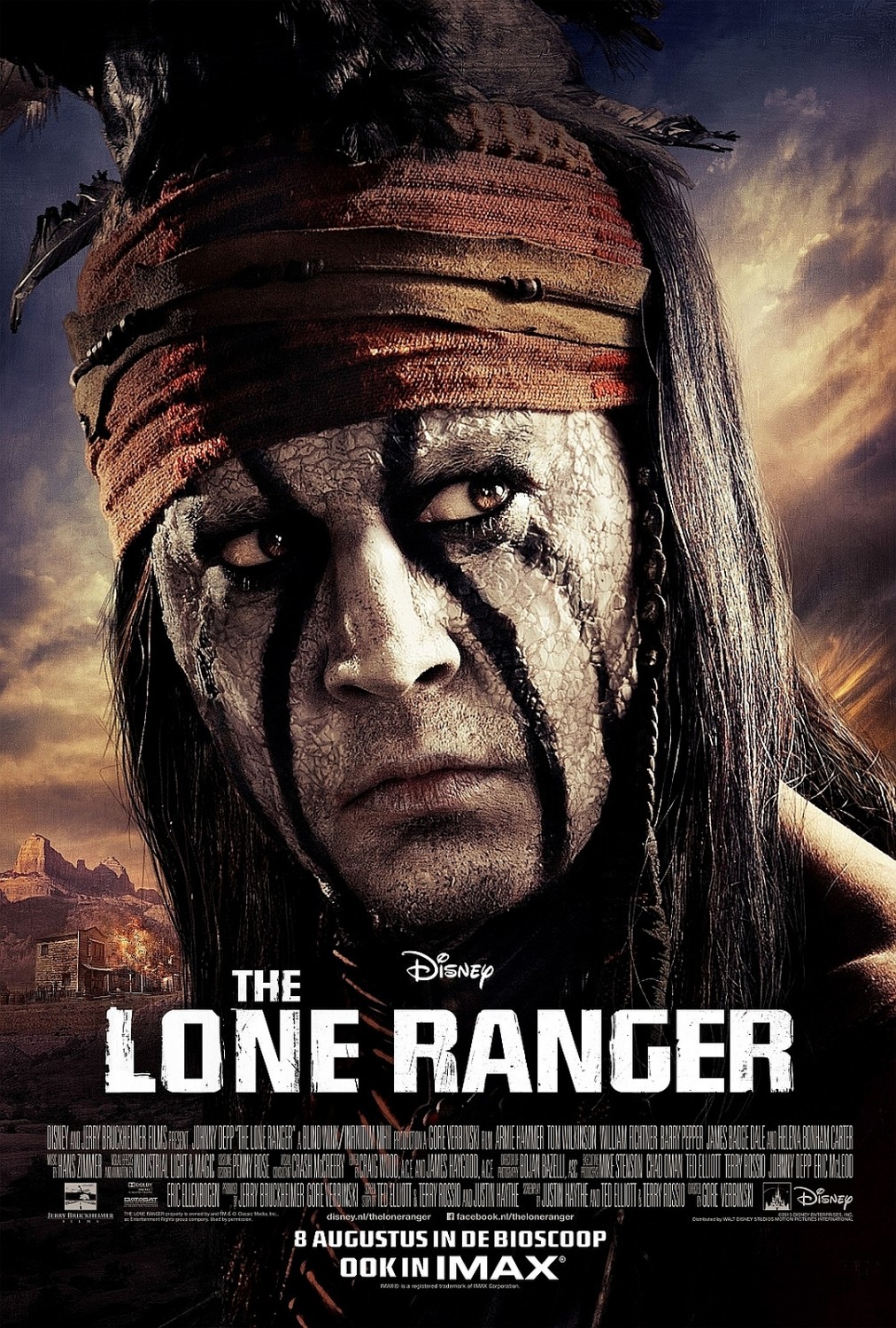 (Image credits: The poster with the badge on it is from Films Index. The Helena Bonham Carter poster is from Disney Dreaming. The poster of Carter, Hammer and Depp is from Roger Ebert. The posters of Ruth Wilson and Depp are both from the excellent and useful Imp Awards. The picture of Johnny Depp in his Tonto makeup and the Kirby Sattler painting ('I am Crow') on which it was based are both from Gawker.)